Saxon Shore fort · Hampshire, England

Portchester

Roman name: Portus Adurni (probably)

At the head of Portsmouth Harbour stand the walls of a Roman sea fort, still at full height. People have lived inside them, on and off, for more than 1,700 years.

RichboroughLondonWroxeterBathYorkVindolandaCorbridgeChestersHousesteadsBirdoswaldPortchester
Other dots are the places we cover. Wall lines simplified. Coast: Natural Earth.
Built
probably AD 285 to 2901
Towers
20, of which 16 stand
Walls
6.1 metres high
Lived in
almost continuously since
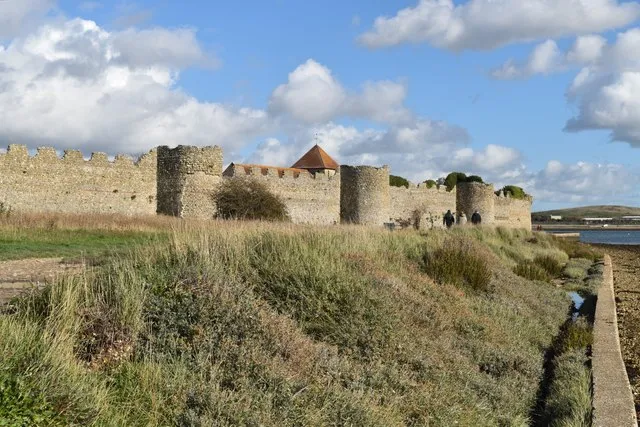
Long flint walls with round towers by the water, with a tall square stone keep rising behind
Portchester from the south-west. The Roman walls run around the whole site; the tall keep in the corner was begun by the Normans in the 12th century.Photo: David Martin, CC BY-SA 2.0, via Geograph

The story of Portchester

Through the 3rd century, Saxon pirates raided the south and east coasts of Roman Britain, and a chain of coastal forts went up against them. They are now called the Forts of the Saxon Shore. Portchester is the best-preserved Roman fort north of the Alps.1

The rebel admiral

No inscription dates the fort, but coins found on the site show it was built after about AD 268, probably between 285 and 290. That points to one man. In about 285 the emperor Diocletian gave Marcus Aurelius Carausius command of the Roman fleet in the Channel. When the co-emperor Maximian condemned him to death, Carausius rebelled with his fleet behind him and declared himself emperor of Britain and northern Gaul. A fort at the head of a great harbour is just what his fleet needed. In 293 his deputy Allectus murdered him, and within a few years Britain was back in the empire.1

The fort was laid out symmetrically, with a gate in the middle of each side and 20 D-shaped towers spaced evenly around it. Sixteen still stand. The walls rise to 6.1 metres, though the top parts were rebuilt in the Middle Ages.1

Families inside the walls

It was not only soldiers. Archaeologists found timber houses and workshops inside the walls, with animal pens, cesspits and rubbish heaps, and the burials of 27 babies. That means families lived here too. The fort seems to have been in use right up to the end of Roman Britain in the early 5th century.1

After Rome

The walls kept people in for centuries more. In the 5th century there were four huts with sunken floors, a well and ploughed ground. In the 7th to 9th centuries came timber houses, then a break, with rubbish dumped over the old buildings. In 904 the Bishop of Winchester gave the fort to King Edward the Elder, who made it a burh, a fortified town against the Vikings. By the 10th century an important family lived here in a large hall with a stone tower.1

After 1066 the Normans built a castle in one corner of the Roman fort. Kings used it on their way to France: Henry V set off from here in 1415 for the campaign that ended at Agincourt. From 1665 to 1814 the castle held prisoners of war, up to 8,000 at a time during the wars with France.1

Where the evidence is unclear

Was it really Portus Adurni?The name comes from the Notitia Dignitatum, whose date is itself disputed, somewhere between AD 380 and 420. Portchester is the favourite, not a certainty.1

Did Carausius build it?The coins say after about 268, and the harbour fits a fleet. But no inscription names its builder, so his part is a strong guess.1
Who lived inside the walls

Seventeen centuries of one enclosure.

  1. Roman fort AD 285 to 410Soldiers, families and workshops.
  2. Sunken huts AD 400 to 500Four huts, a well and ploughing.
  3. Saxon houses AD 600 to 880Timber houses, perhaps two homes.
  4. A burh AD 904 to 1066Given to Edward the Elder in 904; a hall and stone tower.
  5. Priory AD 1128 to 1150Its church is still the parish church.
  6. Royal castle AD 1154 to 1632Held by the Crown until Charles I sold it.
  7. Prison AD 1665 to 1814Dutch, then French and other prisoners of war.
  8. In public care AD 1926 to todayRepaired and dug in the 1920s and 1930s, often by unemployed Welsh miners.
Each bar is one known use of the fort. Hatched: dates are rough. The gap around AD 900 is real: rubbish was dumped over the old houses.

What is there today

Photographs by visitors, shared under an open licence.

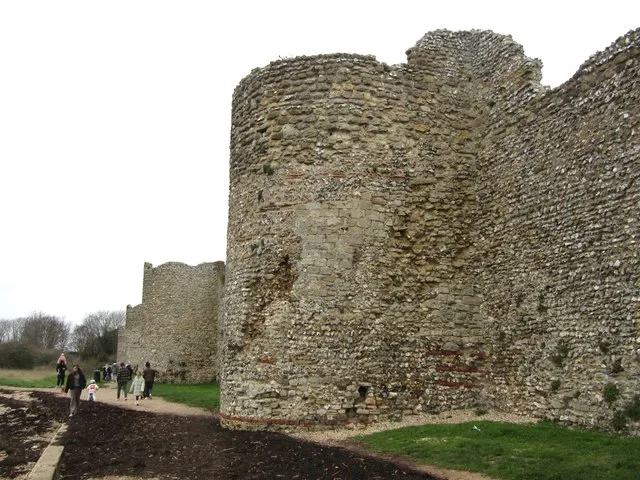
A tall flint wall with a round tower, beside a path
The south wall, where the Roman way of building shows best: flint, with layers of flat limestone slabs or double courses of brick.Photo: Colin Smith, CC BY-SA 2.0, via Geograph
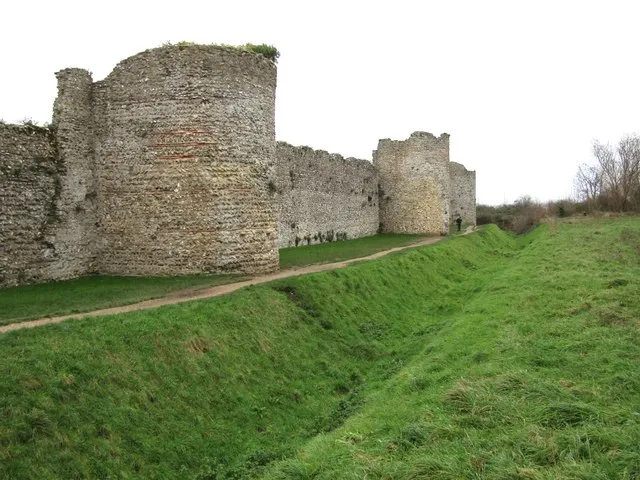
A flint wall with rounded towers above a grassy ditch
The west wall and its ditch. The towers were D-shaped: flat at the back, rounded at the front.Photo: Colin Smith, CC BY-SA 2.0, via Geograph
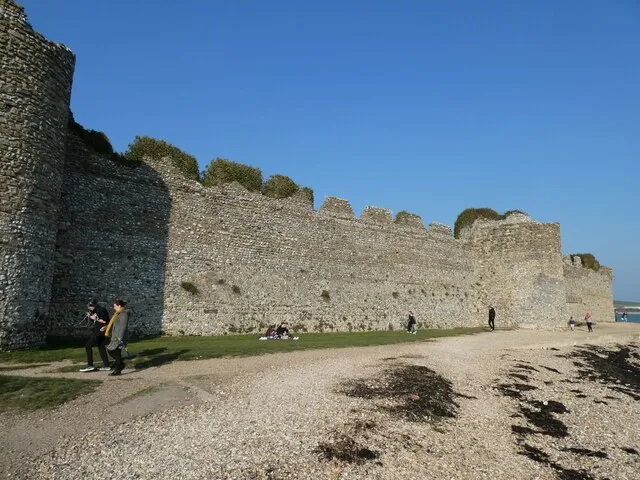
A long high wall with towers above a shingle beach, people walking below
The walls from the shore. The fort was built here to command a huge natural harbour.Photo: Basher Eyre, CC BY-SA 2.0, via Geograph

Sources for this page

Every number on this page comes from one of these. How we check.

Last reviewed 12 November 2026. Spotted a mistake? Tell us.

  1. History of Portchester Castle, and Description of Portchester Castle. English Heritage. www.english-heritage.org.uk/visit/places/portchester-castle/history-and-stories/history/Used for: Portchester: date, Carausius, the 20 towers, wall height and life inside the walls. Checked 12 November 2026.
  2. Pleiades: a gazetteer of past places. Institute for the Study of the Ancient World, New York University. CC BY 3.0. pleiades.stoa.orgUsed for: Roman names of places and their positions. Checked 12 November 2026.
  3. Natural Earth, 1:110m and 1:50m land, public domain, via the world-atlas package by Mike Bostock (ISC licence). www.naturalearthdata.com/Used for: Every coastline drawn on this site. Checked 11 November 2026.