Lesson IV · About AD 85 to 400

Life on the frontier

The questionWho actually lived on the northern frontier?

The northern frontier was not just soldiers on a wall. It was one of the most mixed places in the empire: men from across Europe, their families, traders, enslaved people, and the British women some of them married.

Regina
a Catuvellaunian, aged 301
Barates
from Palmyra, Syria
Letters on wood
about 2,000 fragments2

Fits: Primary (KS2) · A level

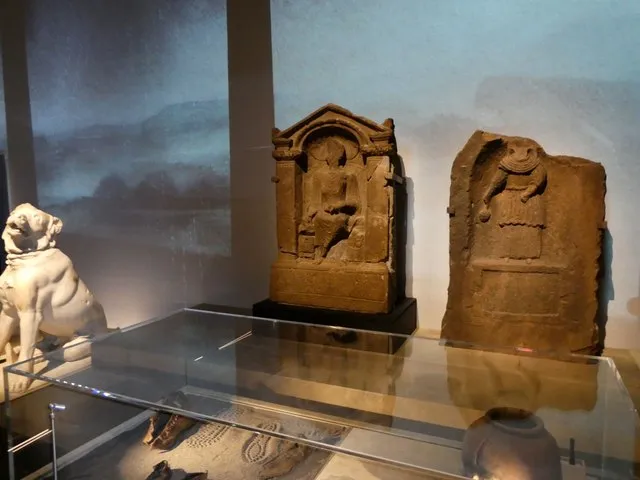
A carved stone tombstone of a seated woman in a gabled niche, displayed in a museum beside other Roman stones
Regina’s tombstone, the gabled stone on the left, a replica photographed in the British Museum; the original is at Arbeia Roman Fort, South Shields. Her face was hacked off at some point; the rest of the carving is clear.Photo: Jeremy Bolwell, CC BY-SA 2.0, via Geograph

The story

Most of the soldiers on the frontier were auxiliaries: not Roman citizens, but men recruited from peoples Rome had conquered, serving in units that kept the names of their homelands. Around AD 100, Vindolanda was held in turn by the First Cohort of Tungrians and the Ninth Cohort of Batavians.2 The Tungrians, raised around Tongeren in what is now Belgium, later moved two miles to Housesteads and stayed into the 4th century, joined in the 3rd by units from Frisia, in the north of the Netherlands.4 At Birdoswald, a cohort of a thousand Dacians, from what is now Romania, carved their own curved swords on their building stones.5

Not only soldiers

Roman soldiers could not legally marry, but many had partners, local women or women who had followed them from other provinces.6 Outside the forts, villages of traders and families grew up. At Housesteads the village was at its biggest in the 3rd century, and near the end its people may have moved inside the walls for safety.4

Officers brought their households. At Vindolanda, Sulpicia Lepidina lived in the commander’s house with her husband. A friend, Claudia Severa, wrote inviting her to a birthday party, “to make the day more enjoyable for me by your arrival”. Most of the letter is in a scribe’s hand, but the goodbye at the end is in another, almost certainly Claudia’s own: probably the earliest known writing in Latin by a woman.3

Regina and Barates

In 1878, near the fort at South Shields, at the mouth of the Tyne, a tombstone was found in four pieces. It is for a woman called Regina. The Latin says she was a Catuvellaunian, from a British people north of the Thames, that she had been enslaved and freed, and that she was the wife of the man who set the stone up: Barates of Palmyra, a desert city in what is now Syria, nearly 3,800 kilometres away as the crow flies.1

Below the Latin is a second line, in Palmyrene, Barates’s own language. It does not repeat the Latin. It says: “Regina, the freedwoman of Barates, alas.”1

We know nothing else about them for certain. A tombstone at Corbridge names a Barates of Palmyra too, but whether he is the same man is an open question.1

From across the empire

Where some of the frontier’s people came from.

The frontierTungriansFrisiansDaciansBaratesRegina
Lines join homelands to the forts where these people are recorded. They show where people came from, not the routes they took. Today’s coastlines; Natural Earth.7
  • Tungrians from around Tongeren, now Belgium, to Housesteads, and earlier Vindolanda.4
  • Frisians from Frisia, now the north of the Netherlands, to Housesteads.4
  • Dacians from Dacia, now Romania, to Birdoswald.5
  • Barates from Palmyra, now in Syria, to South Shields.1
  • Regina from the Catuvellauni, north of the Thames, to South Shields.1

Reading Regina’s stone

What the carving and the two languages say.

Latin

D(is) M(anibus) Regina liberta et coniuge Barates Palmyrenus natione Catuallauna an(norum) XXX

“To the spirits of the departed (and to) Regina, his freedwoman and wife, a Catuvellaunian by tribe, aged 30, Barates of Palmyra (set this up).”

Palmyrene

RGYNᵓ BT ḤRY BR ᶜTᵓ ḤBL

“Regina, the freedwoman of Barates, alas.”

Text and translations from Roman Inscriptions of Britain; the Palmyrene is written here in Latin letters, as scholars transcribe it.1

She sits
in a wicker chair, in a gabled niche between two pillars
She wears
a long robe over a tunic, a cable-pattern necklace and matching bracelets
On her lap
a distaff and spindle, for spinning wool
Beside her
a basket of balls of wool
In her right hand
an open jewellery box
The stone
buff sandstone, 1.12 metres high, 2nd century AD; now in the museum at Arbeia, South Shields1

Barates paid for a fine stone, carved with care, showing Regina as a well-off wife with a household of her own. Whoever carved it was probably from Palmyra too: the Palmyrene letters are confident, the Latin ones uneven.1

Key words

Auxiliary
A soldier who was not a Roman citizen, usually recruited from a conquered people. Most of the frontier garrison were auxiliaries.
Cohort
An army unit of about 500 or 1,000 men.
Freedwoman
A woman who had been enslaved and was then freed. Regina was one; Barates had freed her.
Tombstone
A carved stone over a grave. Many name the dead person, their age and where they came from.
Vicus
The village outside a Roman fort, where traders and soldiers’ families lived.

Check yourself

Try to answer in your head, then open each one.

Name two places outside Britain that frontier soldiers came from.

Any two of: around Tongeren in Belgium (the Tungrians), Frisia in the Netherlands, Dacia in Romania.

Who were Regina and Barates?

Regina was a British woman of the Catuvellauni, once enslaved and freed by Barates, a man from Palmyra in Syria, who married her. She died at 30, at South Shields.

Why is Regina’s tombstone written in two languages?

Barates wrote in Latin, the language of the empire, and in Palmyrene, his own language, probably carved by a sculptor from Palmyra.

What were the Vindolanda tablets, and why did they survive?

Thin slips of wood with letters and records in ink. The ground at Vindolanda is wet and airless, so they did not rot.

Could Roman soldiers marry?

Not legally, in the early years of the frontier. But many had partners and families anyway, and the villages outside the forts were full of them.

Go deeper

  • Vindolanda the fort where the letters were found
  • Housesteads the Tungrians, the Frisians and the village outside
  • Birdoswald a thousand Dacians, for two centuries

Sources for this page

Every number on this page comes from one of these. How we check.

Last reviewed 12 November 2026. Spotted a mistake? Tell us.

  1. The Roman Inscriptions of Britain, RIB 1065: funerary inscription for Regina, South Shields. Text, translation, description and notes. romaninscriptionsofbritain.org/inscriptions/1065Used for: Regina’s tombstone: its words in Latin and Palmyrene, its carving, where and when it was found. Checked 12 November 2026.
  2. Northumberland County Council, Keys to the Past (Historic Environment Record N6566). Vindolanda Roman fort (Chesterholm), Henshaw. keystothepast.info/Site-Details?PRN=N6566Used for: The sequence of forts at Vindolanda, their dates, sizes and garrisons, and the finding of the writing tablets. Checked 11 November 2026.
  3. Roman Inscriptions of Britain online. Tab. Vindol. 291: Birthday invitation of Sulpicia Lepidina. Translation after A. K. Bowman and J. D. Thomas. romaninscriptionsofbritain.org/inscriptions/TabVindol291Used for: The text, date, handwriting and present home of the birthday invitation. Checked 11 November 2026.
  4. Crow, J. History of Housesteads Roman Fort. English Heritage. (Professor of Classical Archaeology, University of Edinburgh; author of the English Heritage guide to Housesteads.) www.english-heritage.org.uk/visit/places/housesteads-roman-fort-hadrians-wall/history/Used for: Housesteads: size, date, garrison, the Tungrians and Frisians, and the end of the fort. Checked 12 November 2026.
  5. Wilmott, T. History of Birdoswald Roman Fort. English Heritage. (Senior Archaeologist, Historic England; excavator of Birdoswald.) www.english-heritage.org.uk/visit/places/birdoswald-roman-fort-hadrians-wall/history-and-stories/history/Used for: Birdoswald: the Turf Wall, the Dacian cohort, and the timber halls after Rome. Checked 12 November 2026.
  6. White, R. H. History of Wroxeter Roman City. English Heritage. (Honorary Research Fellow, University of Birmingham.) www.english-heritage.org.uk/visit/places/wroxeter-roman-city/history/Used for: Wroxeter: the Cornovii, the fortress, the 78-hectare city and its slow end. Checked 12 November 2026.
  7. Natural Earth, 1:110m and 1:50m land, public domain, via the world-atlas package by Mike Bostock (ISC licence). www.naturalearthdata.com/Used for: Every coastline drawn on this site. Checked 11 November 2026.