The story
Julius Caesar, who was conquering Gaul, crossed to Britain twice, in 55 and 54 BC. He fought, took tribute from some tribes and learned about the south and its riches, but he did not come to conquer, and he did not stay.1
In the century after, Rome and Britain traded. Some British peoples, like the Atrebates in the south, became friendly with Rome; others, above all the Catuvellauni north of the Thames, did not.1
Why Claudius came
In AD 41 the emperor Caligula was murdered, and the Praetorian Guard made his uncle Claudius emperor. Claudius had no military record and needed to secure his throne. Caligula had gathered an army to invade Britain, then called it off, which the army took as a humiliation. When the Catuvellauni drove out Verica, king of the friendly Atrebates, Claudius may have used it as his excuse.1
The real reasons were probably the ones emperors usually had: glory, popularity, loot, Britain’s resources, and an army kept busy and pleased.1
The crossing
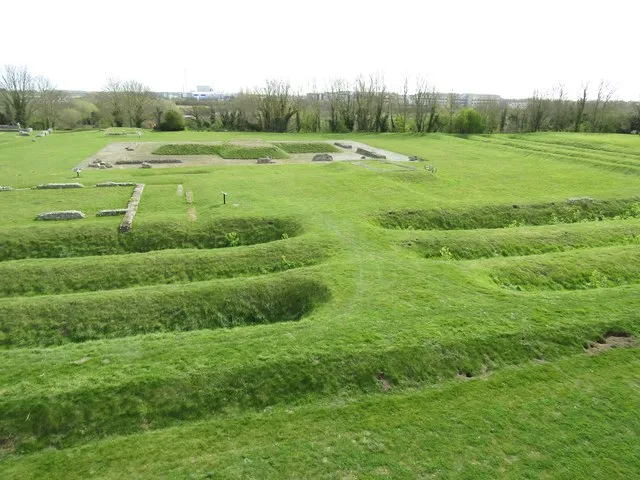
In AD 43 the army, under the general Aulus Plautius, sailed from Gaul, probably from Boulogne, in three divisions, says Dio. It was about 40,000 strong, and moving it may have needed 700 to 1,000 ships. Where it landed is still argued over; Richborough in Kent is the most widely accepted answer, with Chichester the main rival.1 At Richborough, the army dug two long parallel ditches to protect its beachhead. They are still there.2
Two battles and an emperor
Dio describes two great battles. The first was at a river, probably the Medway, where auxiliary cavalry swam their horses across to attack the Britons from the side. The second, on the Thames, beat the Catuvellauni.1
Then Claudius himself arrived, with soldiers of the Praetorian Guard and, according to Dio, elephants, for the final march on Colchester, the Catuvellauni’s capital. Dio says eleven British kings surrendered to him. One leader who did not, Caratacus, escaped to fight on for years. Claudius stayed for just sixteen days. In Rome the Senate voted him a triumph, arches, and the title Britannicus.1
Four years on
By the end of AD 47, the army had spread across much of lowland Britain, into the Midlands and the south-west, building forts as it went. The future emperor Vespasian, then commanding a legion, campaigned in the south-west and took the Isle of Wight. Some peoples were won over without fighting: East Anglia, home of the Iceni, became a friendly kingdom.1 That arrangement would end in fire, thirteen years later.
Near a crossing of the Thames, the Romans had built a small fort. Within a few years a new town grew there: Londinium.3