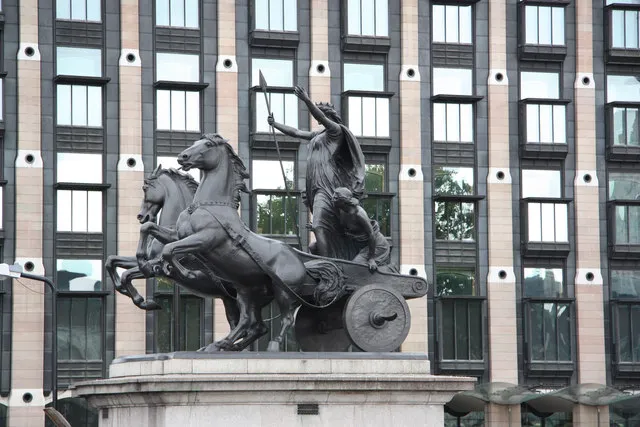
Her story
Boudica was queen of the Iceni, a people living around Norfolk, eastern Cambridgeshire and northern Suffolk. Rome often ruled through local kings, useful friends until they were not needed. Her husband Prasutagus was one. When he died, in AD 60, he left his kingdom to his two daughters and to the emperor Nero, hoping that would keep it safe.1
It did not. In Tacitus’s words, “his wife Boudicca was subjected to the lash and his daughters violated: all the chief men of the Icenians were stripped of their family estates, and the relatives of the king were treated as slaves.”2 She may have been about thirty.1
The revolt
The Iceni rose with their neighbours the Trinovantes. The Roman governor, Suetonius Paulinus, was far away attacking the island of Mona, now Anglesey. The rebels took Colchester first, then London, then St Albans, burning, looting and killing. One Roman division sent against them was destroyed.12
We do not have to take the Romans’ word for it. In central London, archaeologists find thick layers of burnt debris from this time, and burnt finds come from Colchester too. In Eastcheap, someone buried four small carved gemstones in a pot, very possibly to hide them from the rebels, and never came back for them.1
Paulinus gathered what troops he could and chose his battlefield, probably somewhere in the Midlands. The Britons far outnumbered the Romans, but they lost. Boudica died soon after: Tacitus says by poison, Dio says of illness. No one knows where she is buried; the story that she lies under King’s Cross station has no evidence behind it.123
How the Romans wrote about her
Both accounts were written by elite Roman men, long after the event, and both use the stock picture of a wild northern woman. Dio describes her as “very tall, in appearance most terrifying, in the glance of her eye most fierce, and her voice was harsh; a great mass of the tawniest hair fell to her hips; around her neck was a large golden necklace.”3 He never saw her. The London Museum notes that these descriptions draw on common prejudices about women from northern Europe.1
Tacitus gives her a speech before the battle: she was fighting, he has her say, “not, as a queen of glorious ancestry, … but, as a woman of the people,” for “her liberty lost, her body tortured by the lash, the tarnished honour of her daughters.”2 Roman historians wrote speeches for their characters; these are his words, not hers.