Lesson III · AD 122 to 410

Hadrian’s Wall

The questionWhat was the Wall for, and how was it built?

Hadrian spent years travelling the empire. In AD 122 he came to Britain, and ordered a wall eighty Roman miles long from sea to sea.

Emperor
AD 117 to 1382
In Britain
AD 1221
His Wall
73 miles, Wallsend to Bowness
Building took
at least six years

Fits: Primary (KS2) · A level

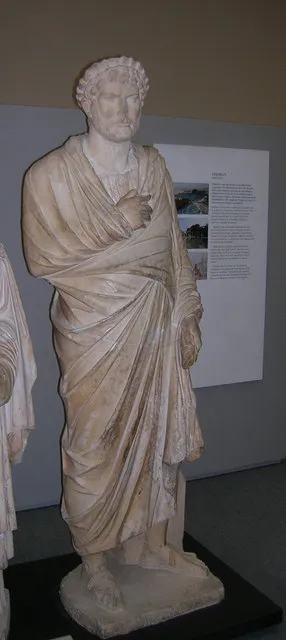
A white marble statue of a bearded man in a draped cloak, in a museum gallery
A marble statue of Hadrian in the British Museum. It is one of the ways we know what he looked like: unlike Boudica, emperors had their portraits made.Photo: Robin Sones, CC BY-SA 2.0, via Geograph

His story

Hadrian was unusual among emperors: he spent years touring the provinces.4 In AD 122 he came to Britain, and visited London with his wife, the empress Sabina.4 A biography written about two hundred years later says that he “put many things to right and was the first to build a wall 80 miles long from sea to sea to separate the barbarians from the Romans”.1

The first plan

By about AD 100 the most northern Roman forts already lay along a road, now called the Stanegate, between Corbridge and Carlisle. The Wall was put slightly north of them. As first planned it was a wall of stone in the east and turf in the west, with a guarded gate every Roman mile, two watchtowers between each pair of gates, and a wide, deep ditch in front. The soldiers would stay in the forts behind.1

It was built mostly by the three legions of Britain, each about 5,000 trained heavy infantry, helped by auxiliary units and even the British fleet. It was surveyed from each end towards the crags in the middle, in sections.1

The change of plan

Before the first plan was finished, it changed. Forts were moved onto the Wall itself, about seven and a third miles apart, built across it where they could be so that soldiers could get out to the north quickly. Chesters and Housesteads are two of them.13 Then a huge earthwork, the Vallum, was dug behind the Wall: a ditch between two mounds, about 35 metres across. To finish faster, the Wall was narrowed from 10 Roman feet to 8 or less, and built less carefully.1

The Wall may even have been begun before Hadrian arrived, and his visit may be what changed the plan. No one knows for sure.1

After Hadrian

Hadrian died in AD 138. His successor, Antoninus Pius, abandoned the Wall and built a new one, of turf, between the Forth and the Clyde. It lasted about twenty years before the army came back to Hadrian’s Wall, which then stayed the frontier until the end of Roman Britain. The latest coins found on it were minted in AD 403 to 406.1

One Roman mile

The repeating unit of the Wall, at true spacing.

Northditchthe Wallmilecastlemilecastleturretturretone Roman mile, about 1.48 kmSouth: the forts on the Stanegate, and later the Vallum
Plan of one Roman mile of Hadrian’s Wall as first designed: a small fortified gate, the milecastle, every mile, with two turrets between them, a third of a mile apart. Spacing is to scale; the buildings are drawn larger than scale so they can be seen. In some places crags or rivers made the ditch unnecessary.1

How big was it?

The stone Wall in section, to scale.

about 4.6 m high3 m widea person

The stone Wall was 10 Roman feet, about 3 metres, wide: enough for a walkway along the top. It stood up to about 15 feet, 4.6 metres, high. The turf Wall in the west was twice as wide, 20 Roman feet.1

Later stretches were built narrower, at 8 Roman feet or less, to save time.

Cross-section of the first, broad stone Wall at its greatest height, beside a person 1.7 metres tall. Whether it had a parapet on top is not known.

Key words

Milecastle
A small fort with a gate through the Wall, built every Roman mile.
Turret
A stone watchtower. There were two between each pair of milecastles.
Vallum
The great earthwork behind the Wall: a ditch between two mounds, marking the military zone.
Legion
A unit of about 5,000 Roman citizen soldiers, trained as heavy infantry. Three legions built most of the Wall.
Stanegate
The modern name for the older Roman road, with forts, just south of the Wall between Corbridge and Carlisle.

Check yourself

Try to answer in your head, then open each one.

When did Hadrian come to Britain, and what did he order?

In AD 122. A wall 80 Roman miles long from sea to sea, now 73 miles from Wallsend to Bowness.

What changed in the plan while the Wall was being built?

Forts were moved up onto the Wall itself, the Vallum was dug behind it, and the Wall was built narrower to finish faster.

Who did most of the building?

Soldiers from the three legions in Britain, helped by auxiliary units and the British fleet.

Why is it not certain that the Wall was Hadrian’s own idea?

It may have been begun before he arrived, and his visit may be what changed the plan. The evidence does not settle it.

Go deeper

  • Housesteads a fort added to the Wall when the plan changed
  • Chesters a cavalry fort built across the Wall
  • Birdoswald where the turf Wall was rebuilt in stone

Sources for this page

Every number on this page comes from one of these. How we check.

Last reviewed 12 November 2026. Spotted a mistake? Tell us.

  1. Breeze, D. J. History of Hadrian’s Wall. English Heritage. (Former Chief Inspector of Ancient Monuments for Scotland; co-author of the standard work on the Wall.) www.english-heritage.org.uk/visit/places/hadrians-wall/hadrians-wall-history-and-stories/history/Used for: Hadrian’s Wall: its length, plan, builders, garrisons, changes of plan and the end. Checked 12 November 2026.
  2. Crow, J. History of Housesteads Roman Fort. English Heritage. (Professor of Classical Archaeology, University of Edinburgh; author of the English Heritage guide to Housesteads.) www.english-heritage.org.uk/visit/places/housesteads-roman-fort-hadrians-wall/history/Used for: Housesteads: size, date, garrison, the Tungrians and Frisians, and the end of the fort. Checked 12 November 2026.
  3. Hodgson, N. History of Chesters Roman Fort. English Heritage. (Principal Keeper of Archaeology, Tyne & Wear Archives & Museums.) www.english-heritage.org.uk/visit/places/chesters-roman-fort-and-museum-hadrians-wall/history/Used for: Chesters: the cavalry units, the bridge, the bath house and John Clayton. Checked 12 November 2026.
  4. London Museum. A timeline of Roman London: Londinium from start to end. www.londonmuseum.org.uk/collections/london-stories/timeline-roman-london-londinium/Used for: Londinium: founding, population, the fires, the wall, the provinces and the end. Checked 12 November 2026.