The story of Bath
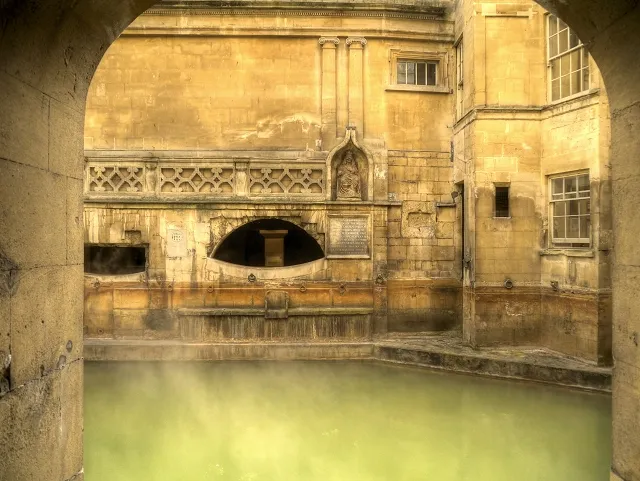
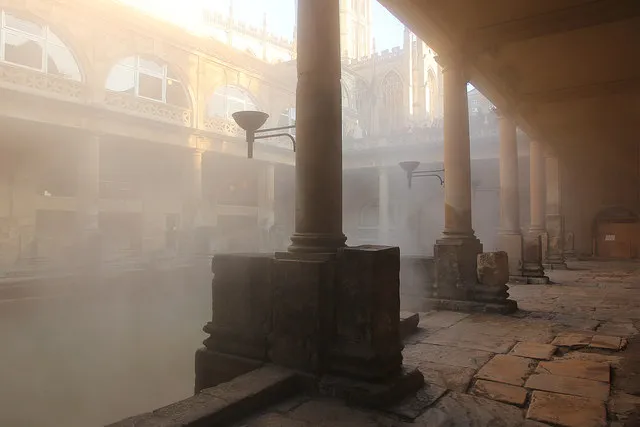
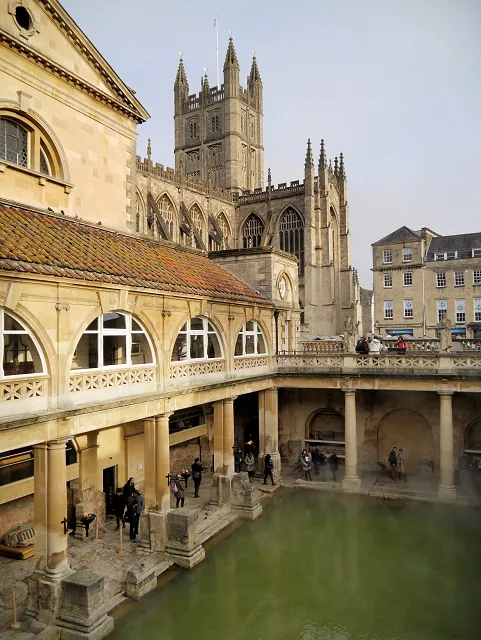
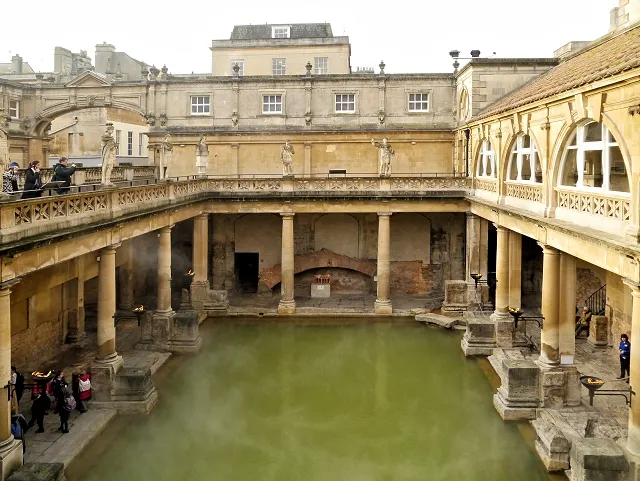
Water at 46 °C rises from the spring here every day, about 1,170,000 litres of it, and has done for thousands of years. To people in the past it was beyond explaining, the work of the gods. In Roman times a great temple was built beside it to Sulis Minerva, a goddess with the power to heal, and the spring fed a bath house that drew visitors from across the Roman empire.1
The temple
The temple was one of only two truly classical temples in Roman Britain. Its pediment, the carved triangle over the front, survives and has been put back together in the museum. At its centre is a fierce carved head, thought to be the Gorgon’s head, a powerful sign of the goddess.1
Inside stood the cult statue, and its head survives. Found in 1727, the gilt bronze head is slightly larger than life and was gilded six times: twice by fire-gilding, then four times with gold leaf. Small holes in the hairline once held rivets for a tall helmet. The statue may date from the founding of the site in the later first century AD, which would make it more than 300 years old when it was destroyed.3
In front of the temple, in the courtyard, was a great altar for sacrifices. A stone found in 1965 was set up by Lucius Marcius Memor, a haruspex, a priest who read omens and advised before important decisions.1
The baths
Roman bathing was not swimming. You moved through a series of heated rooms and finished with a cold plunge. Bath had all of that and more: a tiny room of intense dry heat, called a laconicum; a cold plunge pool 1.6 metres deep; and two suites of heated rooms at either end, perhaps so that men and women could bathe separately.2
In the middle was the Great Bath, fed straight from the spring, lined with 45 thick sheets of lead and 1.6 metres deep, with steps all round. It stood in a vaulted hall 20 metres high. For many Roman visitors it may have been the largest building they had ever been inside.12
Gifts and curses
People threw offerings into the spring: more than 12,000 Roman coins, the largest such deposit known from Britain. They threw curses too, scratched on sheets of lead or pewter, rolled up and dropped into the water where the goddess lived. The Bath curse tablets include Britain’s earliest known prayers and are on UNESCO’s Memory of the World register. In the Roman drain, archaeologists found 34 carved gemstones and a mysterious tin mask.1
Where the evidence is unclear
What was the building with the four seasons?Carved stones found in 1790 come from a building with a front showing the four seasons and the moon goddess Luna. It may have been where worshippers slept by the temple, hoping for visions in their dreams.1
Why two sets of heated rooms?The suites at the east and west ends may have let men and women use the baths at the same time, kept apart. No Roman text from Bath says so.2