Lesson V · AD 47 to about 300

Towns and the new life

The questionHow did Roman rule change the way people lived?

Before the Romans, Britain had no towns in the Roman sense. Within fifty years it had dozens, laid out on grids, with baths, markets and temples, and full of people from all over the empire.

London by AD 60
about 10,000 people2
Wroxeter
78 hectares, 48 blocks1
Coins thrown into Bath’s spring
more than 12,0005

Fits: Primary (KS2) · GCSE · A level

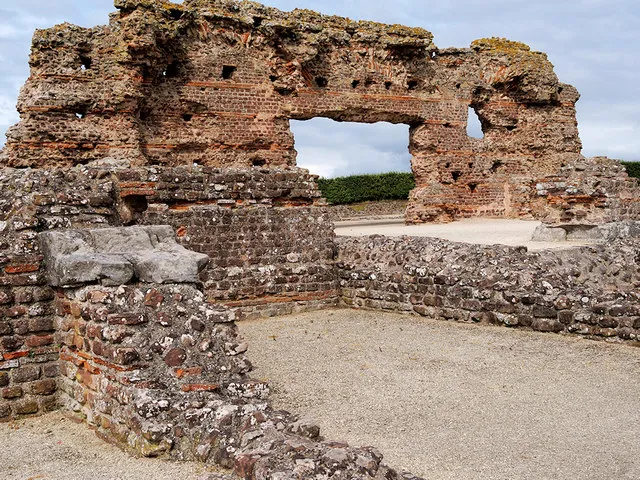
A tall ruined wall of red sandstone and brick with a large opening
The Old Work at Wroxeter: a towering piece of the city’s public baths, still standing after 1,800 years.Photo: David Dixon, CC BY-SA 2.0, via Geograph

The story

When the army reached the Shropshire plain in the late 40s AD, the people there, the Cornovii, had been farming it for more than 1,500 years. They lived on farmsteads. Their wealth was cattle and sheep. They used no coins, and hardly any pottery except containers of salt.1

Then came the army, its fort, its money and its language. Losing land to a fortress, English Heritage’s historian writes, must have been a shock.1 When the legion left, in the 90s, a city was laid out on its streets, probably by local leading families and retired soldiers together: 78 hectares and 48 blocks, with a forum, public baths and a market hall. This was Wroxeter, Viroconium, capital of the Cornovii.1

London

Londinium was founded around AD 47 to 50 on the north bank of the Thames, with a bridge and a port. By AD 60 about 10,000 people lived there, many from across the empire: soldiers, merchants, officials and their households, including enslaved people. On its edge, glassworkers lived in traditional British roundhouses.2

After Boudica burnt it, London was rebuilt as the capital of the province, with a forum, a two-storey basilica, public baths, a temple and an amphitheatre. By about 150 it held around 30,000 people.2 Through its port came wine, olive oil, fish sauce, figs, fine pottery, glass and marble from across the Mediterranean.3

New gods, old gods

The Romans often joined local gods to their own rather than replace them. At Bath, Roman Aquae Sulis, “the waters of Sulis”, the goddess of the hot spring was worshipped as Sulis Minerva: a local name joined to a Roman one. A great temple went up beside the spring, and a bath house that drew visitors from across the empire.54 People threw more than 12,000 coins into the spring, and curses scratched on sheets of lead or pewter, rolled up and dropped into the water where the goddess lived.5

Who got what

Be careful with the picture. Towns, forts and the well-off left the most behind, so they fill the museums and these pages. Most people in Britain had always lived by farming, and the Romans needed them to go on doing it. For some, the new towns meant opportunity. For others they meant taxes, soldiers and a new language for the people in charge, and for the enslaved, little choice at all.

What made a Roman town

What each of our towns is recorded as having.

Roman town buildings recorded at London, Wroxeter, Bath and Richborough
TownPlanned streetsForum and basilicaPublic bathsTempleAmphitheatreTown wall
London50s ADunder Vespasian, AD 69 to 79YesYestimber, then stoneabout AD 200
Wroxeter90s ADAD 130 to 150AD 130 to 150Not coveredNot coveredtimber and turf, about 200
BathNot coveredNot coveredthe Great BathSulis MinervaNot coveredNot covered
RichboroughNot coveredNot coveredNot coveredNot coveredYesNot covered

A filled mark means the building is recorded in the sources on that town’s own page; the dates are when it was built, where known. A blank means our pages do not cover it, not that the town never had one. Bath was a sacred spring more than a town, and Richborough a port.

Key words

Romanisation
The way people in the provinces took up Roman ways: towns, Latin, coins, baths, gods. Historians argue about how far, and how willingly.
Forum
The open square at the heart of a Roman town: its marketplace and meeting place.
Basilica
The great hall beside the forum, used for the town council and law courts.
Civitas capital
A town that was the centre of government for a British people, like Wroxeter for the Cornovii.
Curse tablet
A thin sheet of lead or pewter with a curse scratched on it, asking a god to punish someone. Bath’s are among Britain’s earliest known prayers.

Check yourself

Try to answer in your head, then open each one.

How did the Cornovii live before Wroxeter was built?

On farmsteads, with their wealth in cattle and sheep. They used no coins and little pottery.

Name three buildings a big Roman town would have.

Any three of: a forum, a basilica, public baths, temples, an amphitheatre, a town wall.

Who lived in London by AD 60?

About 10,000 people, many from across the empire: soldiers, merchants, officials, and the people of their households, including enslaved people.

What did people throw into the spring at Bath?

More than 12,000 coins, and curses scratched on sheets of lead or pewter.

Go deeper

  • London the biggest town, and how many people lived there
  • Wroxeter a fortress that became a city
  • Bath a goddess, a hot spring and a great bath
  • Corbridge a town that grew up to feed the Wall

Sources for this page

Every number on this page comes from one of these. How we check.

Last reviewed 12 November 2026. Spotted a mistake? Tell us.

  1. White, R. H. History of Wroxeter Roman City. English Heritage. (Honorary Research Fellow, University of Birmingham.) www.english-heritage.org.uk/visit/places/wroxeter-roman-city/history/Used for: Wroxeter: the Cornovii, the fortress, the 78-hectare city and its slow end. Checked 12 November 2026.
  2. London Museum. A timeline of Roman London: Londinium from start to end. www.londonmuseum.org.uk/collections/london-stories/timeline-roman-london-londinium/Used for: Londinium: founding, population, the fires, the wall, the provinces and the end. Checked 12 November 2026.
  3. London Museum. A bustling port: Roman London. www.londonmuseum.org.uk/collections/london-stories/bustling-port-roman-london/Used for: The port: when it was built and closed, what came in, Fortunata and Tiberinius Celerianus. Checked 12 November 2026.
  4. The Roman Baths. The Roman bathing complex. www.romanbaths.co.uk/roman-bathing-complex-0Used for: How a Roman bath worked, room by room, and the Great Bath’s depth and lead lining. Checked 12 November 2026.
  5. The Roman Baths (Bath & North East Somerset Council). Walkthrough of the site; The Roman bathing complex; Minerva’s head. www.romanbaths.co.uk/walkthroughUsed for: Bath: the spring’s heat and flow, the Great Bath, the temple, the curse tablets and the head of Sulis Minerva. Checked 12 November 2026.
  6. History of Richborough Roman Fort and Amphitheatre. English Heritage. www.english-heritage.org.uk/visit/places/richborough-roman-fort-and-amphitheatre/history-and-stories/history/Used for: Richborough: the landing of AD 43, the coastline, the port, the amphitheatre and the Saxon Shore fort. Checked 12 November 2026.