People
Out of millions of people who lived in Roman Britain, we know the names of very few. Emperors, a queen, and a handful of ordinary people whose words or tombstones survived. Here they are, in order.
Emperor · Roman
Claudius
Invaded AD 43
Made emperor by the Praetorian Guard after Caligula was murdered in AD 41. He sent about 40,000 men to Britain in AD 43, came himself for the fall of Colchester, and stayed sixteen days.1
British leader · British
Caratacus
From AD 43
One of the leaders who would not surrender to Claudius. He escaped and fought on for years.1
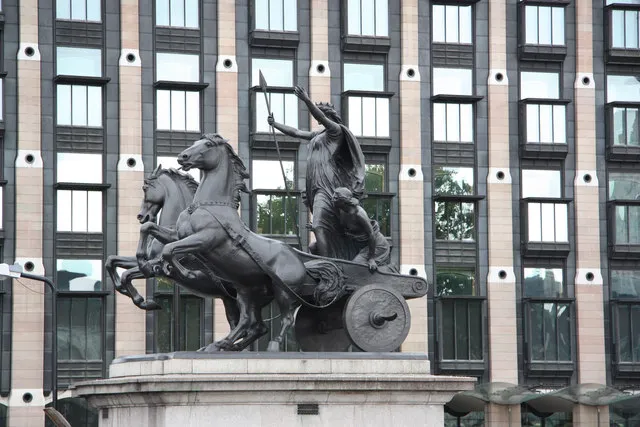
Queen of the Iceni · British
Boudica
Revolt AD 60 to 61
After her husband Prasutagus died in AD 60, the Romans seized his kingdom, had her whipped and her daughters raped. She led a revolt that burnt Colchester, London and St Albans, and was defeated. Tacitus says she died by poison; Dio says of illness.234
Photo: Richard Croft, CC BY-SA 2.0, via Geograph
Officer’s wife · Roman
Claudia Severa
About AD 97 to 105
Wrote to her friend Sulpicia Lepidina at Vindolanda, inviting her to a birthday party. The goodbye at the end of the letter is almost certainly in her own hand.5
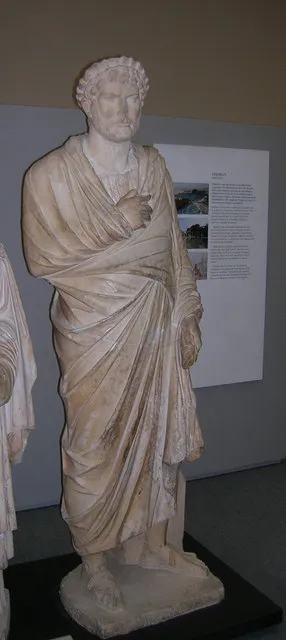
Emperor · Roman
Hadrian
Publius Aelius Hadrianus
Visited Britain AD 122
Came to Britain with his wife Sabina in AD 122, the year building of the Wall began. He died in AD 138.69
Photo: Robin Sones, CC BY-SA 2.0, via Geograph
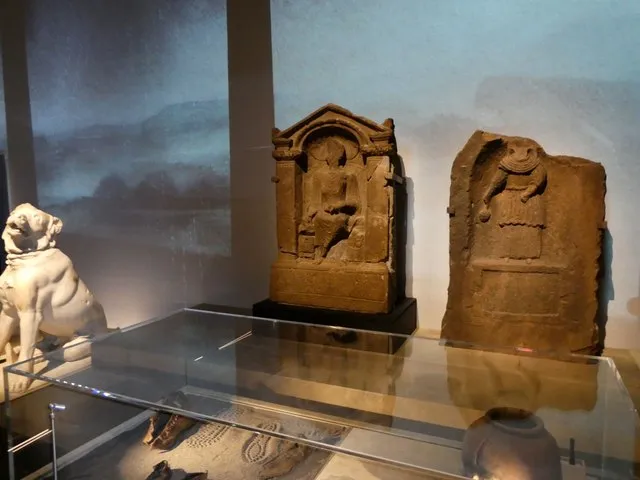
A freed Briton and a man from Palmyra · British and from the East
Regina and Barates
Tombstone found in 1878
Regina was a Catuvellaunian who had been enslaved and freed, and married Barates, from Palmyra in what is now Syria. She died aged 30. He set up her tombstone at South Shields, in Latin and in his own language.7
Photo: Jeremy Bolwell, CC BY-SA 2.0, via Geograph
Emperor · Roman
Septimius Severus
Died at York, AD 211
Came to Britain for a war in Scotland, and died at York.8
Fleet commander, then emperor · Roman
Carausius
Emperor in Britain from AD 286
Commander of the Channel fleet who rebelled and ruled Britain as emperor. He, and then Allectus, held it until Britain was taken back in 296.9
Almost everyone here was rich, powerful or both, or is known because of someone who was. The farmers who made up most of the population left no names at all.
Sources for this page
Every number on this page comes from one of these. How we check.
Last reviewed 12 November 2026. Spotted a mistake? Tell us.
- The Roman invasion of Britain, AD 43. English Heritage, Story of England: Romans. www.english-heritage.org.uk/learn/story-of-england/romans/invasion/Used for: Why Claudius invaded, the size of the army, and the debate over where it landed. Checked 12 November 2026.
- London Museum. Boudica: rebel queen of the Iceni. www.londonmuseum.org.uk/collections/london-stories/boudica-rebel-queen-iceni/Used for: Boudica: who she was, the revolt, the burnt layers in London, and how Roman writers described her. Checked 12 November 2026.
- Tacitus, Annals, book 14, chapters 29 to 39 (written in the early 2nd century AD). Translated by J. Jackson, Loeb Classical Library, 1937, public domain; online at LacusCurtius (Bill Thayer). penelope.uchicago.edu/Thayer/E/Roman/Texts/Tacitus/Annals/14B*.htmlUsed for: Boudica’s revolt as a Roman senator told it, about fifty years later. Checked 12 November 2026.
- Cassius Dio, Roman History, epitome of book 62 (written around AD 200). Translated by E. Cary, Loeb Classical Library, 1925, public domain; online at LacusCurtius. penelope.uchicago.edu/Thayer/E/Roman/Texts/Cassius_Dio/62*.htmlUsed for: Boudica as Dio described her, and his figures for the revolt. Checked 12 November 2026.
- Roman Inscriptions of Britain online. Tab. Vindol. 291: Birthday invitation of Sulpicia Lepidina. Translation after A. K. Bowman and J. D. Thomas. romaninscriptionsofbritain.org/inscriptions/TabVindol291Used for: The text, date, handwriting and present home of the birthday invitation. Checked 11 November 2026.
- Breeze, D. J. History of Hadrian’s Wall. English Heritage. (Former Chief Inspector of Ancient Monuments for Scotland; co-author of the standard work on the Wall.) www.english-heritage.org.uk/visit/places/hadrians-wall/hadrians-wall-history-and-stories/history/Used for: Hadrian’s Wall: its length, plan, builders, garrisons, changes of plan and the end. Checked 12 November 2026.
- The Roman Inscriptions of Britain, RIB 1065: funerary inscription for Regina, South Shields. Text, translation, description and notes. romaninscriptionsofbritain.org/inscriptions/1065Used for: Regina’s tombstone: its words in Latin and Palmyrene, its carving, where and when it was found. Checked 12 November 2026.
- Historia Augusta, Life of Septimius Severus (written in the late 4th century AD). Translated by D. Magie, Loeb Classical Library, 1921, public domain; online at LacusCurtius. penelope.uchicago.edu/Thayer/E/Roman/Texts/Historia_Augusta/Septimius_Severus*.htmlUsed for: Where Severus died, and a later writer’s version of his last words. Checked 12 November 2026.
- London Museum. A timeline of Roman London: Londinium from start to end. www.londonmuseum.org.uk/collections/london-stories/timeline-roman-london-londinium/Used for: Londinium: founding, population, the fires, the wall, the provinces and the end. Checked 12 November 2026.