A civilisation in West Africa · From the Ogiso kings to the present Oba, in Benin City
The Kingdom of Benin
For more than a thousand years, by its own reckoning, the kingdom with its capital at Benin City has had kings: first the Ogiso, then the Obas. The present Oba, Ewuare II, crowned in 2016, is the fortieth of his line.1 This page follows Benin’s own historians, collected by the Digital Benin project, wherever it can.
Edo, Benin’s language, writes some vowels with a dot beneath them, as in Ọba. We leave the dots off in our own writing to keep it easy to read.
The line of kings
Thirty-one Ogiso, a gap ruled by an appointed administrator, then the Obas from about 1170.1 The pale stretch is 1897 to 1914, when Oba Ovonramwen was in exile and the palace stood burnt. Read chapter one: Kings of the sky.
Every lesson is written for anyone. Choose a course and the lessons that match it are marked.
National curriculum, Key Stage 2: “a non-European society that provides contrasts with British history”, one choice being “Benin (West Africa) c. AD 900 to 1300”
The first chapter covers AD 900 to 1300. The others carry the story on to today, which most schools that choose Benin also teach.
We are not an exam board. Check the details against your own course.
We have not matched this subject to a GCSE or A level course yet. Read it as an introduction.
We have not matched this subject to a GCSE or A level course yet. Read it as an introduction.
The city in two halves
Oba Ewuare I, about 1440 to 1473, divided Benin City in two: the palace, Ogbe, and the town, Ore n’khua, each laid out in streets.1 The two halves of this page are the two halves of the city.
Ogbe
The palace
At the centre was the Oba, a sacred king. Three palace societies served him: the Iwebo looked after his wardrobe and regalia, the Iweguae were his attendants, and the Ibiwe ran his household of wives.2
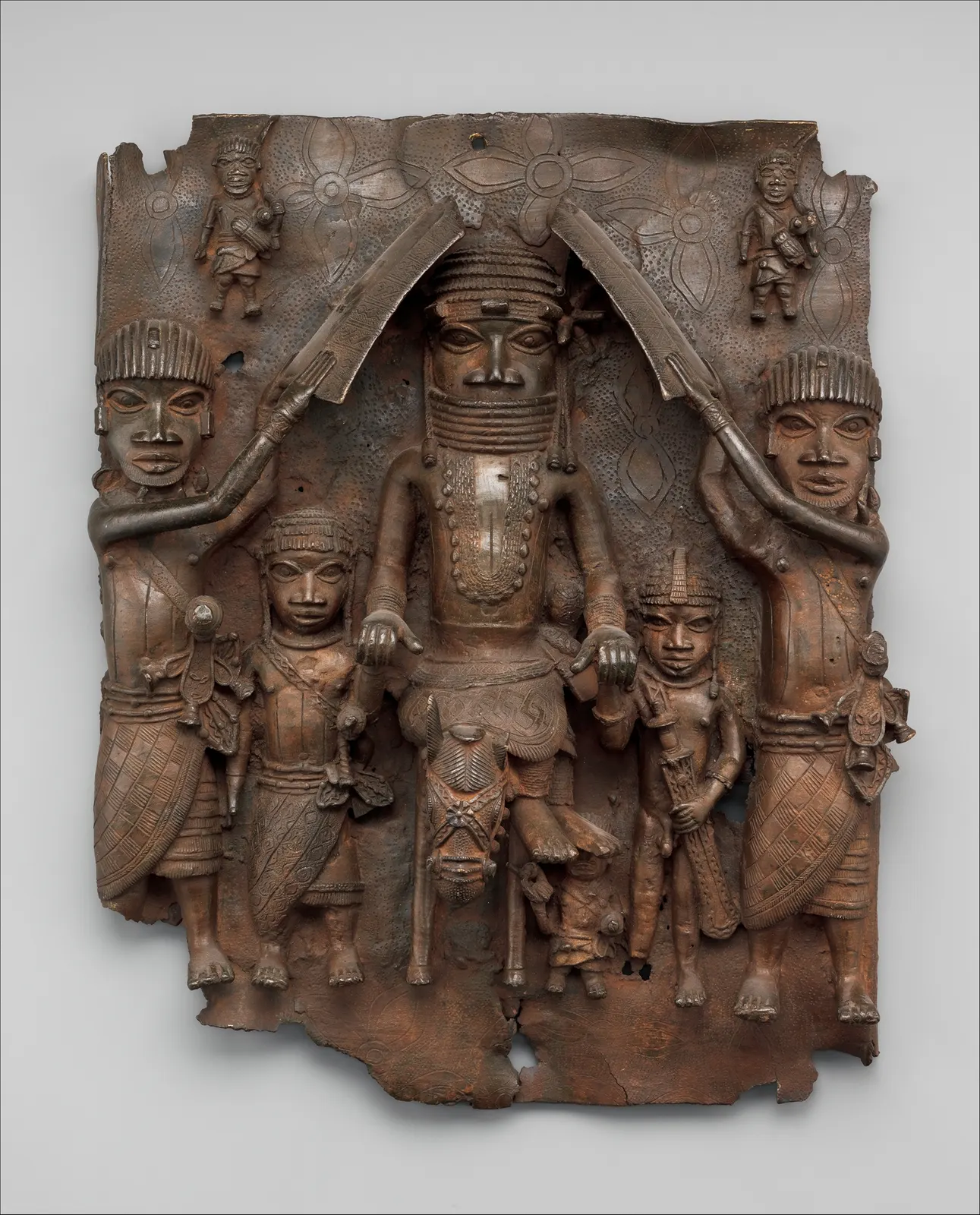
The palace held the altars to past Obas, with heads cast in brass to remember them, and courtyards with galleries on wooden pillars. Brass plaques, probably made in matching pairs, were fixed to those pillars, showing wars, ceremonies and life at court.5,11
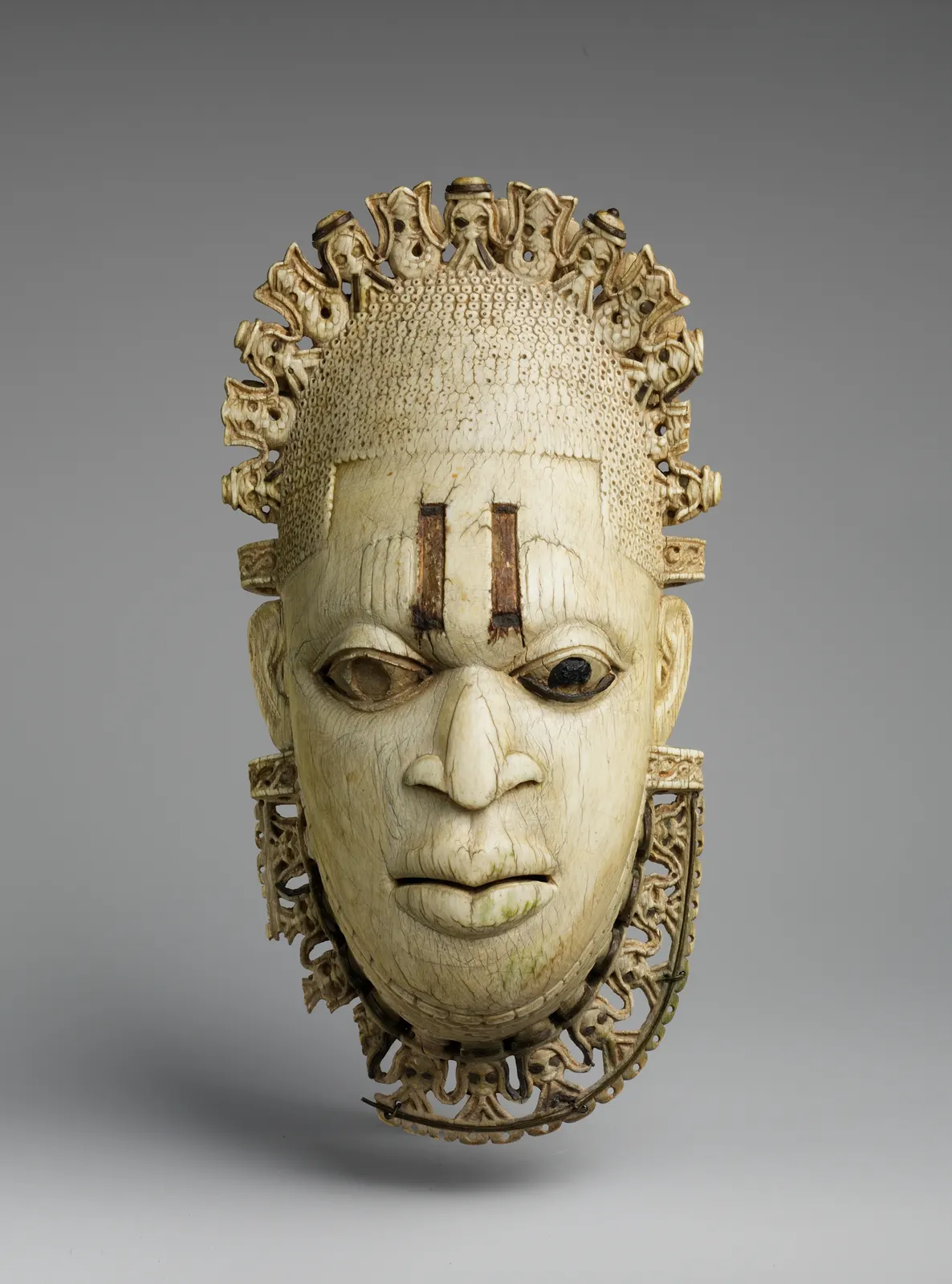
Oba Esigie, early in the 1500s, created a new title for his mother, Idia, who had fought beside him: Iy’Oba, queen mother. She was the first.4
Ore n’khua
The town
The Oba ruled with ranks of chiefs: the Uzama, the senior chiefs, whose titles Oba Eweka I made hereditary, and two orders of title holders, one for the palace and one for the town.2,1
The town was home to the guilds. Each craft that served the Oba, from brass casting and ivory carving to weaving and building, was a guild with its own quarter and chiefs. The Oba oversaw them through the palace societies, and some guilds were open only to certain families.3
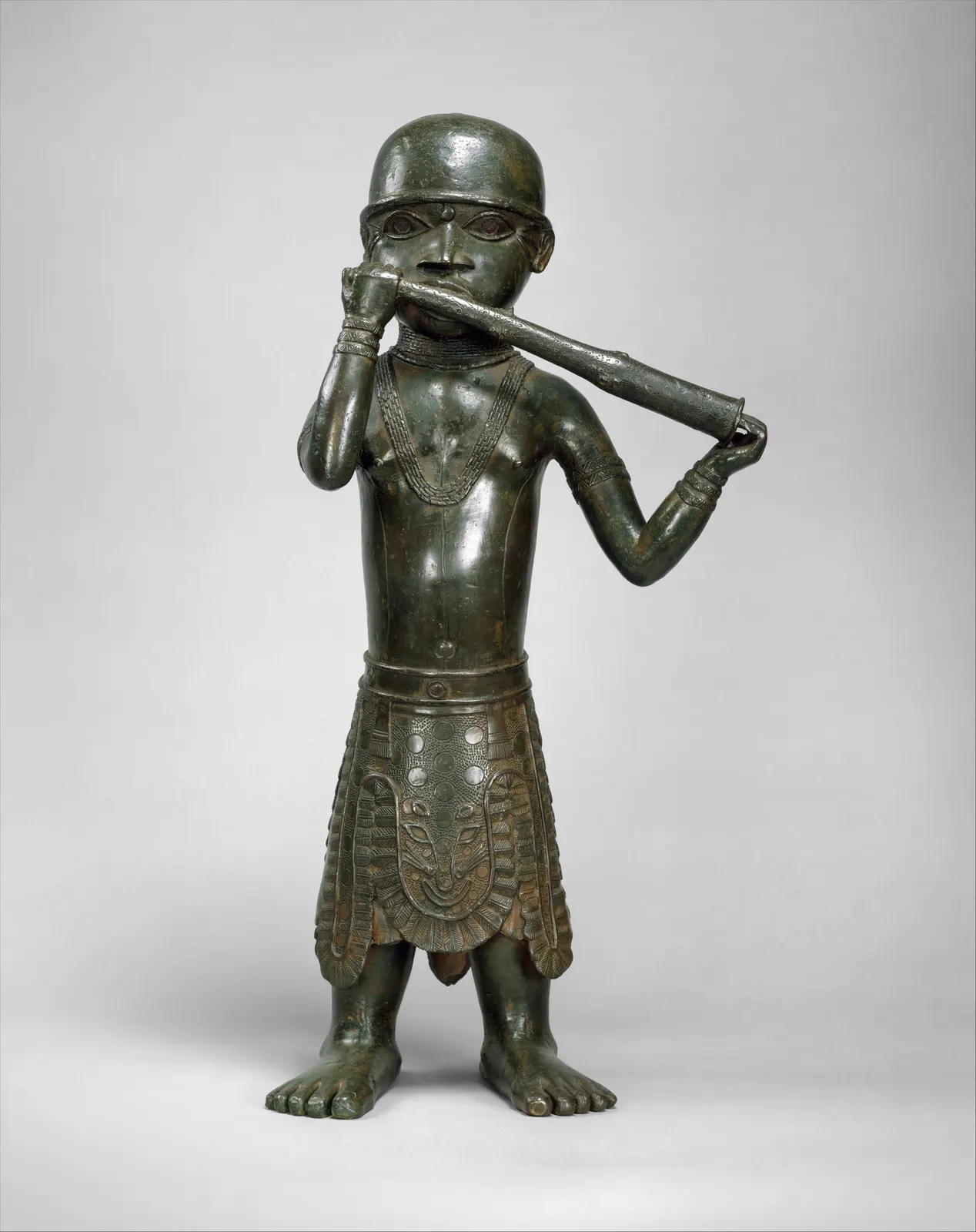
The brass casters, Igun-Ẹrọnmwọn, lived in Igun quarter, and membership is still limited to descendants of its founding families.3
Where the halves meet
February 1897
On 18 February 1897, after ten days of fighting, British forces entered Benin City. Over the next days they emptied the palace altars and storerooms, destroyed chiefs’ compounds and shrines, and on 21 February a fire reached the palace.6 Oba Ovonramwen was exiled to Calabar, where he died in 1914. That year his son was crowned Eweka II and began to rebuild the palace.1
Thousands of the objects taken are still in museums abroad. Some have begun to come back. Chapter four: 1897 and the long way home.
Where experts disagree: who should keep what comes back?
The Oba, as owner and keeper.On 28 March 2023 Nigeria’s outgoing president, Muhammadu Buhari, declared in the official gazette that returned works belong to the Oba of Benin and are in his keeping. Oba Ewuare II has said the right place for them is a royal museum at the palace.7,9
A public museum, for everyone.Others argue that the works should be cared for by Nigeria’s National Commission for Museums and Monuments and shown in public museums. The governor of Edo State, Godwin Obaseki, backed housing them in federal museums.9 After the gazette, Cambridge’s Museum of Archaeology and Anthropology put a planned return of 116 objects on hold.8
By 2024, Digital Benin reports, the two sides had agreed to work together: the Oba as owner and traditional keeper, and the National Commission managing, caring for and showing the works.7
Objects in the archive
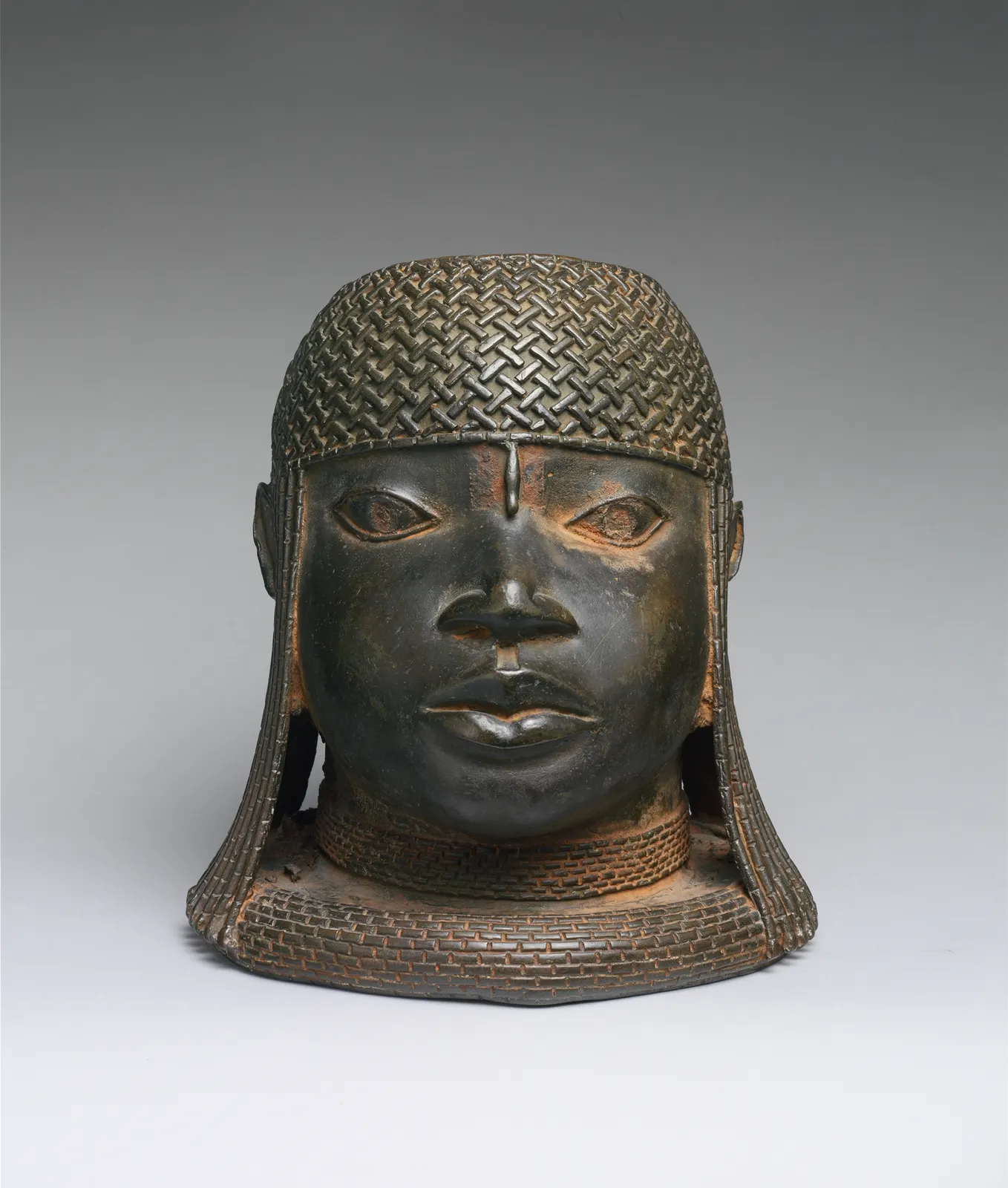 A brass head of a king
- A horn player
- A plaque of a king on horseback
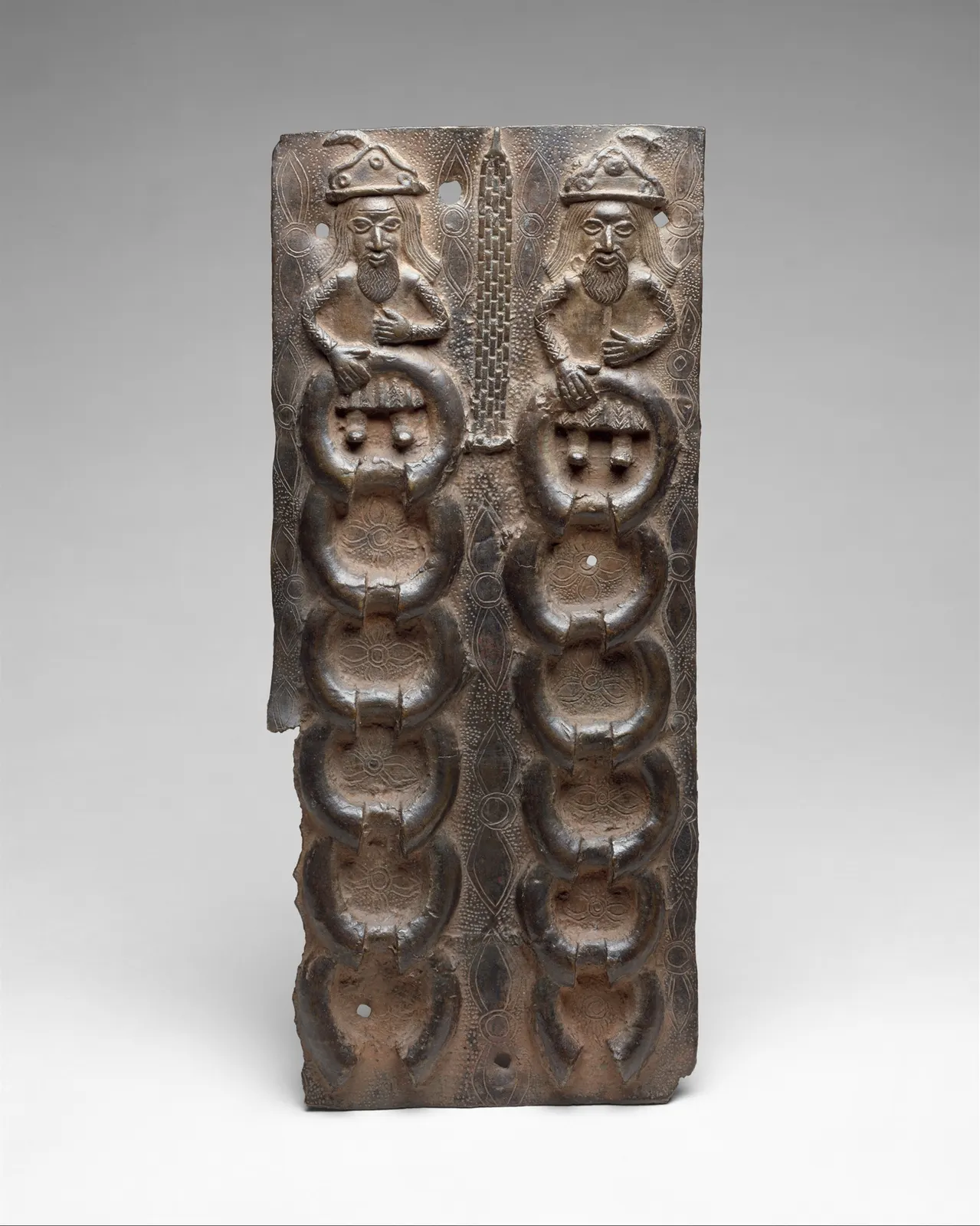 A plaque of Portuguese traders
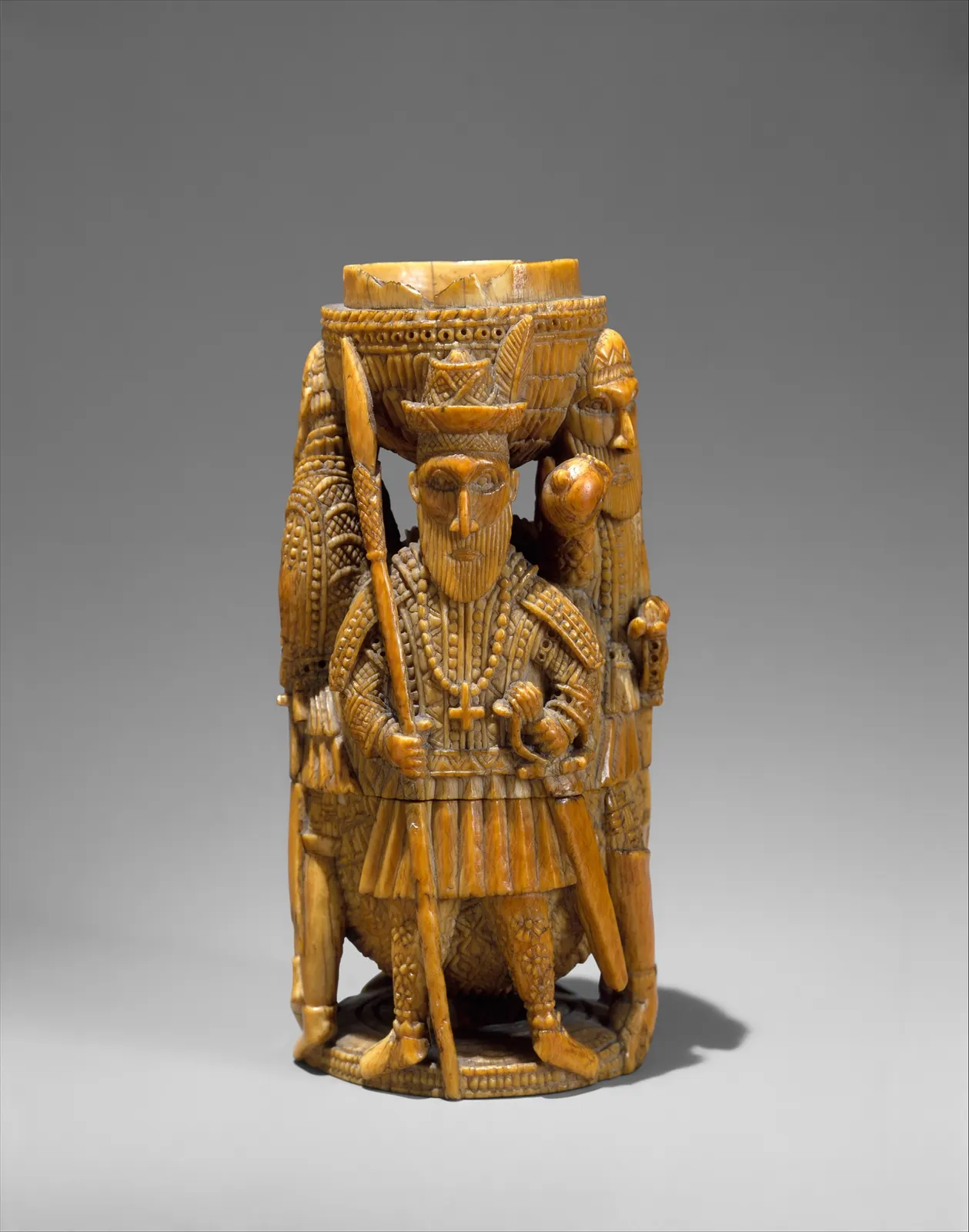 An ivory saltcellar with Portuguese figures
- The ivory mask of Queen Mother Idia
All six are in the Metropolitan Museum of Art, New York. The Met’s records describe the brass and ivory works as made for the court of Benin; Digital Benin traces the movement of works like them after 1897.
Sources for this page
Every number on this page comes from one of these. How we check.
Last reviewed 12 November 2026. Spotted a mistake? Tell us.
- Digital Benin (2020–2026), hosted by MARKK Hamburg; principal investigators K. Agbontaen-Eghafona, F. Bodenstein, J. Fine, A. Luther and B. Plankensteiner. Itan Edo: Kings. Drawing on Agbontaen-Eghafona (2018), Osadolor (2018) and Egharevba (1968), A Short History of Benin. digitalbenin.org/itan-edo/kingsUsed for: The Ogiso and Oba dynasties and their dates; Evian; Oranmiyan; Oguola and the casting guild; Ewuare I; Ozolua and the first Portuguese visit; Esigie; Ovonramwen’s exile; Eweka II, Akenzua II, Erediauwa and Ewuare II. Checked 12 November 2026.
- Digital Benin (2020–2026), hosted by MARKK Hamburg; principal investigators K. Agbontaen-Eghafona, F. Bodenstein, J. Fine, A. Luther and B. Plankensteiner. Itan Edo: the history of Benin from an indigenous perspective, using Benin-authored sources. digitalbenin.org/itan-edoUsed for: The palace societies and chiefs, and how the Oba governed with them. Checked 12 November 2026.
- Digital Benin (2020–2026), hosted by MARKK Hamburg; principal investigators K. Agbontaen-Eghafona, F. Bodenstein, J. Fine, A. Luther and B. Plankensteiner. Itan Edo: Guilds. Drawing on Egharevba (1949), Eweka (1992), Inneh (2007) and Agbontaen-Eghafona (2018). digitalbenin.org/itan-edo/guildsUsed for: The brass casters’ guild (Igun-Ẹrọnmwọn), the ivory and wood carvers (Igbesanmwan), the Iwoki guild, and how the Oba oversaw the guilds. Checked 12 November 2026.
- Digital Benin (2020–2026), hosted by MARKK Hamburg; principal investigators K. Agbontaen-Eghafona, F. Bodenstein, J. Fine, A. Luther and B. Plankensteiner. Itan Edo: Queens, Queen Mothers and Prominent Women. Drawing on Ebohon (2019), Edebiri (2003) and Egharevba (1968). digitalbenin.org/itan-edo/queens-queen-mothers-and-prominent-womenUsed for: Iy’Oba Idia and the title of queen mother. Checked 12 November 2026.
- Digital Benin (2020–2026), hosted by MARKK Hamburg; principal investigators K. Agbontaen-Eghafona, F. Bodenstein, J. Fine, A. Luther and B. Plankensteiner. Catalogue record for a brass plaque, British Museum Af1898,0115.18, with the museum’s curatorial notes (citing Gunsch, K. (2018). The Benin Plaques: A 16th Century Imperial Monument. London: Routledge) and its provenance events. digitalbenin.org/catalogue/Af1898011518Used for: What the plaques are made of, how they were cast, that they were fixed in pairs to the palace pillars, and the dating to the 16th and 17th centuries. Checked 12 November 2026.
- Digital Benin (2020–2026), hosted by MARKK Hamburg; principal investigators K. Agbontaen-Eghafona, F. Bodenstein, J. Fine, A. Luther and B. Plankensteiner. Provenance contexts: “Looting of the Ọba’s Palace”, “Looting of the Benin Ama-Ẹrọnmwọn (Brass Plaques)”, “Destruction of the Palatial Compound”, “Benin-Portuguese Ivories”, “Diplomatic Gifts”. digitalbenin.org/provenance/contextsUsed for: The invasion of February 1897, the looting and the fire; how the plaques were found, shipped and sold; the Benin-Portuguese ivories. Checked 12 November 2026.
- Digital Benin (2020–2026), hosted by MARKK Hamburg; principal investigators K. Agbontaen-Eghafona, F. Bodenstein, J. Fine, A. Luther and B. Plankensteiner. Provenance contexts: “The Reinstatement of Cultural Practices and Early Requests for Returns”, “Post-Independence Appeals for Returns”, “Activism and the Restitution and Call for Return”, “Joint Declaration on the Return of Benin Bronzes”, “Gazette Declaring the Ọba of Benin’s Ownership”. digitalbenin.org/provenance/contextsUsed for: Requests for return from 1914 onwards, the 1938 return of regalia, FESTAC ’77, the 1997 centenary, the 2022 Joint Declaration and the 2023 gazette. Checked 12 November 2026.
- Reuters (11 May 2023). Return of Benin Bronzes delayed after Nigerian president’s decree. Republished by The Star. www.thestar.com.my/news/world/2023/05/11/return-of-benin-bronzes-delayed-after-nigerian-president039s-decreeUsed for: The March 2023 gazette, and the postponed return of 116 objects from Cambridge. Checked 12 November 2026.
- Enahoro, N. A. (2 April 2024). Nigeria debates the fate of returning Benin Bronzes. New Lines Magazine. newlinesmag.com/reportage/nigeria-debates-the-fate-of-returning-benin-bronzes/Used for: The first return, by Jesus College, Cambridge, in October 2021; the disagreement over where returned works should be kept. Checked 12 November 2026.
- The Metropolitan Museum of Art. Plaque with equestrian ọ́bà (king) and attendants. Edo peoples, Ìgùn Ẹ́rọ̀nmwọ̀n (brass-casting guild) artists, ca. 1540–70. Collection record 310752, Open Access (CC0). www.metmuseum.org/art/collection/search/310752Used for: A brass plaque of a king on horseback, 49.5 cm high. Checked 12 November 2026.
- The Metropolitan Museum of Art. Ùhúnmwèlaò (head of an ọ́bà). Edo peoples, Ìgùn Ẹ́rọ̀nmwọ̀n artists, early 15th–mid-16th century. Collection record 312290, Open Access (CC0). www.metmuseum.org/art/collection/search/312290Used for: A brass commemorative head of a king, 23.5 cm high. Checked 12 November 2026.