People
Benin remembers its history through its kings and queen mothers, reign by reign. Here they are in order, strung on one line, with some of the casters, chiefs and visitors who appear beside them. Dates before the 1800s are approximate.
Oba or Ogiso Queen mother Others
About 40 BC, by tradition
Igodo
The first Ogiso
Head of the elders of Evbuoto village, who came to lead the wider land. People said he was “like the king in the sky”, and the saying became the title Ogiso.1
Read more: Kings of the sky
About 1100 to 1170
Evian
Administrator between the dynasties
Chosen by the people to run the land after they banished the last Ogiso, Owodo, in recognition of his bravery. The elders refused to let him make the rule his own.1
Read more: Kings of the sky
About 1170 to 1200
Oranmiyan
The first Oba
Sent from Uhe (Ife) by his father, Oduduwa, at the request of Benin elders. He decided that only a child born and raised in Benin should rule, and left his son to be king.1
Read more: Kings of the sky
About 1280 to 1295
Oguola
Oba
Had moats dug around the city and defeated his rival Akpanigiakon of Udo. A guild of brass casters was set up in his reign to keep records.1
Read more: The casters’ guild
About 1440 to 1473
Ewuare I
Oba
Prince Ogun returned from twenty years in exile to take the throne. A warrior king, he conquered 201 towns and villages and made Benin an empire, divided the city into palace and town, and organised the guilds.1
Read more: The city in two halves
About 1483 to 1504
Ozolua
Oba, “the Conqueror”
Said to have fought and won over a hundred wars. In his reign the first Portuguese visitor came to Benin, in 1485 to 1486.1
Read more: The plaques and the Portuguese
Early 1500s
Idia
The first queen mother, Iy’Oba
A dancer chosen by Oba Ozolua, whose parents had marked her forehead to keep her from the palace. She prepared her son Esigie for war and is believed to have fought beside him. He broke the old custom and created the title of queen mother for her.2
Read more: 1897 and the long way home
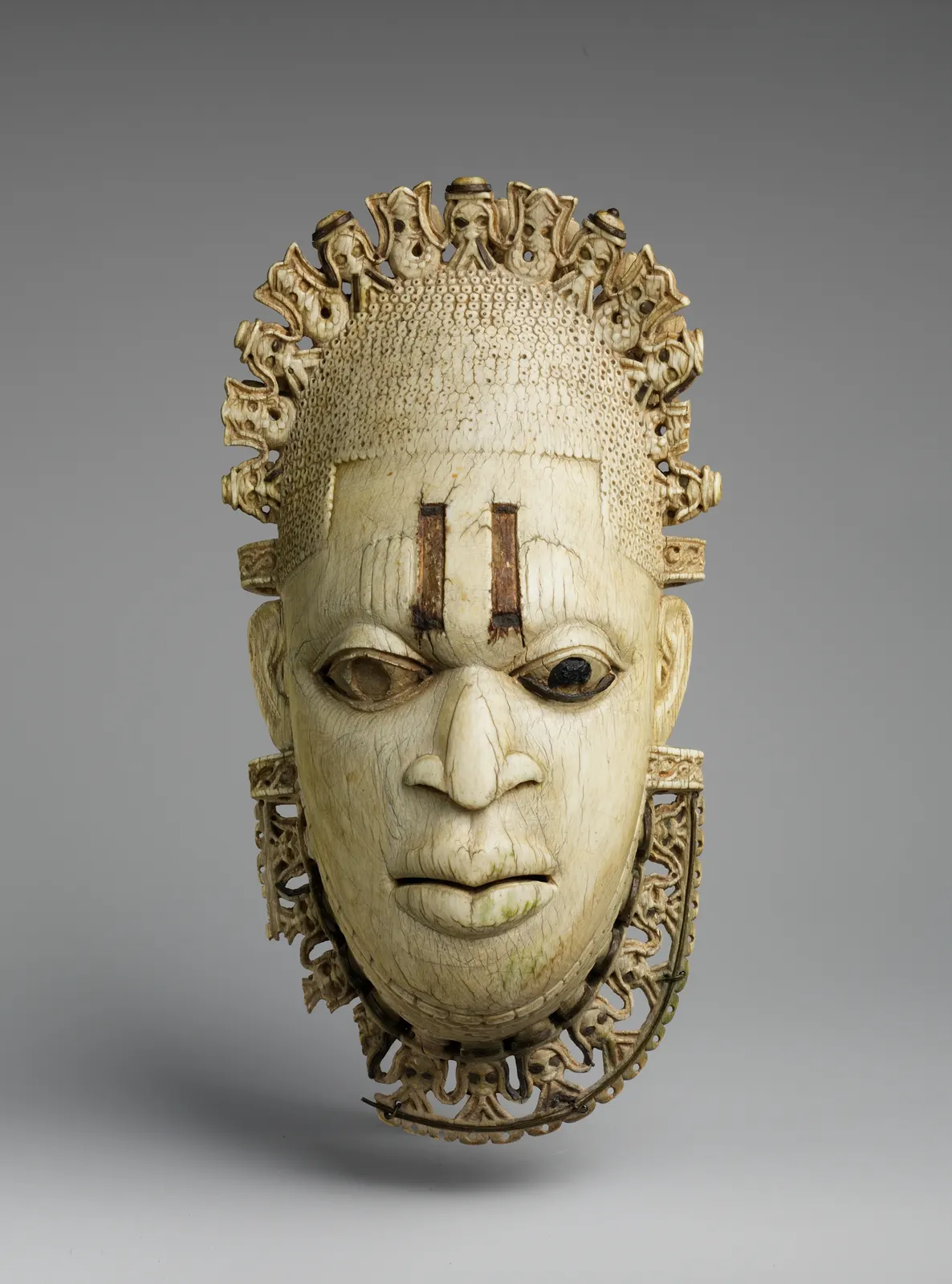
The Met, CC0 About 1504 to 1550
Esigie
Oba
Won a war with his brother, made his mother queen mother, accepted Christianity, sent Benin’s first ambassador to Portugal and set up the Iwoki guild.1,3
Read more: The plaques and the Portuguese
Early 1500s
Ava and Uti
Portuguese members of the Iwoki guild
Believed to have fought beside Esigie in the war with Idah. At Ugie festivals they are still remembered as ceremonial guards.3
Read more: The plaques and the Portuguese
1800s
Omozogie
Iy’Oba, mother of Oba Osemwende (1816 to 1848)
A wealthy trader who raised an army to win the throne for her son, and the most famous queen mother of 19th-century Benin. A street in Benin City is named after her.2
1888 to 1914
Ovonramwen
Oba
Ruled until the British invasion of 1897, when he was exiled to Calabar with two of his wives. He died there in 1914.1
Read more: 1897 and the long way home
1914 to 1933
Eweka II
Oba, “the rebuilder”
Ovonramwen’s son, himself a skilled brass smith and carver. He rebuilt the burnt palace and founded a school to train young casters and carvers.1,4
Read more: 1897 and the long way home
1933 to 1978
Akenzua II
Oba
Began the campaign for the return of Benin’s treasures, and in 1938 received back parts of Ovonramwen’s regalia.1,4
Read more: 1897 and the long way home
1998
John Ihama
Brass caster of Igun Street
Made a set of models for the Horniman Museum showing each stage of lost-wax casting. He learned from Chief Ihama as a young boy: casting passes from father to son.5
Read more: The casters’ guild
From 2016
Ewuare II
Oba, the fortieth of his dynasty
Crowned on 20 October 2016. Before that he was a diplomat, Nigeria’s ambassador to Italy.1
Read more: Who should keep what comes back?
Sources for this page
Every number on this page comes from one of these. How we check.
Last reviewed 12 November 2026. Spotted a mistake? Tell us.
- Digital Benin (2020–2026), hosted by MARKK Hamburg; principal investigators K. Agbontaen-Eghafona, F. Bodenstein, J. Fine, A. Luther and B. Plankensteiner. Itan Edo: Kings. Drawing on Agbontaen-Eghafona (2018), Osadolor (2018) and Egharevba (1968), A Short History of Benin. digitalbenin.org/itan-edo/kingsUsed for: The Ogiso and Oba dynasties and their dates; Evian; Oranmiyan; Oguola and the casting guild; Ewuare I; Ozolua and the first Portuguese visit; Esigie; Ovonramwen’s exile; Eweka II, Akenzua II, Erediauwa and Ewuare II. Checked 12 November 2026.
- Digital Benin (2020–2026), hosted by MARKK Hamburg; principal investigators K. Agbontaen-Eghafona, F. Bodenstein, J. Fine, A. Luther and B. Plankensteiner. Itan Edo: Queens, Queen Mothers and Prominent Women. Drawing on Ebohon (2019), Edebiri (2003) and Egharevba (1968). digitalbenin.org/itan-edo/queens-queen-mothers-and-prominent-womenUsed for: Iy’Oba Idia and the title of queen mother. Checked 12 November 2026.
- Digital Benin (2020–2026), hosted by MARKK Hamburg; principal investigators K. Agbontaen-Eghafona, F. Bodenstein, J. Fine, A. Luther and B. Plankensteiner. Itan Edo: Guilds. Drawing on Egharevba (1949), Eweka (1992), Inneh (2007) and Agbontaen-Eghafona (2018). digitalbenin.org/itan-edo/guildsUsed for: The brass casters’ guild (Igun-Ẹrọnmwọn), the ivory and wood carvers (Igbesanmwan), the Iwoki guild, and how the Oba oversaw the guilds. Checked 12 November 2026.
- Digital Benin (2020–2026), hosted by MARKK Hamburg; principal investigators K. Agbontaen-Eghafona, F. Bodenstein, J. Fine, A. Luther and B. Plankensteiner. Provenance contexts: “The Reinstatement of Cultural Practices and Early Requests for Returns”, “Post-Independence Appeals for Returns”, “Activism and the Restitution and Call for Return”, “Joint Declaration on the Return of Benin Bronzes”, “Gazette Declaring the Ọba of Benin’s Ownership”. digitalbenin.org/provenance/contextsUsed for: Requests for return from 1914 onwards, the 1938 return of regalia, FESTAC ’77, the 1997 centenary, the 2022 Joint Declaration and the 2023 gazette. Checked 12 November 2026.
- Horniman Museum and Gardens, London. Plaque; casting; stage of manufacture. Wax model made by the brass caster John Ihama of Igun Street, Benin City, in 1998, one of a series showing the lost-wax process. Object record HC.1999.938.4. www.horniman.ac.uk/object/HC.1999.938.4Used for: The steps of lost-wax casting as done on Igun Street, and that casting is taught from father to son. Checked 12 November 2026.
- The Metropolitan Museum of Art. Pendant mask of Ìyọ́bà Idià. Edo peoples, Ìgbèsànmwà (ivory- and wood-carving guild) artists, 16th century. Collection record 318622, Open Access (CC0). www.metmuseum.org/art/collection/search/318622Used for: An ivory pendant mask of Queen Mother Idia, 23.8 cm high. Checked 12 November 2026.