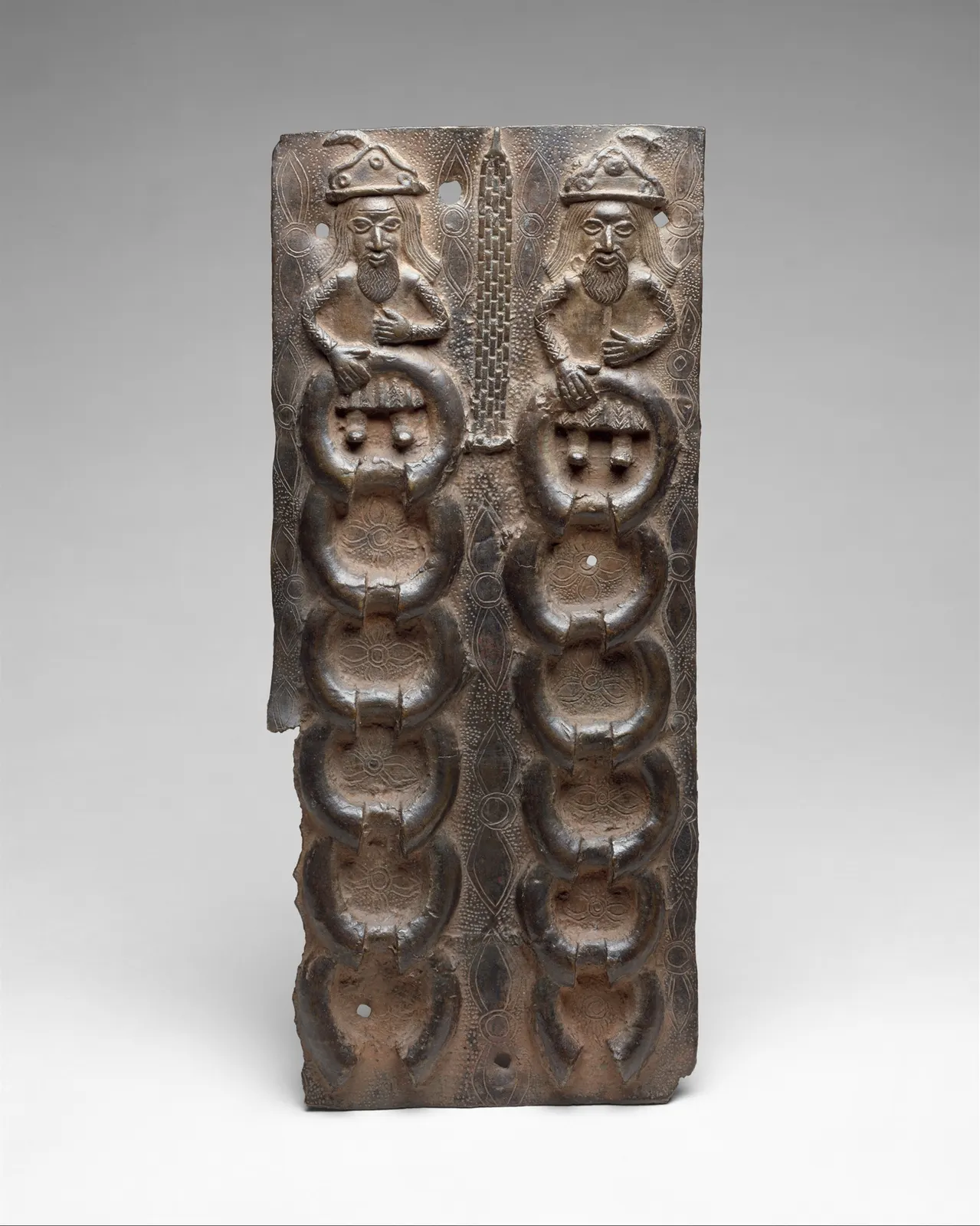
A tall narrow brass plaque of a long-haired man in a hat, holding brass bracelets, with smaller figures of traders

OC 023

A plaque of Portuguese traders

A palace plaque showing Portuguese traders holding manillas, open rings of brass. Brass was one of the main goods the Portuguese brought to trade.1,2

Date
About 1540 to 1570, by the Met’s datingIX · Oceans crossed
Place
Benin City, Nigeria
Type
Relief plaque (ama) · BrassKingdom of Benin
Size
45.7 by 19.7 cm
Made by
Igun-Ẹrọnmwọn, the brass casters’ guild
Held by
The Metropolitan Museum of Art, New YorkMuseum number 1991.17.13
Image
The Metropolitan Museum of Art, CC0, via The Met Open Access
Appears in

Where it sits in human time

Made about 470 years ago. On this strip, each step to the right is ten times closer to today.

300,000 years ago10,0003,0001,000100nowA plaque of Portuguese traders

Sources for this page

Every number on this page comes from one of these. How we check.

Last reviewed 12 November 2026. Spotted a mistake? Tell us.

  1. The Metropolitan Museum of Art. Plaque with Portuguese traders and manillas. Edo peoples, Ìgùn Ẹ́rọ̀nmwọ̀n artists, ca. 1540–70. Collection record 316486, Open Access (CC0). www.metmuseum.org/art/collection/search/316486Used for: A brass plaque of Portuguese traders holding manillas, 45.7 cm high. Checked 12 November 2026.
  2. Metzig, G. M. (2016). Corals, brass and firearms: material commodities in cultural interactions between Edo and Portuguese in Benin around 1500. In Material Culture in Modern Diplomacy from the 15th to the 20th Century, pp. 29–54. Berlin: De Gruyter. doi.org/10.1515/9783110463217-002Used for: Brass, coral and guns as goods in the trade between Benin and Portugal around 1500. Checked 12 November 2026.