Chapter Four
1897 and the long way home
February 1897 to today
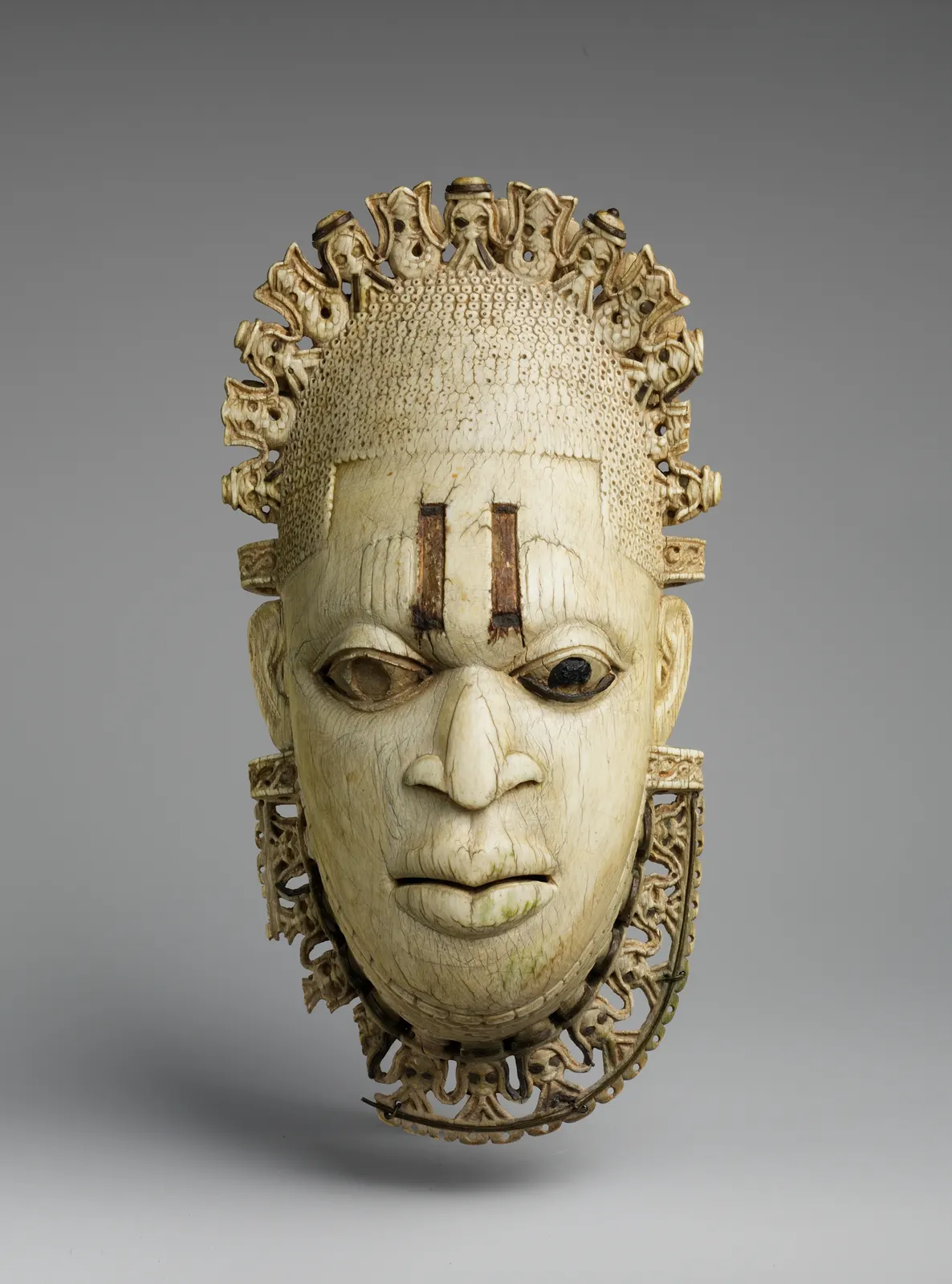
An ivory mask of Queen Mother Idia, 16th century. Masks like this were kept in the Oba’s bedchambers. Photo: The Metropolitan Museum of Art, CC0, via The Met Open Access.
The questionHow did thousands of Benin’s treasures end up abroad, and should they go back?
In February 1897 a British force took Benin City, burned it, and carried away thousands of objects from the palace and its altars. They were sold and scattered across the world. Benin began asking for them back almost at once, and is still asking.
Fits: Primary (KS2). See Courses.
February 1897
By the 1890s, Oba Ovonramwen stood in the way of British and Itsekiri traders who wanted roads into Benin and its forest goods. The quarrel led to a British invasion.2 On 18 February 1897, after ten days of fighting, British naval and Protectorate forces entered Benin City. The people had left. The troops camped in and around the palace, and began at once to take the brass, ivory, coral, wood and terracotta of the royal court.1
Over the next days they cleared the altars, storerooms and courtyards. Photographs show the ancestral altars stripped bare, piles of ivory tusks, and rows of brass heads laid out on the ground. From 19 to 21 February the force destroyed chiefs’ compounds, shrines and the queen mother’s palace, and on 21 February fire reached the Oba’s palace. Looting went on in the city and villages around it for months, and in places for years.1 Oba Ovonramwen was exiled to Calabar, where he died in 1914.2
Where experts disagree: did the palace burn by accident?
An accident.Whether the fire of 21 February was an accident has been argued over many times since 1897.1
Part of a pattern.Several British officers’ diaries describe troops being sent again and again to burn villages, compounds and palaces during the campaign, including the queen mother’s palace on 20 February.1
Where the plaques went
The brass plaques were found stored in the Oba’s compound. The British consul-general, Ralph Moor, sent them to London as official “prize”: 304 arrived in March 1897 and 11 more in July 1898. The British Museum showed them in 1897 and then argued to keep two thirds. In 1898 the 315 were shared out like this:1
- British Museum203
- Berlin Ethnological Museum44
- Eva Cutter, a dealer39
- General Pitt Rivers9
- Kept by the Foreign Office8
- Dresden Museum6
- Horniman Museum2
- Unknown buyer1
More than a century of asking
- 1914
Oba Eweka II is crowned in an emptied, burnt palace. He rebuilds it, has new brass heads cast for his father’s altar, and is said to have asked a British official for the royal stools.3,2
- 1935
Oba Akenzua II makes the first recorded request for named objects: two royal stools, traced to Berlin. Berlin refuses, and sends copies instead. The Oba has them inscribed to say the originals were taken in 1897.3
- 1938
Parts of Oba Ovonramwen’s coral regalia are given back to Akenzua II by Lord Plymouth. They are still used in ceremonies.3
- 1976
The British Museum refuses to lend its ivory mask of Queen Mother Idia for FESTAC ’77, the festival of Black and African arts in Lagos, which had chosen it as its emblem.3
- 1997
A hundred years after the invasion, Benin holds the Great Benin Centenary. Oba Erediauwa asks Bernie Grant, a London MP, to make formal requests for return on the palace’s behalf.3
- 2021
Jesus College, Cambridge, returns a brass cockerel: the first institution in the world to return a Benin work.4
- 2022
Germany and Nigeria sign a joint declaration. Berlin’s museums transfer ownership of all 512 of their Benin works to Nigeria, with about a third staying in Berlin on loan.3,5
- 2023
A presidential gazette declares that returned works belong to the Oba. A planned return from Cambridge is put on hold while this is worked out.3,6
By 2024 the Oba and Nigeria’s National Commission for Museums and Monuments had agreed to work together: the Oba as owner and traditional keeper, the Commission caring for and showing the works.3 Thousands of works are still abroad.
Key words
- Loot
- Goods taken by force, especially by soldiers in a war.
- Exile
- Being forced to live away from your home country.
- Restitution
- Giving something back to its rightful owner.
- Provenance
- The history of who has owned an object, and how it moved from one owner to the next.
- Regalia
- The special clothes and objects a king or queen wears or carries to show their rank.
Check yourself
Try to answer in your head, then open each one.
When did British forces enter Benin City?
18 February 1897, after ten days of fighting.
What happened to Oba Ovonramwen?
He was exiled to Calabar, where he died in 1914.
Which institution was the first to return a Benin work, and when?
Jesus College, Cambridge, in October 2021.
Give one reason some returns have been delayed.
Disagreement over who should own and keep the returned works: the Oba, or Nigeria’s national museums.
Go deeper
- The Kingdom of Benin where experts disagree on who should keep what returns
- The object archive each record says where an object is now
Sources for this page
Every number on this page comes from one of these. How we check.
Last reviewed 12 November 2026. Spotted a mistake? Tell us.
- Digital Benin (2020–2026), hosted by MARKK Hamburg; principal investigators K. Agbontaen-Eghafona, F. Bodenstein, J. Fine, A. Luther and B. Plankensteiner. Provenance contexts: “Looting of the Ọba’s Palace”, “Looting of the Benin Ama-Ẹrọnmwọn (Brass Plaques)”, “Destruction of the Palatial Compound”, “Benin-Portuguese Ivories”, “Diplomatic Gifts”. digitalbenin.org/provenance/contextsUsed for: The invasion of February 1897, the looting and the fire; how the plaques were found, shipped and sold; the Benin-Portuguese ivories. Checked 12 November 2026.
- Digital Benin (2020–2026), hosted by MARKK Hamburg; principal investigators K. Agbontaen-Eghafona, F. Bodenstein, J. Fine, A. Luther and B. Plankensteiner. Itan Edo: Kings. Drawing on Agbontaen-Eghafona (2018), Osadolor (2018) and Egharevba (1968), A Short History of Benin. digitalbenin.org/itan-edo/kingsUsed for: The Ogiso and Oba dynasties and their dates; Evian; Oranmiyan; Oguola and the casting guild; Ewuare I; Ozolua and the first Portuguese visit; Esigie; Ovonramwen’s exile; Eweka II, Akenzua II, Erediauwa and Ewuare II. Checked 12 November 2026.
- Digital Benin (2020–2026), hosted by MARKK Hamburg; principal investigators K. Agbontaen-Eghafona, F. Bodenstein, J. Fine, A. Luther and B. Plankensteiner. Provenance contexts: “The Reinstatement of Cultural Practices and Early Requests for Returns”, “Post-Independence Appeals for Returns”, “Activism and the Restitution and Call for Return”, “Joint Declaration on the Return of Benin Bronzes”, “Gazette Declaring the Ọba of Benin’s Ownership”. digitalbenin.org/provenance/contextsUsed for: Requests for return from 1914 onwards, the 1938 return of regalia, FESTAC ’77, the 1997 centenary, the 2022 Joint Declaration and the 2023 gazette. Checked 12 November 2026.
- Enahoro, N. A. (2 April 2024). Nigeria debates the fate of returning Benin Bronzes. New Lines Magazine. newlinesmag.com/reportage/nigeria-debates-the-fate-of-returning-benin-bronzes/Used for: The first return, by Jesus College, Cambridge, in October 2021; the disagreement over where returned works should be kept. Checked 12 November 2026.
- Stiftung Preußischer Kulturbesitz (25 August 2022). Return of the Berlin Benin bronzes: ownership of all Berlin “Benin Bronzes” transferred to Nigeria. Press release. www.preussischer-kulturbesitz.de/en/news-detail/article/2022/08/25/return-of-the-berlin-benin-bronzes.htmlUsed for: The transfer of 512 works from Berlin to Nigeria, with about a third staying on loan. Checked 12 November 2026.
- Reuters (11 May 2023). Return of Benin Bronzes delayed after Nigerian president’s decree. Republished by The Star. www.thestar.com.my/news/world/2023/05/11/return-of-benin-bronzes-delayed-after-nigerian-president039s-decreeUsed for: The March 2023 gazette, and the postponed return of 116 objects from Cambridge. Checked 12 November 2026.
- The Metropolitan Museum of Art. Pendant mask of Ìyọ́bà Idià. Edo peoples, Ìgbèsànmwà (ivory- and wood-carving guild) artists, 16th century. Collection record 318622, Open Access (CC0). www.metmuseum.org/art/collection/search/318622Used for: An ivory pendant mask of Queen Mother Idia, 23.8 cm high. Checked 12 November 2026.