Chapter Two
The casters’ guild
From about 1280 to today
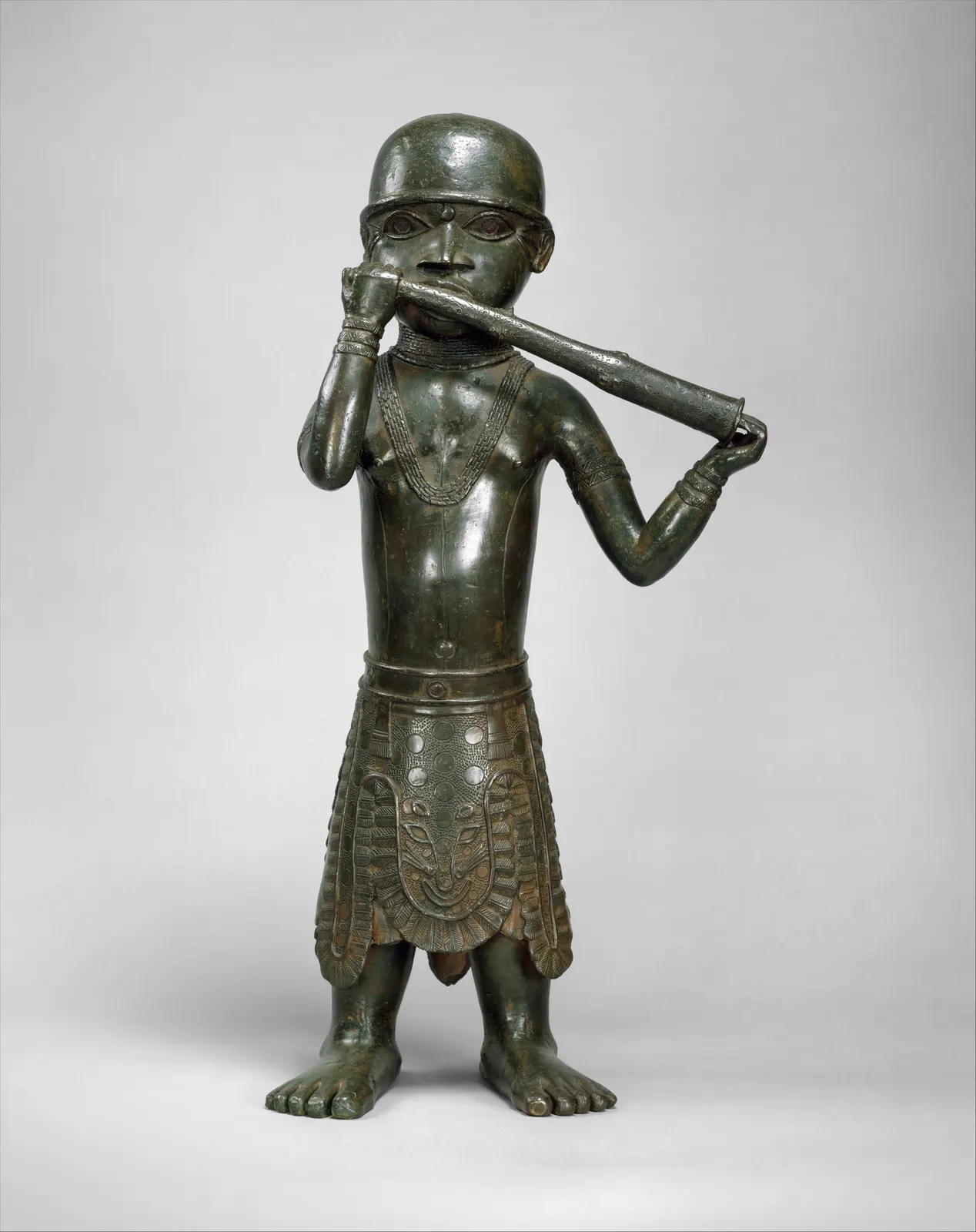
A horn player, cast in brass by the casters’ guild, 1550 to 1680. Photo: The Metropolitan Museum of Art, CC0, via The Met Open Access.
The questionWho made the Benin brasses, and how?
Most of the famous “Benin Bronzes” were made by one guild of casters, working for the Oba, in one quarter of Benin City. The guild is still there. This chapter is about them and how they work.
Fits: Primary (KS2). See Courses.
One guild, one quarter
In Benin each craft that served the Oba was a guild. The guilds were organised into quarters of the city, kept to their standards, and stopped outsiders taking up their trade.1 The brass casters’ guild is Igun-Ẹrọnmwọn. Its members come only from the families of Igun quarter descended from the Ineh and Osa families, and its head is the Ine n’Igun-Ẹrọnmwọn.1 Oba Esigie made the guild’s two senior chiefs members of the Uzama n’Ibie, a rank of chiefs.1 Skills are still passed from father to son.3
Benin’s historians say a guild of brass casters was set up early in the reign of Oba Oguola, about 1280 to 1295, “for the preservation of records”.2 What they cast was a kind of history: heads of past kings, scenes of war and ceremony, the court and its visitors.
Where experts disagree: where did casting in Benin come from?
From Ife.The Benin people believe the craft came from Ife, to the north-west. They name the first head of the casters’ guild as Igueghae, said to have been sent from Ife.1
Older, and from Benin itself.The same history notes that Igueghae sounds more like an Edo name than a Yoruba one from Ife, and that the earliest metal objects remembered, the swords called ada and eben, go back to the second Ogiso king, long before.1
How a casting is made
The guild uses the lost-wax method, which the Benin plaques and heads were made by.4 In 1998 John Ihama, a caster of Igun Street, made a set of models for the Horniman Museum in London showing each stage. This is how the museum describes the method.3
- 1Clay core
Make a base of soft clay with the rough shapes on it, and let it harden.
- 2Wax
Model the picture in soft wax, mostly beeswax, on top, cutting the fine detail with wooden tools.
- 3Clay coat
Cover the wax with more clay, leaving a hole at the top, and bind the whole “parcel” with wire.
- 4Fire
Dry it, then put it in the furnace. The wax melts and runs out of the hole: this is the wax that is “lost”.
- 5Pour
Melt brass until it runs like liquid and pour it in to fill the space the wax left.
- 6Break
Let it cool, which can take up to a week, break off the clay, then clean and polish the brass.
Because the mould has to be broken to get the brass out, each mould is used only once.3
Heads for the altars
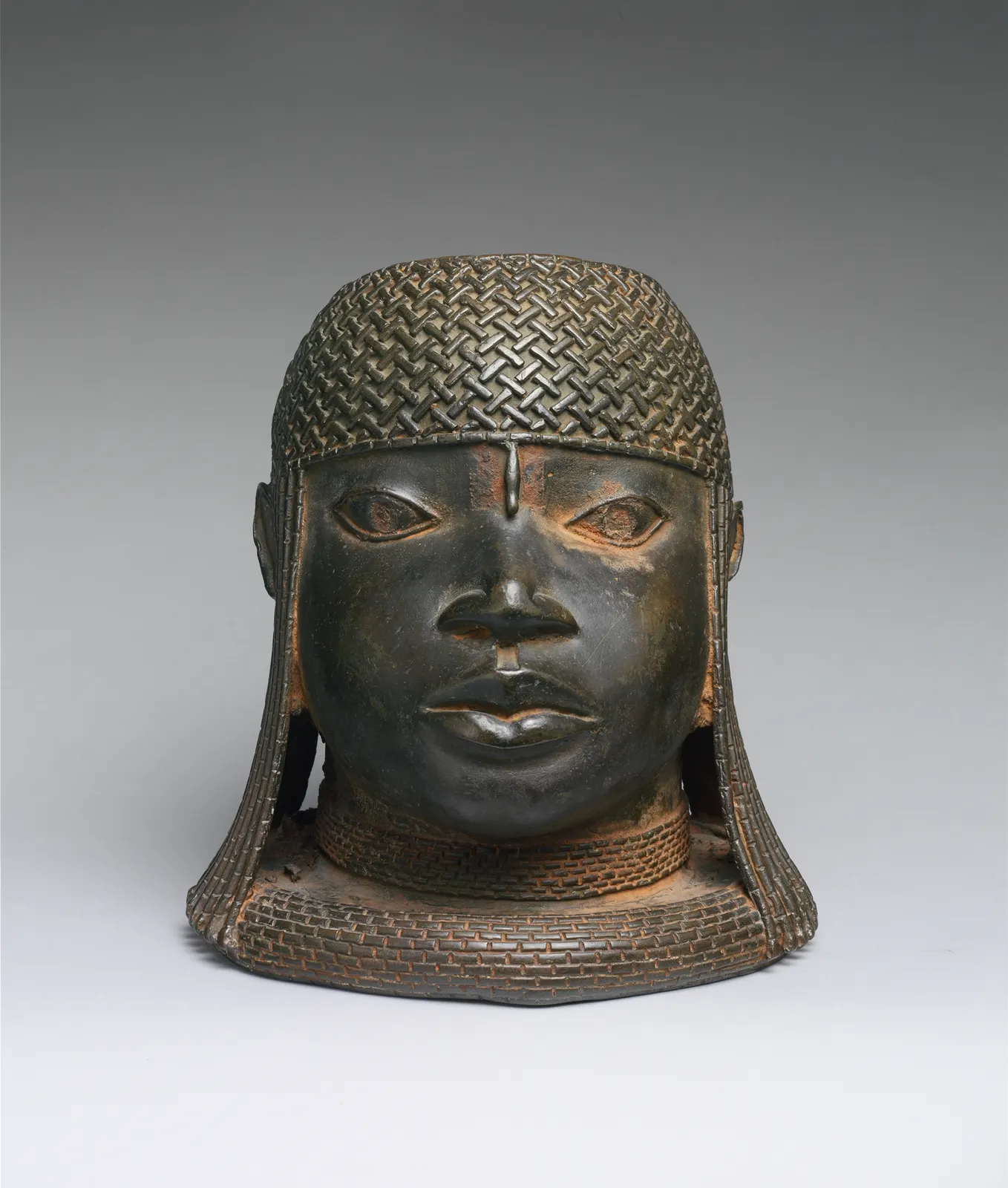
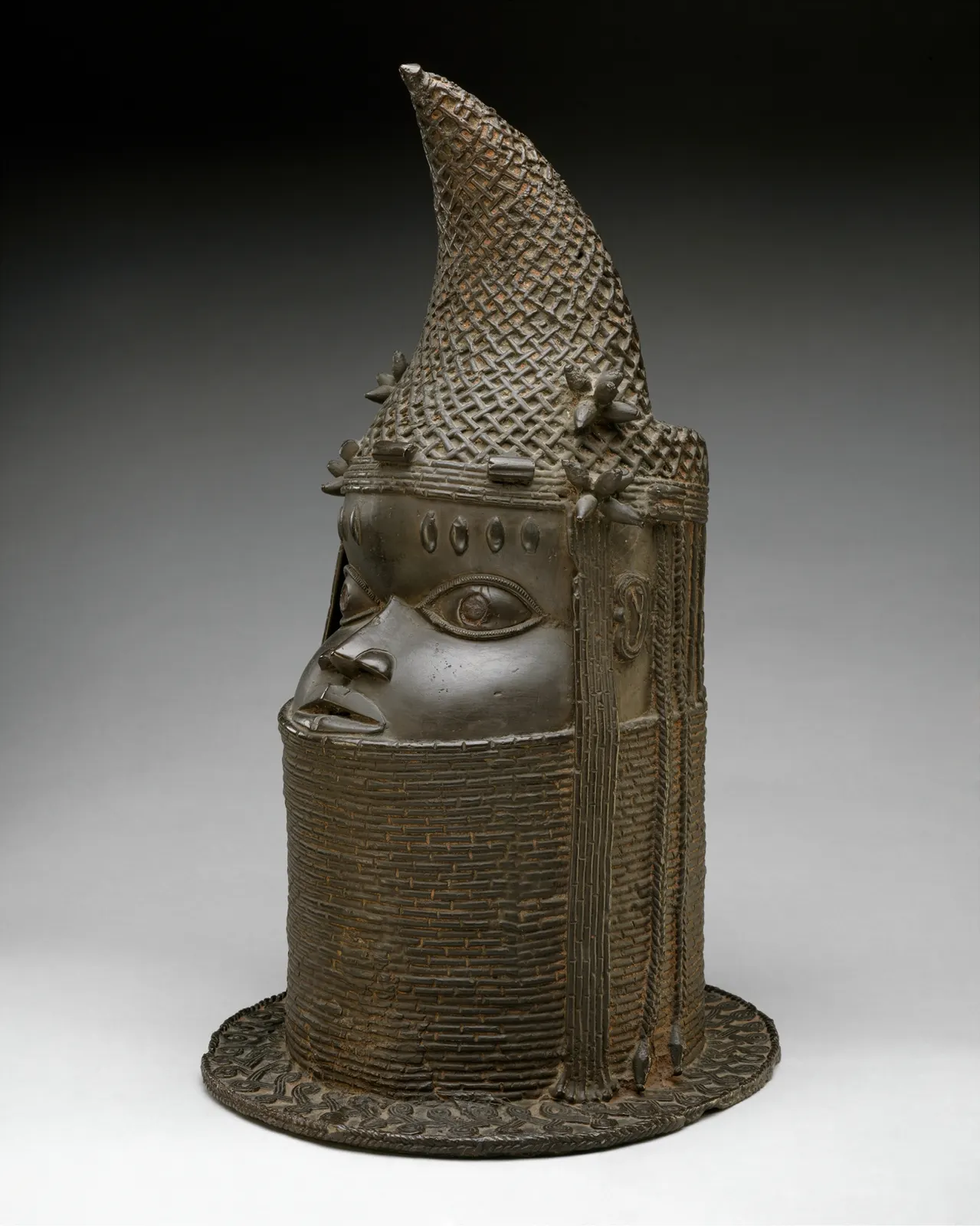
Some of the guild’s most important work was for the royal altars, where past Obas were remembered. Heads cast in brass, ùhúnmwèlaò in Edo, stood on them.6,7 When British forces took Benin City in 1897, photographs show the altars stripped bare and long rows of these heads laid out on the ground. In the palace they could only have come from the royal altars.5
Most of these objects are brass, which is copper mixed with zinc, not bronze. The name “Benin Bronzes” was given to them after they reached Europe, partly to make them sound more valuable.4,5
Key words
- Guild
- A group of people who do the same craft, who train new members and protect the craft’s standards.
- Brass
- A metal made of copper mixed with zinc. Most “Benin Bronzes” are brass, not bronze.
- Lost-wax casting
- Making a metal object by modelling it in wax, covering the wax in clay, melting the wax out, and pouring metal into the space.
- Mould
- A hollow shape that liquid metal is poured into, to set in that shape.
- Altar
- A place where offerings are made to gods or ancestors. Benin’s royal altars remembered past Obas.
Check yourself
Try to answer in your head, then open each one.
What is the name of Benin’s brass casters’ guild?
Igun-Ẹrọnmwọn.
Why is the method called “lost wax”?
The wax model melts and runs out of the mould in the fire, so it is lost, and brass takes its place.
Who could join the guild?
Only members of the families of Igun quarter descended from its founding families.
Why are “Benin Bronzes” not really bronze?
Most are brass, copper mixed with zinc, not bronze, copper mixed with tin.
Go deeper
- The plaques and the Portuguese where the brass came from, and the palace plaques
- Bronze for the ancestors another kingdom that cast metal for its ancestors
Sources for this page
Every number on this page comes from one of these. How we check.
Last reviewed 12 November 2026. Spotted a mistake? Tell us.
- Digital Benin (2020–2026), hosted by MARKK Hamburg; principal investigators K. Agbontaen-Eghafona, F. Bodenstein, J. Fine, A. Luther and B. Plankensteiner. Itan Edo: Guilds. Drawing on Egharevba (1949), Eweka (1992), Inneh (2007) and Agbontaen-Eghafona (2018). digitalbenin.org/itan-edo/guildsUsed for: The brass casters’ guild (Igun-Ẹrọnmwọn), the ivory and wood carvers (Igbesanmwan), the Iwoki guild, and how the Oba oversaw the guilds. Checked 12 November 2026.
- Digital Benin (2020–2026), hosted by MARKK Hamburg; principal investigators K. Agbontaen-Eghafona, F. Bodenstein, J. Fine, A. Luther and B. Plankensteiner. Itan Edo: Kings. Drawing on Agbontaen-Eghafona (2018), Osadolor (2018) and Egharevba (1968), A Short History of Benin. digitalbenin.org/itan-edo/kingsUsed for: The Ogiso and Oba dynasties and their dates; Evian; Oranmiyan; Oguola and the casting guild; Ewuare I; Ozolua and the first Portuguese visit; Esigie; Ovonramwen’s exile; Eweka II, Akenzua II, Erediauwa and Ewuare II. Checked 12 November 2026.
- Horniman Museum and Gardens, London. Plaque; casting; stage of manufacture. Wax model made by the brass caster John Ihama of Igun Street, Benin City, in 1998, one of a series showing the lost-wax process. Object record HC.1999.938.4. www.horniman.ac.uk/object/HC.1999.938.4Used for: The steps of lost-wax casting as done on Igun Street, and that casting is taught from father to son. Checked 12 November 2026.
- Digital Benin (2020–2026), hosted by MARKK Hamburg; principal investigators K. Agbontaen-Eghafona, F. Bodenstein, J. Fine, A. Luther and B. Plankensteiner. Catalogue record for a brass plaque, British Museum Af1898,0115.18, with the museum’s curatorial notes (citing Gunsch, K. (2018). The Benin Plaques: A 16th Century Imperial Monument. London: Routledge) and its provenance events. digitalbenin.org/catalogue/Af1898011518Used for: What the plaques are made of, how they were cast, that they were fixed in pairs to the palace pillars, and the dating to the 16th and 17th centuries. Checked 12 November 2026.
- Digital Benin (2020–2026), hosted by MARKK Hamburg; principal investigators K. Agbontaen-Eghafona, F. Bodenstein, J. Fine, A. Luther and B. Plankensteiner. Provenance contexts: “Looting of the Ọba’s Palace”, “Looting of the Benin Ama-Ẹrọnmwọn (Brass Plaques)”, “Destruction of the Palatial Compound”, “Benin-Portuguese Ivories”, “Diplomatic Gifts”. digitalbenin.org/provenance/contextsUsed for: The invasion of February 1897, the looting and the fire; how the plaques were found, shipped and sold; the Benin-Portuguese ivories. Checked 12 November 2026.
- The Metropolitan Museum of Art. Ùhúnmwèlaò (head of an ọ́bà). Edo peoples, Ìgùn Ẹ́rọ̀nmwọ̀n artists, early 15th–mid-16th century. Collection record 312290, Open Access (CC0). www.metmuseum.org/art/collection/search/312290Used for: A brass commemorative head of a king, 23.5 cm high. Checked 12 November 2026.
- The Metropolitan Museum of Art. Ùhúnmwèlaò ọ́ghé iyọ́bà (head of a queen mother). Edo peoples, Ìgùn Ẹ́rọ̀nmwọ̀n artists, 18th–19th century. Collection record 316614, Open Access (CC0). www.metmuseum.org/art/collection/search/316614Used for: A brass commemorative head of a queen mother, 53.3 cm high. Checked 12 November 2026.
- The Metropolitan Museum of Art. Horn player. Edo peoples, Ìgùn Ẹ́rọ̀nmwọ̀n artists, 1550–1680. Collection record 310753, Open Access (CC0). www.metmuseum.org/art/collection/search/310753Used for: A brass figure of a horn player, 62.9 cm high. Checked 12 November 2026.