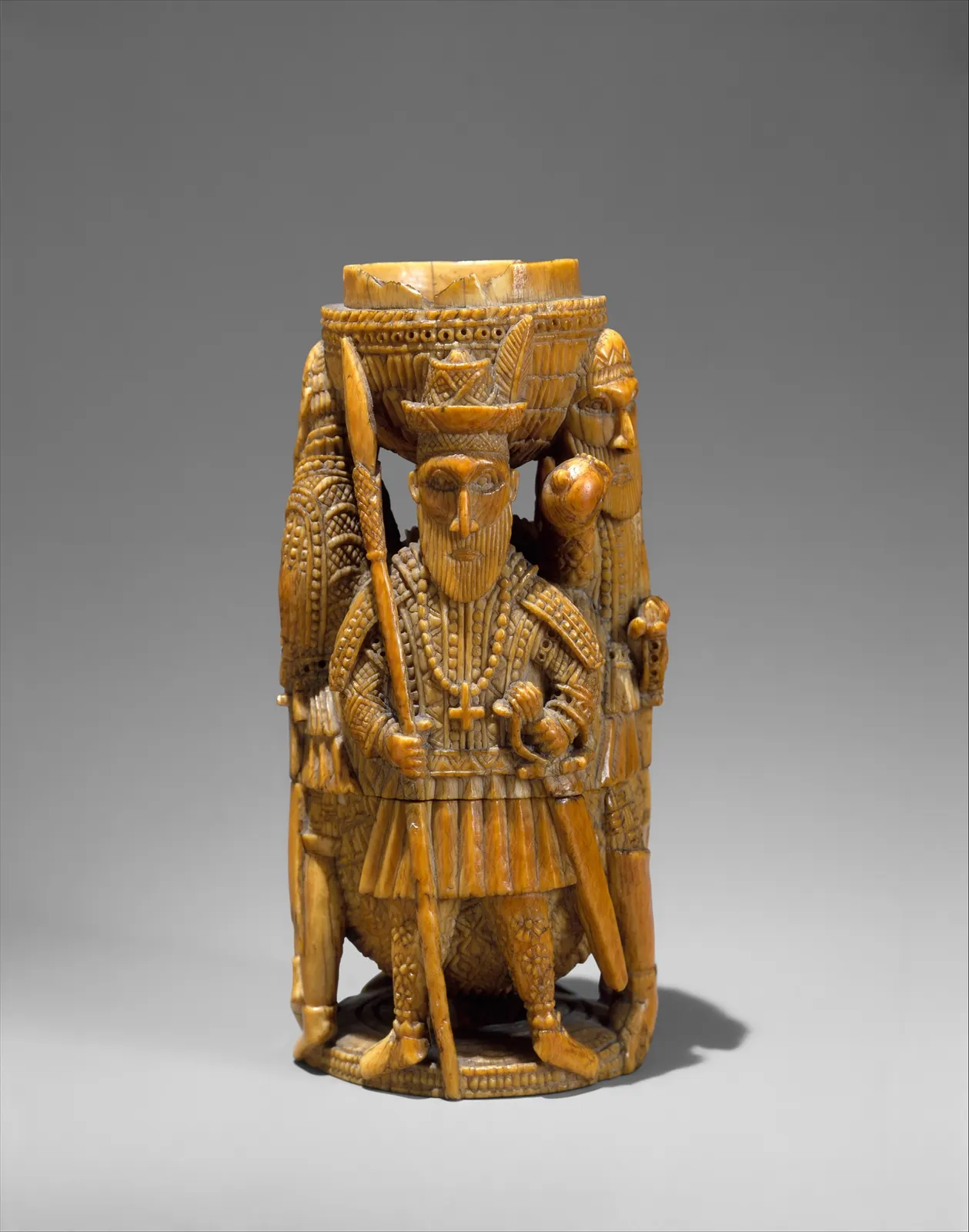
A carved ivory container on a stand of standing Portuguese men in hats, with a lid topped by a ship

OC 024

An ivory saltcellar with Portuguese figures

Carved in Benin for European buyers, not for the Oba. Ivories like this reached Europe in the 1500s by trade, long before 1897.1,2

Date
About 1525 to 1600IX · Oceans crossed
Place
Benin City, Nigeria
Type
Saltcellar · IvoryKingdom of Benin
Size
19.1 cm high
Made by
An ivory carver known as the Master of the Heraldic Ship
Held by
The Metropolitan Museum of Art, New YorkMuseum number 1972.63a, b
Image
The Metropolitan Museum of Art, CC0, via The Met Open Access
Appears in

Where it sits in human time

Made about 460 years ago. On this strip, each step to the right is ten times closer to today.

300,000 years ago10,0003,0001,000100nowAn ivory saltcellar with Portuguese figures

Sources for this page

Every number on this page comes from one of these. How we check.

Last reviewed 12 November 2026. Spotted a mistake? Tell us.

  1. The Metropolitan Museum of Art. Saltcellar with Portuguese figures. Edo peoples, “Master of the Heraldic Ship”, ca. 1525–1600. Collection record 309900, Open Access (CC0). www.metmuseum.org/art/collection/search/309900Used for: An ivory saltcellar carved with Portuguese figures, 19.1 cm high. Checked 12 November 2026.
  2. Digital Benin (2020–2026), hosted by MARKK Hamburg; principal investigators K. Agbontaen-Eghafona, F. Bodenstein, J. Fine, A. Luther and B. Plankensteiner. Provenance contexts: “Looting of the Ọba’s Palace”, “Looting of the Benin Ama-Ẹrọnmwọn (Brass Plaques)”, “Destruction of the Palatial Compound”, “Benin-Portuguese Ivories”, “Diplomatic Gifts”. digitalbenin.org/provenance/contextsUsed for: The invasion of February 1897, the looting and the fire; how the plaques were found, shipped and sold; the Benin-Portuguese ivories. Checked 12 November 2026.