Chapter One
Kings of the sky
The Ogiso kings, then the Oba dynasty from about 1170
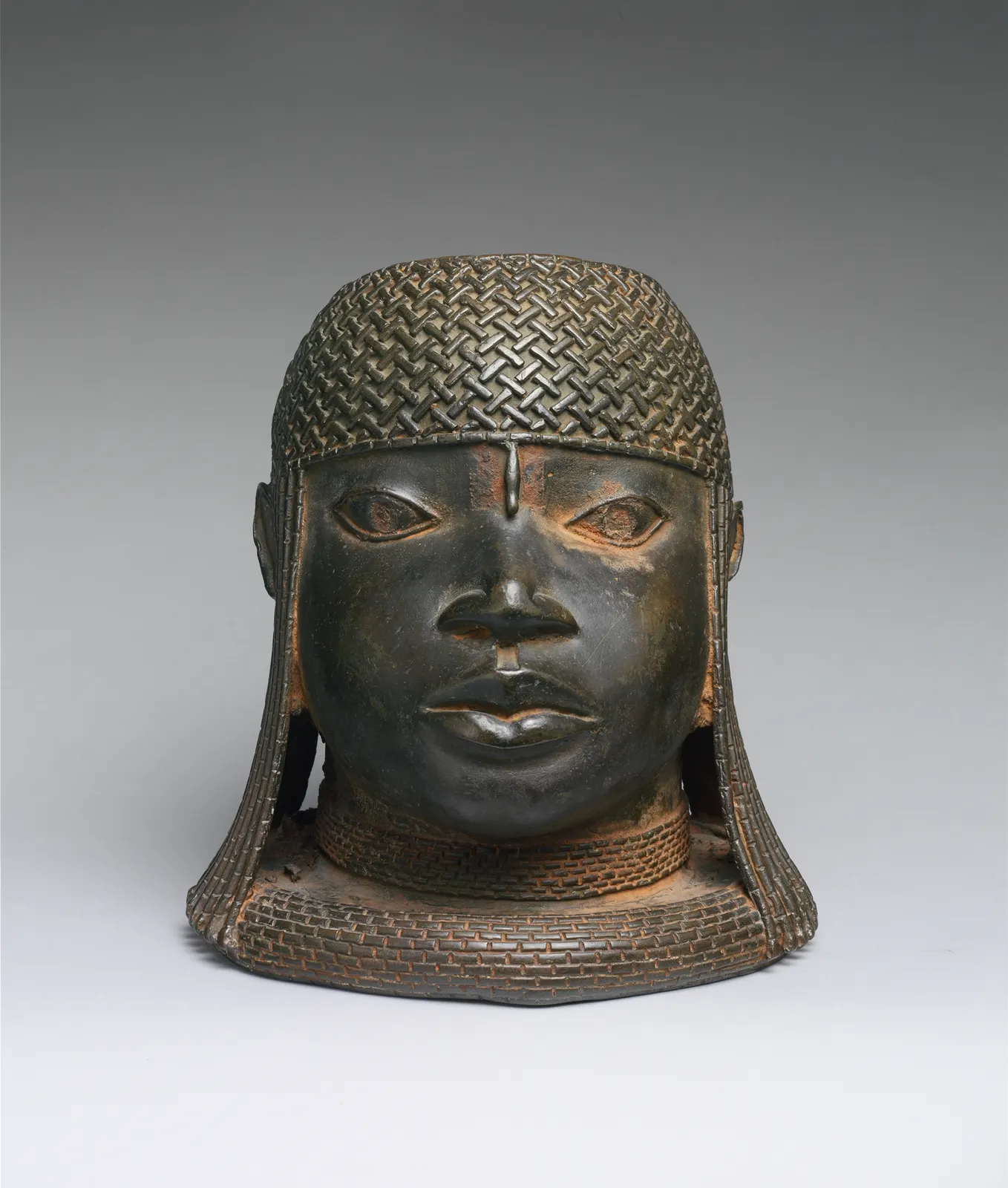
A brass head made to remember a past Oba on a royal altar, early 1400s to mid-1500s. Photo: The Metropolitan Museum of Art, CC0, via The Met Open Access.
The questionWho ruled Benin before the Obas, and how did the kingdom change hands?
Before the Obas, Benin had another line of kings, the Ogiso. Their story was kept by Benin’s historians and chiefs, and it explains things you can still see in Benin City today: the titles of its chiefs, its guilds, and the king at its centre.
Fits: Primary (KS2). See Courses.
A history kept by its own people
Benin did not write its history down in books until modern times. It was kept by people: chiefs, royal chroniclers and families, who told it to the next generation. Ogiso Ere is even said to have created a group of royal chroniclers, the Ughoron.1 In the 20th century Benin historians wrote these histories down, and the Digital Benin project has gathered them together. This chapter follows them.
From the Ogiso to the Obas
- About 40 BCThe first Ogiso
Igodo, head of the elders of his village, rises to lead a wider land. People say of him that he is “like the king in the sky”, Ogie ne ọ rre Iso, which becomes the title Ogiso.1
- AD 16 to 66A palace and a court
Ogiso Ere moves the royal seat, sets up guilds of iron workers, woodworkers and weavers, and brings in the swords of authority, the ada and the eben.1
- About 1059 to 1100The last Ogiso
Owodo, the thirty-first Ogiso, fails his people after a famine and orders the death of his own son, Ekaladerhan. The people banish him.1
- About 1100 to 1170No king
The people appoint Evian, a brave man from the Ihogbe family, to run the land. When he tries to make the rule his own, the elders refuse him.1
- About 1170A new line
Benin elders ask Oduduwa, at Uhe (Ife), for a ruler. His son Oranmiyan comes and becomes the first Oba, but decides only a child born and raised in Benin can rule it.1
- About 1200Oba Eweka I
Oranmiyan’s son by a Benin princess is crowned Eweka I. He makes the titles of the senior chiefs, the Uzama, hereditary.1
Dates for the Ogiso come from counting back through the reigns in the oral histories. Some Ogiso are remembered as living to over a hundred, so treat the early dates as Benin’s own reckoning, not as measurements.1
Benin about 1300
By the time of Oba Oguola, about 1280 to 1295, the new dynasty was settled. Oguola had trenches dug around the city to keep enemies out, and won a battle against a powerful rival, Akpanigiakon of Udo, around 1285.1 In his reign a guild of brass casters was set up, according to Benin’s historian Jacob Egharevba, “for the preservation of records”: its work would remember the kings and their deeds.1 The guilds were, and are, a great part of the city’s life.2
About 150 years later, Oba Ewuare I, a warrior king, turned the kingdom into an empire. He had moats dug around the palace and city, divided the city into the palace and the town, and organised the guilds of brass casters and builders.1
Key words
- Ogiso
- The title of Benin’s first line of kings. It comes from words meaning “king in the sky”.
- Oba
- The title of Benin’s kings from about 1170 to today.
- Dynasty
- A line of rulers from the same family.
- Interregnum
- A time between two reigns with no king.
- Oral history
- History passed on by people telling it, generation after generation, rather than writing it down.
- Uzama
- Benin’s most senior chiefs, whose titles pass from father to son.
Check yourself
Try to answer in your head, then open each one.
What were Benin’s two lines of kings called?
The Ogiso, then the Obas.
Who ran Benin between the last Ogiso and the first Oba?
Evian, an administrator the people chose after they banished Ogiso Owodo.
Why did Oranmiyan leave Benin?
He said only a child born and brought up in Benin could rule its people, so he left his son, who became Eweka I.
Name one thing Oba Oguola is remembered for.
Digging moats around the city, or setting up a guild of brass casters to keep records.
Go deeper
- The casters’ guild the brass heads and who made them
- People of Benin the kings and queens named here
Sources for this page
Every number on this page comes from one of these. How we check.
Last reviewed 12 November 2026. Spotted a mistake? Tell us.
- Digital Benin (2020–2026), hosted by MARKK Hamburg; principal investigators K. Agbontaen-Eghafona, F. Bodenstein, J. Fine, A. Luther and B. Plankensteiner. Itan Edo: Kings. Drawing on Agbontaen-Eghafona (2018), Osadolor (2018) and Egharevba (1968), A Short History of Benin. digitalbenin.org/itan-edo/kingsUsed for: The Ogiso and Oba dynasties and their dates; Evian; Oranmiyan; Oguola and the casting guild; Ewuare I; Ozolua and the first Portuguese visit; Esigie; Ovonramwen’s exile; Eweka II, Akenzua II, Erediauwa and Ewuare II. Checked 12 November 2026.
- Digital Benin (2020–2026), hosted by MARKK Hamburg; principal investigators K. Agbontaen-Eghafona, F. Bodenstein, J. Fine, A. Luther and B. Plankensteiner. Itan Edo: Guilds. Drawing on Egharevba (1949), Eweka (1992), Inneh (2007) and Agbontaen-Eghafona (2018). digitalbenin.org/itan-edo/guildsUsed for: The brass casters’ guild (Igun-Ẹrọnmwọn), the ivory and wood carvers (Igbesanmwan), the Iwoki guild, and how the Oba oversaw the guilds. Checked 12 November 2026.
- Digital Benin (2020–2026), hosted by MARKK Hamburg; principal investigators K. Agbontaen-Eghafona, F. Bodenstein, J. Fine, A. Luther and B. Plankensteiner. Itan Edo: the history of Benin from an indigenous perspective, using Benin-authored sources. digitalbenin.org/itan-edoUsed for: The palace societies and chiefs, and how the Oba governed with them. Checked 12 November 2026.
- The Metropolitan Museum of Art. Ùhúnmwèlaò (head of an ọ́bà). Edo peoples, Ìgùn Ẹ́rọ̀nmwọ̀n artists, early 15th–mid-16th century. Collection record 312290, Open Access (CC0). www.metmuseum.org/art/collection/search/312290Used for: A brass commemorative head of a king, 23.5 cm high. Checked 12 November 2026.