Chapter Three
The plaques and the Portuguese
From 1485 to about 1650
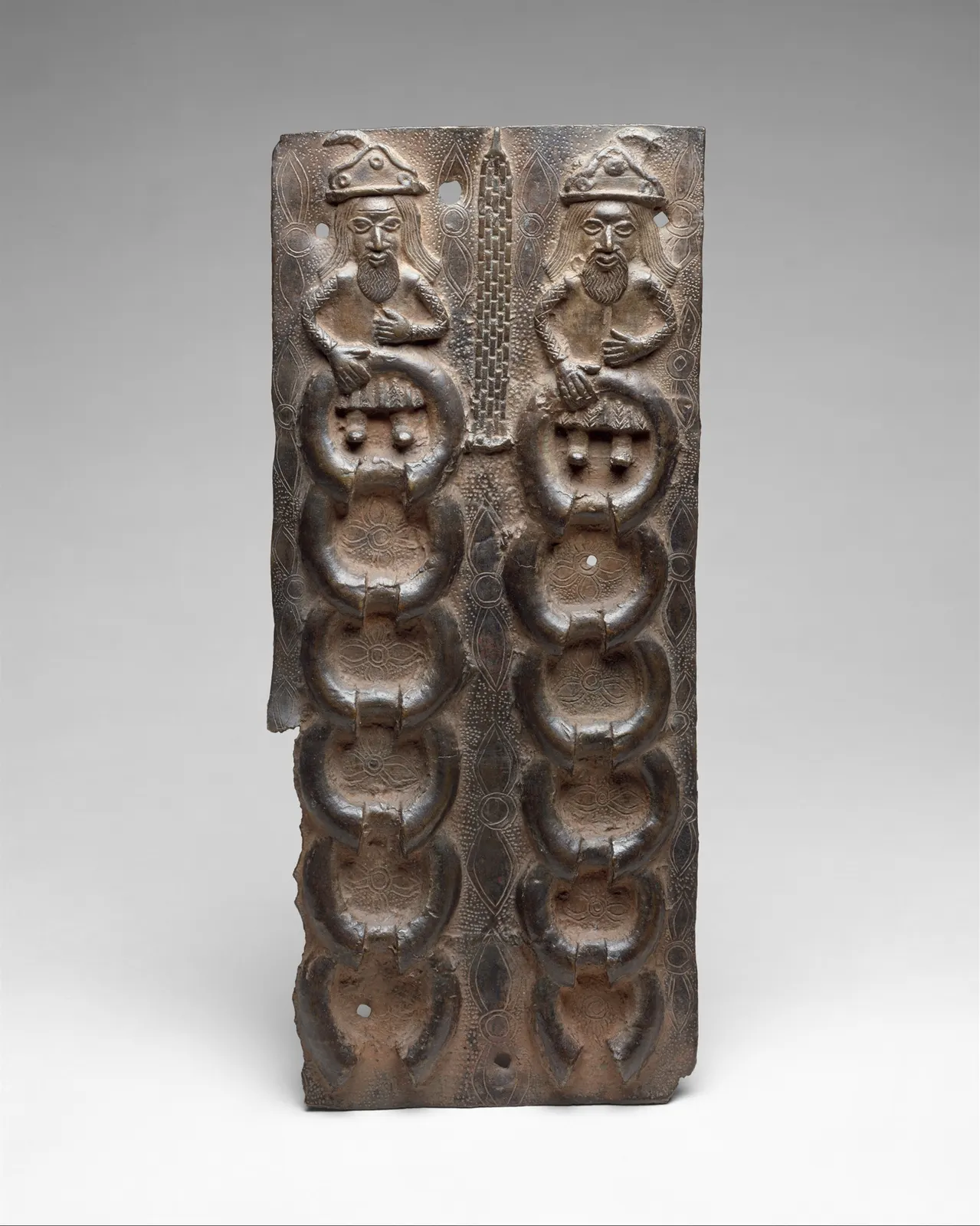
Portuguese traders with manillas, rings of brass, on a palace plaque made about 1540 to 1570. Photo: The Metropolitan Museum of Art, CC0, via The Met Open Access.
The questionWhat happened when Portuguese ships reached Benin, and what did Benin’s artists make of them?
In the 1480s Portuguese ships reached the coast of West Africa and an envoy came to Benin City. The meeting changed both sides: Benin gained trade, guns and new allies, and its artists began to show the strangers with long hair and hats on the brass plaques of the palace.
Fits: Primary (KS2). See Courses.
A visitor and an ambassador
In 1485 to 1486, in the reign of Oba Ozolua the Conqueror, a Portuguese explorer, João Afonso de Aveiro, came to Benin. Benin remembers him for bringing the first gun and the first coconuts.1
Under the next Oba, Esigie, about 1504 to 1550, the two kingdoms grew close. Esigie accepted Christianity and is said to have spoken and read Portuguese; Portuguese missionaries built churches in the city. He sent the Ohen-Olokun, the priest of Olokun from Ughoton, to Portugal as Benin’s first ambassador, and the two kings exchanged gifts: a copper stool from Portugal, and in 1540 a crucifix from Benin.1
Esigie also set up a guild, the Iwoki, which is believed to have included two Portuguese men, Ava and Uti, who fought beside him in the war with Idah, and Edo people who had learned to read and write and to steer by the stars while enslaved in Portugal. They looked after the Portuguese cannons in Benin City. At Ugie festivals, Ava and Uti stand as ceremonial guards.2
Trade grew alongside. Brass, coral and guns were among the goods exchanged between Benin and the Portuguese.3 Coral beads made the Oba’s regalia,4 and brass was the metal of the casters’ guild.
Pictures on the palace pillars
The Oba’s palace was built around courtyards, some with galleries whose roofs stood on wooden pillars. Brass plaques, probably made in matching pairs, were fixed to those pillars. Some show wars and victories, others ceremonies and life at court.5 Here are six, set two columns wide as they might have been on two pillars.
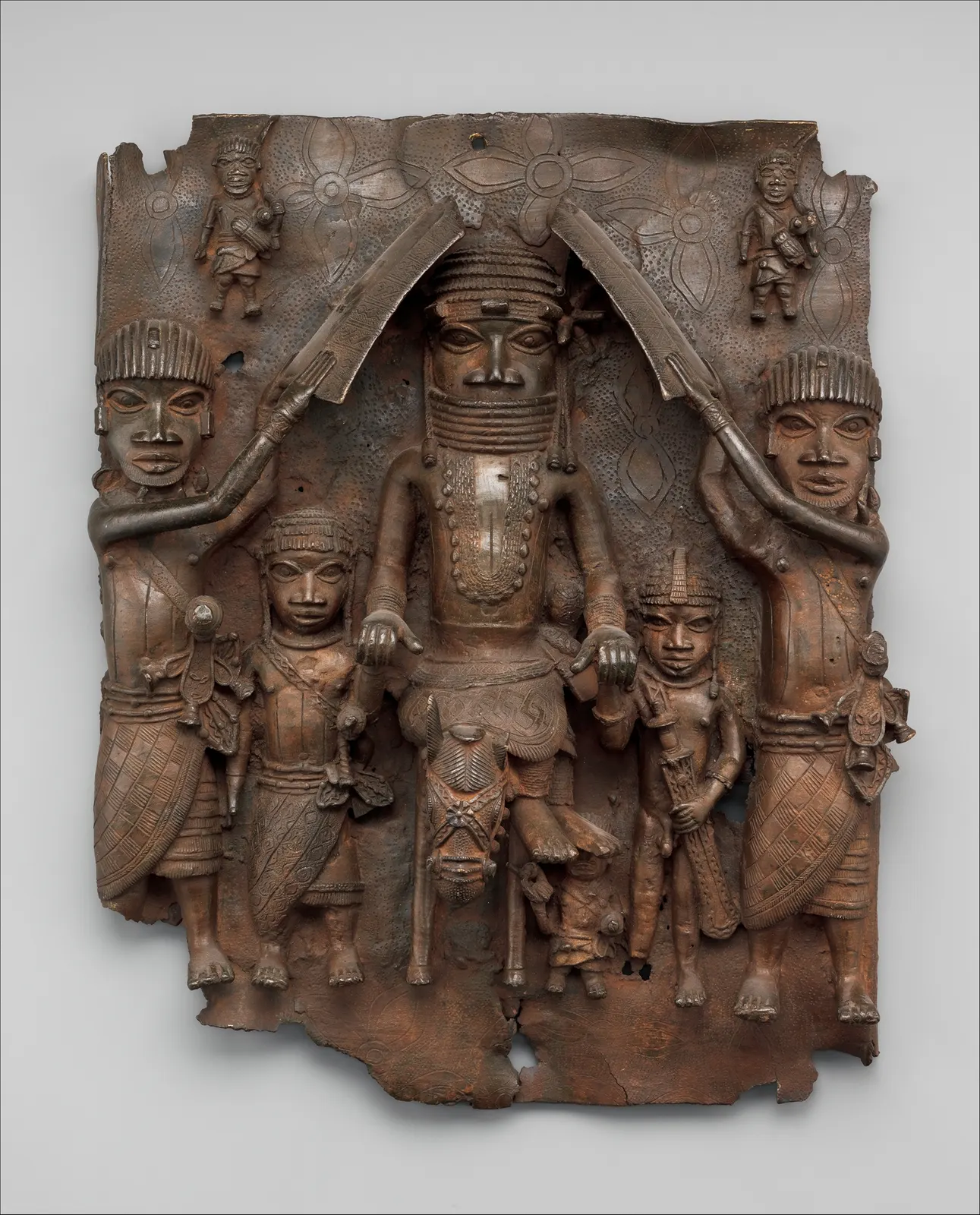
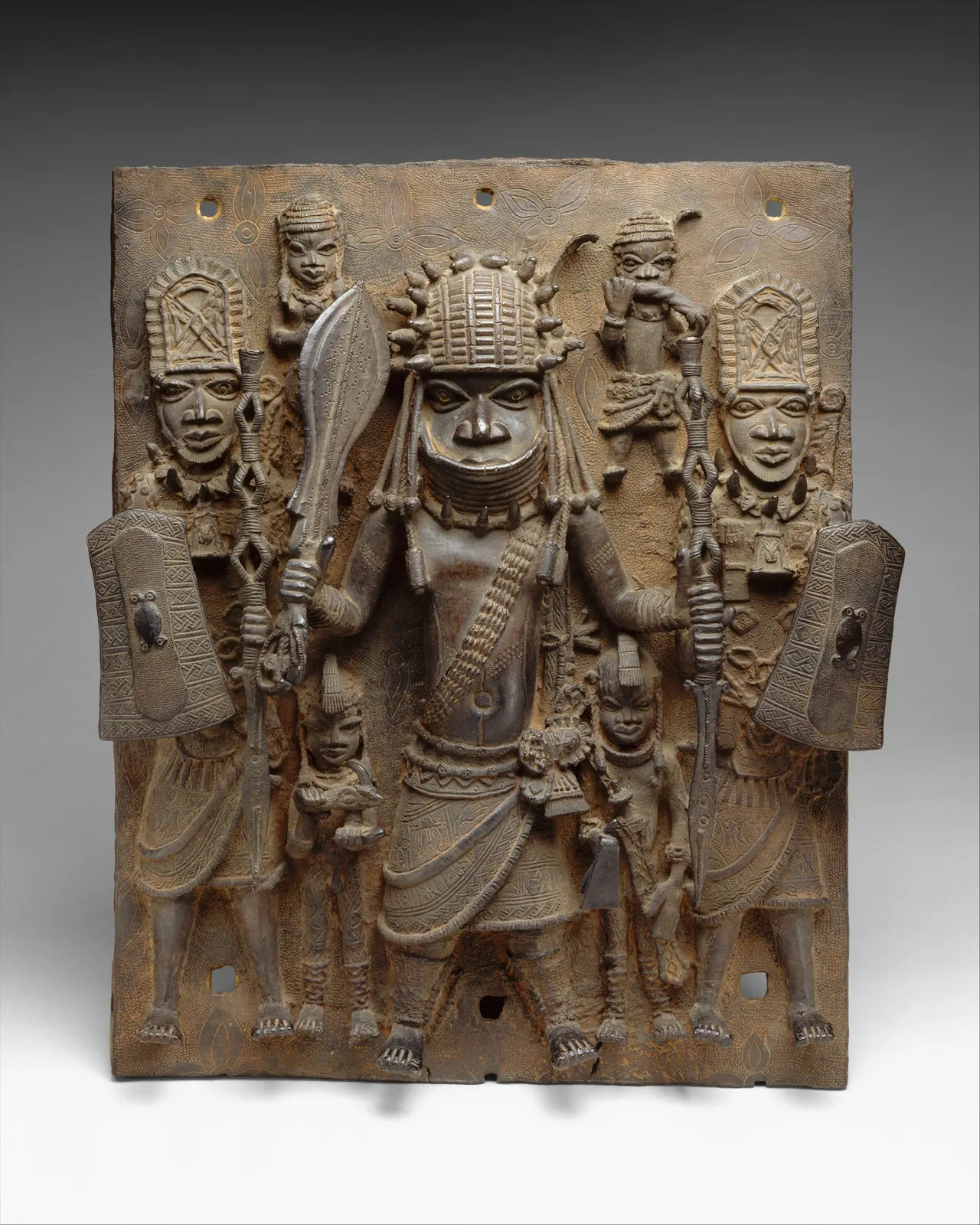
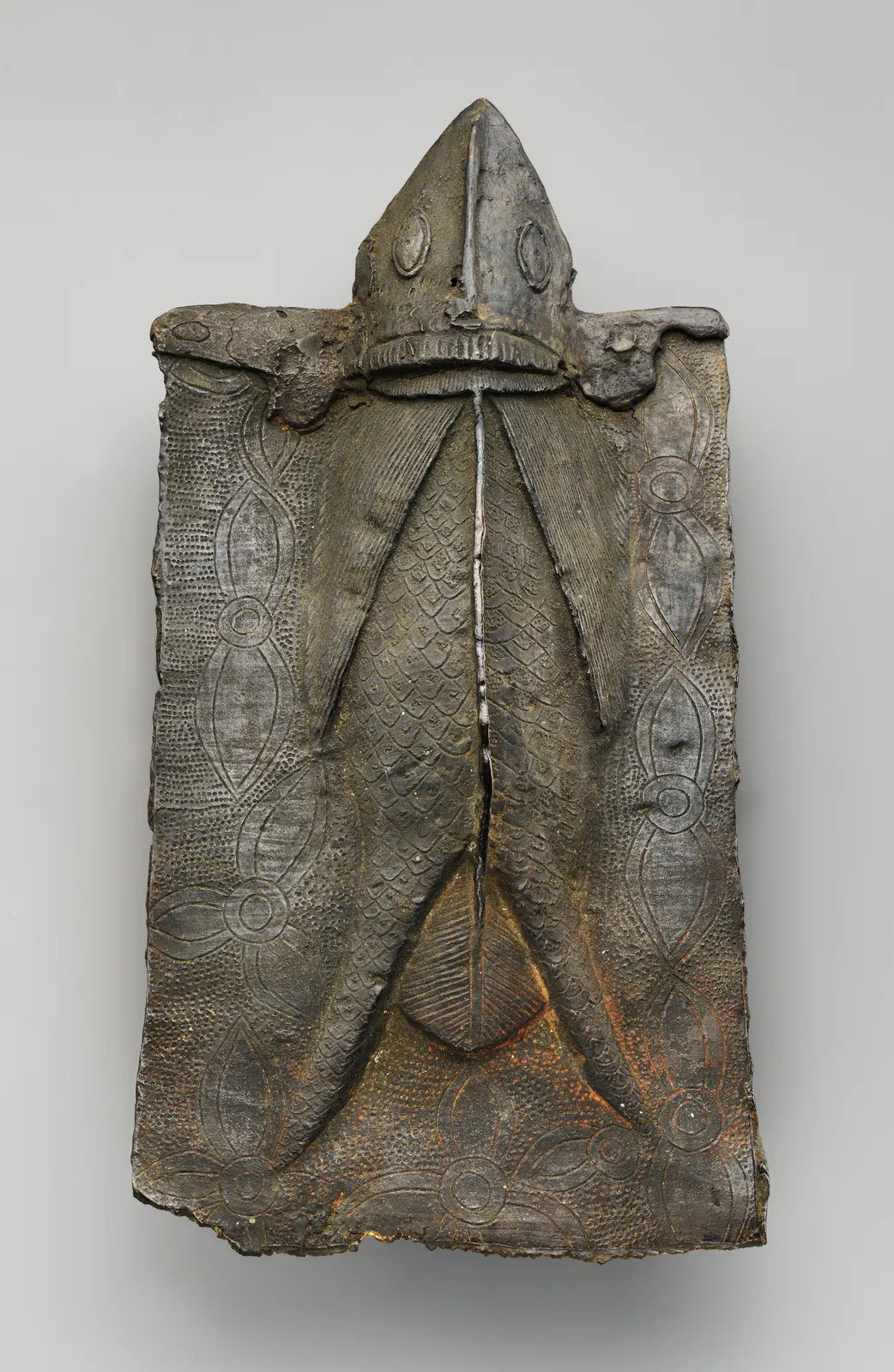
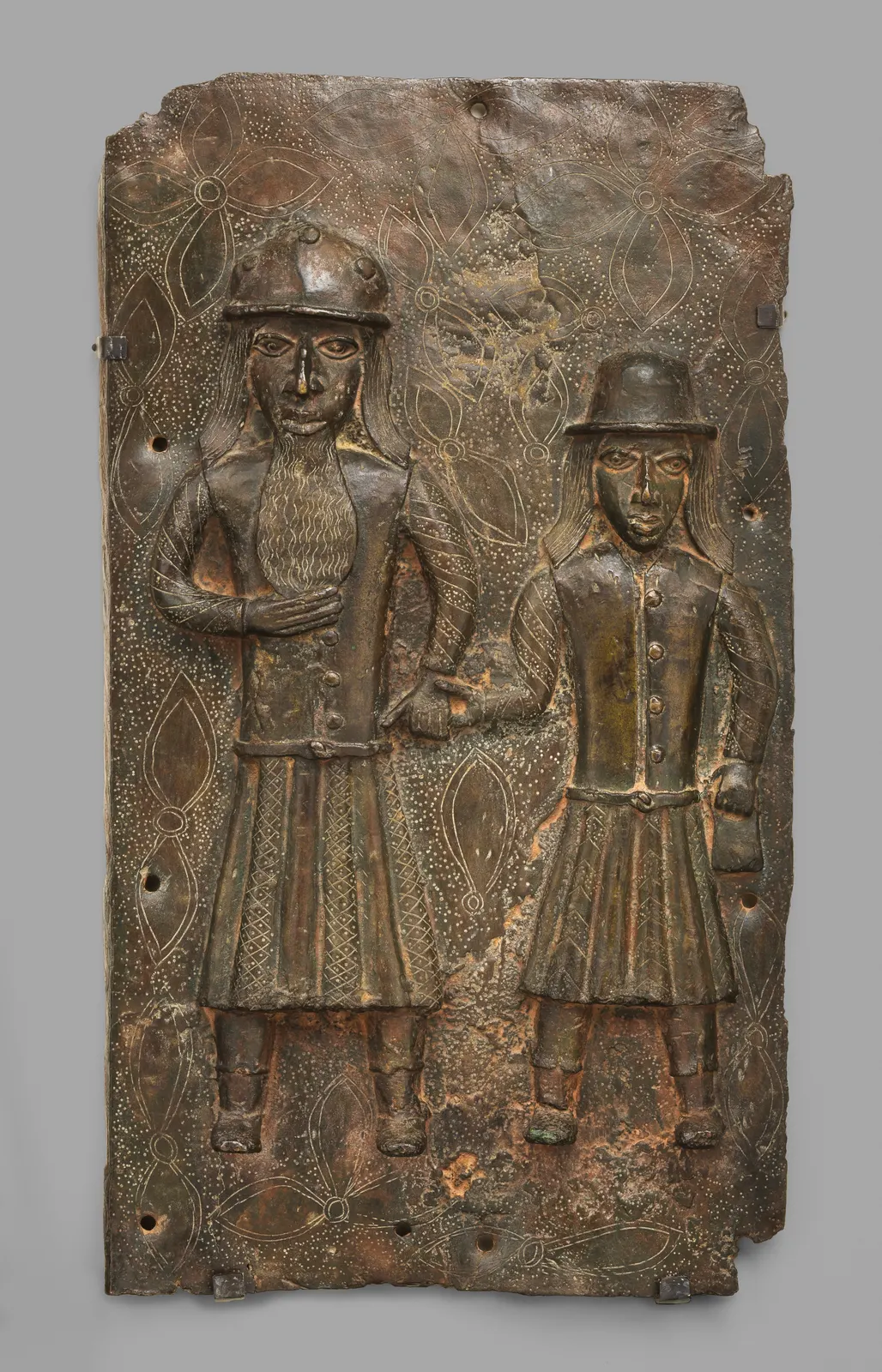
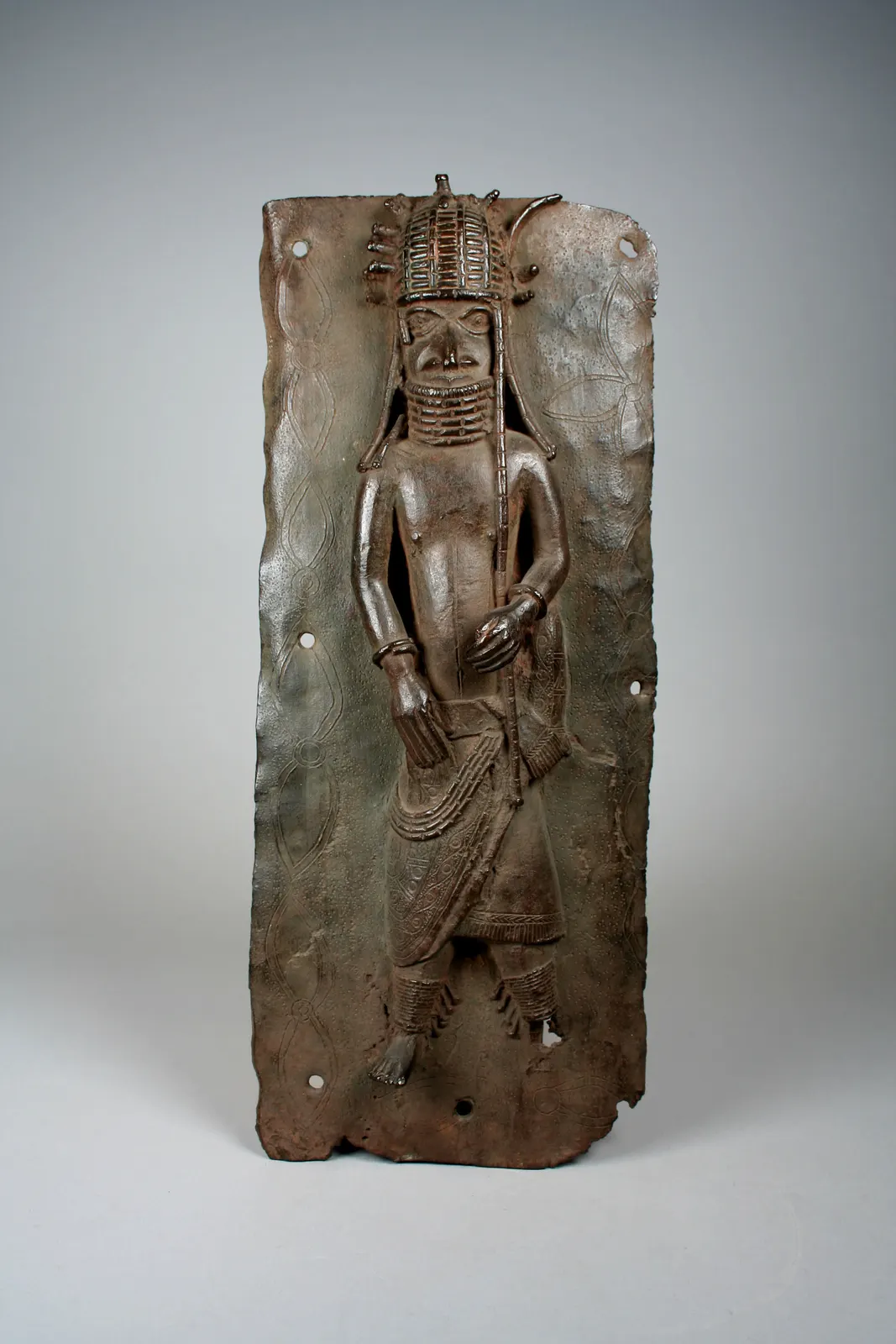
Look at the Portuguese figures. Benin’s casters showed them with long hair, beards and hats, sometimes as small heads in the corners of a plaque about someone else.5 On the plaque of the king on horseback, the Oba is shown far larger than everyone around him. Why might the caster have done that?
Where experts disagree: when were the plaques made?
In one generation, about 1540 to 1570.The Metropolitan Museum of Art dates its plaques, from the king on horseback to the Portuguese traders, to about 1540 to 1570.7,8
Over a century or more.The British Museum’s curators, whose notes Digital Benin publishes, give the 16th and 17th centuries, the dating they call widely accepted, and point to small details of casting that help to date them.5
By 1897 the plaques were no longer on the pillars: the British found them stored in the Oba’s compound.6
Ivory for Europe
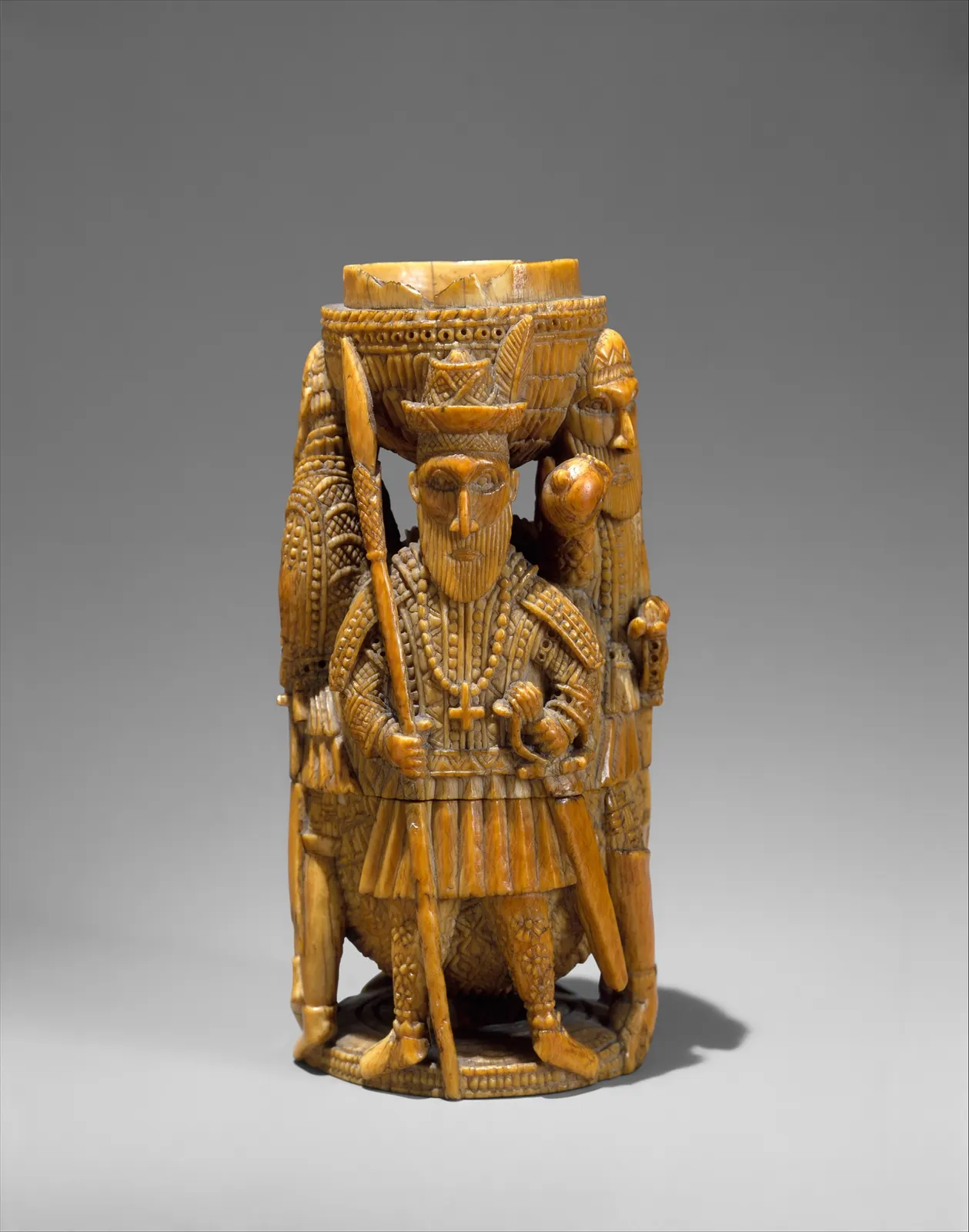
Not everything Benin’s artists made was for the Oba. Members of the ivory carvers’ guild, the Igbesanmwan, carved saltcellars, spoons and horns for European buyers, mixing Portuguese royal badges with Benin carving. These Benin-Portuguese ivories were traded to Europe in the 1400s and 1500s, so, unlike almost everything else from Benin in museums today, they were not looted in 1897.6
Key words
- Ambassador
- Someone sent by a ruler to speak for them in another country.
- Plaque
- A flat panel with a picture standing out from it. Benin’s were cast in brass and fixed to the palace pillars.
- Manilla
- A ring of brass or copper, open on one side, used in the West African trade.
- Relief
- A picture that stands out from a flat surface.
- Ivory
- The hard white material of elephants’ tusks, carved by Benin’s ivory guild.
Check yourself
Try to answer in your head, then open each one.
When did the first Portuguese visitor come to Benin, and what did he bring?
In 1485 to 1486, during Oba Ozolua’s reign. He brought the first gun and coconuts.
Who was Benin’s first ambassador to Portugal?
The Ohen-Olokun, the priest of Olokun, from Ughoton, sent by Oba Esigie.
Where did the brass plaques hang?
On the wooden pillars of galleries in the Oba’s palace, probably in matching pairs.
Who were the Benin-Portuguese ivories made for?
For European buyers, not for the Oba.
Go deeper
- 1897 and the long way home how the plaques left Benin
- The casters’ guild who cast the plaques, and how
Sources for this page
Every number on this page comes from one of these. How we check.
Last reviewed 12 November 2026. Spotted a mistake? Tell us.
- Digital Benin (2020–2026), hosted by MARKK Hamburg; principal investigators K. Agbontaen-Eghafona, F. Bodenstein, J. Fine, A. Luther and B. Plankensteiner. Itan Edo: Kings. Drawing on Agbontaen-Eghafona (2018), Osadolor (2018) and Egharevba (1968), A Short History of Benin. digitalbenin.org/itan-edo/kingsUsed for: The Ogiso and Oba dynasties and their dates; Evian; Oranmiyan; Oguola and the casting guild; Ewuare I; Ozolua and the first Portuguese visit; Esigie; Ovonramwen’s exile; Eweka II, Akenzua II, Erediauwa and Ewuare II. Checked 12 November 2026.
- Digital Benin (2020–2026), hosted by MARKK Hamburg; principal investigators K. Agbontaen-Eghafona, F. Bodenstein, J. Fine, A. Luther and B. Plankensteiner. Itan Edo: Guilds. Drawing on Egharevba (1949), Eweka (1992), Inneh (2007) and Agbontaen-Eghafona (2018). digitalbenin.org/itan-edo/guildsUsed for: The brass casters’ guild (Igun-Ẹrọnmwọn), the ivory and wood carvers (Igbesanmwan), the Iwoki guild, and how the Oba oversaw the guilds. Checked 12 November 2026.
- Metzig, G. M. (2016). Corals, brass and firearms: material commodities in cultural interactions between Edo and Portuguese in Benin around 1500. In Material Culture in Modern Diplomacy from the 15th to the 20th Century, pp. 29–54. Berlin: De Gruyter. doi.org/10.1515/9783110463217-002Used for: Brass, coral and guns as goods in the trade between Benin and Portugal around 1500. Checked 12 November 2026.
- Digital Benin (2020–2026), hosted by MARKK Hamburg; principal investigators K. Agbontaen-Eghafona, F. Bodenstein, J. Fine, A. Luther and B. Plankensteiner. Provenance contexts: “The Reinstatement of Cultural Practices and Early Requests for Returns”, “Post-Independence Appeals for Returns”, “Activism and the Restitution and Call for Return”, “Joint Declaration on the Return of Benin Bronzes”, “Gazette Declaring the Ọba of Benin’s Ownership”. digitalbenin.org/provenance/contextsUsed for: Requests for return from 1914 onwards, the 1938 return of regalia, FESTAC ’77, the 1997 centenary, the 2022 Joint Declaration and the 2023 gazette. Checked 12 November 2026.
- Digital Benin (2020–2026), hosted by MARKK Hamburg; principal investigators K. Agbontaen-Eghafona, F. Bodenstein, J. Fine, A. Luther and B. Plankensteiner. Catalogue record for a brass plaque, British Museum Af1898,0115.18, with the museum’s curatorial notes (citing Gunsch, K. (2018). The Benin Plaques: A 16th Century Imperial Monument. London: Routledge) and its provenance events. digitalbenin.org/catalogue/Af1898011518Used for: What the plaques are made of, how they were cast, that they were fixed in pairs to the palace pillars, and the dating to the 16th and 17th centuries. Checked 12 November 2026.
- Digital Benin (2020–2026), hosted by MARKK Hamburg; principal investigators K. Agbontaen-Eghafona, F. Bodenstein, J. Fine, A. Luther and B. Plankensteiner. Provenance contexts: “Looting of the Ọba’s Palace”, “Looting of the Benin Ama-Ẹrọnmwọn (Brass Plaques)”, “Destruction of the Palatial Compound”, “Benin-Portuguese Ivories”, “Diplomatic Gifts”. digitalbenin.org/provenance/contextsUsed for: The invasion of February 1897, the looting and the fire; how the plaques were found, shipped and sold; the Benin-Portuguese ivories. Checked 12 November 2026.
- The Metropolitan Museum of Art. Plaque with equestrian ọ́bà (king) and attendants. Edo peoples, Ìgùn Ẹ́rọ̀nmwọ̀n (brass-casting guild) artists, ca. 1540–70. Collection record 310752, Open Access (CC0). www.metmuseum.org/art/collection/search/310752Used for: A brass plaque of a king on horseback, 49.5 cm high. Checked 12 November 2026.
- The Metropolitan Museum of Art. Plaque with Portuguese traders and manillas. Edo peoples, Ìgùn Ẹ́rọ̀nmwọ̀n artists, ca. 1540–70. Collection record 316486, Open Access (CC0). www.metmuseum.org/art/collection/search/316486Used for: A brass plaque of Portuguese traders holding manillas, 45.7 cm high. Checked 12 November 2026.
- The Metropolitan Museum of Art. Plaque with two Portuguese merchants. Edo peoples, Ìgùn Ẹ́rọ̀nmwọ̀n artists, ca. 1540–70. Collection record 316490, Open Access (CC0). www.metmuseum.org/art/collection/search/316490Used for: A brass plaque of two Portuguese merchants. Checked 12 November 2026.
- The Metropolitan Museum of Art. Plaque with warrior and attendants. Edo peoples, Ìgùn Ẹ́rọ̀nmwọ̀n artists, ca. 1540–70. Collection record 316393, Open Access (CC0). www.metmuseum.org/art/collection/search/316393Used for: A brass plaque of a warrior chief with attendants. Checked 12 November 2026.
- The Metropolitan Museum of Art. Plaque with mudfish. Edo peoples, Ìgùn Ẹ́rọ̀nmwọ̀n artists, ca. 1540–70. Collection record 316488, Open Access (CC0). www.metmuseum.org/art/collection/search/316488Used for: A brass plaque with a mudfish. Checked 12 November 2026.
- The Metropolitan Museum of Art. Saltcellar with Portuguese figures. Edo peoples, “Master of the Heraldic Ship”, ca. 1525–1600. Collection record 309900, Open Access (CC0). www.metmuseum.org/art/collection/search/309900Used for: An ivory saltcellar carved with Portuguese figures, 19.1 cm high. Checked 12 November 2026.