Chapter One
Before kings
About 1000 to 800 BC
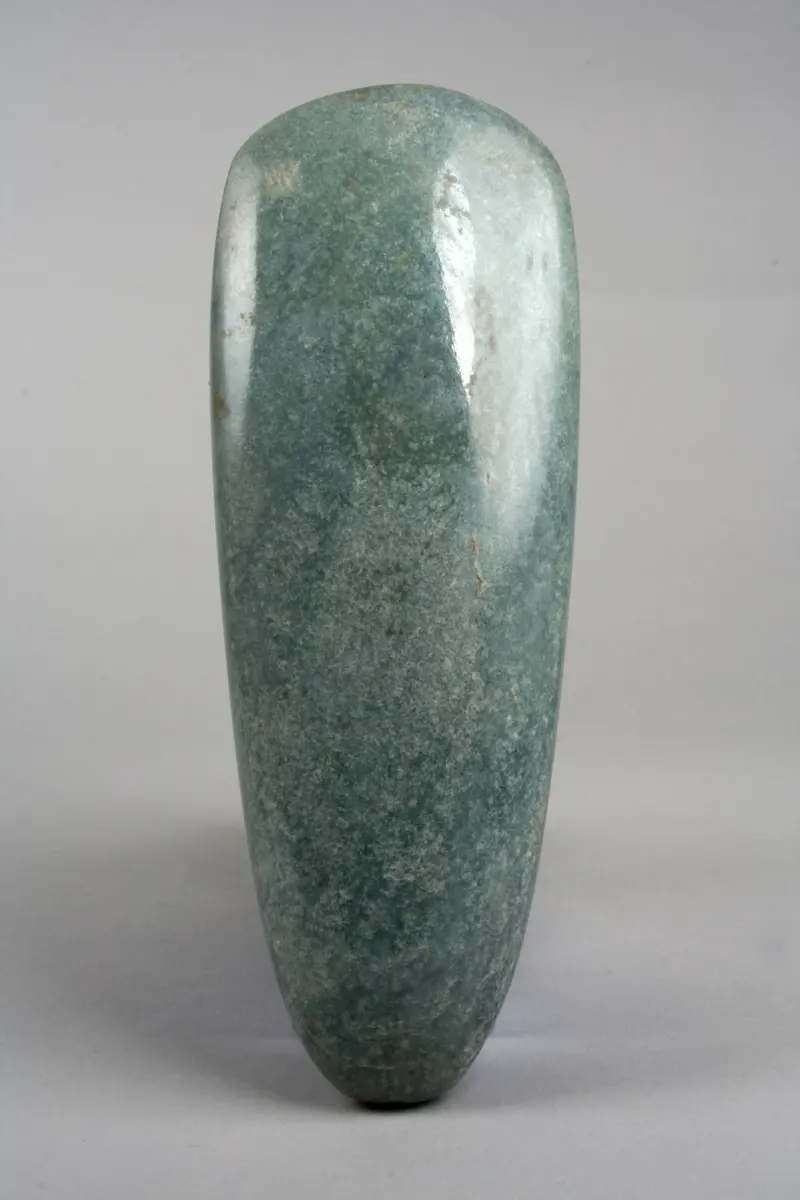
An Olmec jade axe from Mexico, made between the 900s and 300s BC, around the time of Aguada Fénix. It is not from Aguada Fénix itself. Photo: The Metropolitan Museum of Art, CC0, via The Met Open Access.
The questionWho built the oldest and largest Maya monument, and why does it surprise archaeologists?
In south-eastern Mexico lies a raised platform of earth so long and so low that nobody noticed it until 2017. It is the oldest and biggest Maya monument yet found, and it seems to have been built before there were Maya kings.
Fits: Primary (KS2). See Courses.
Too big to see
The University of Arizona describes the monument as nearly 4,600 feet long, about 1.4 kilometres, and 30 to 50 feet high, about 9 to 15 metres. Nine wide causeways, raised roads, run out from it. It is the largest building known from the whole of Maya history, bigger than the pyramids and palaces built in later centuries.1
Even so, nobody noticed it. It is so long and so flat that, standing on it, it looks like ordinary ground. It was only seen in 2017, in lidar maps of the area. “Using low-resolution lidar collected by the Mexican government, we noticed this huge platform,” said Takeshi Inomata, who led the work.1
How we know, step by step
- About 1000 to 800 BCBuilt
Radiocarbon dates from 69 pieces of charcoal place the building of the platform in these two centuries.1
- About 950 BCCeibal, the old record
Until Aguada Fénix, the Maya site of Ceibal, built about 950 BC, was the oldest ceremonial centre that had been confirmed.1
- 2017Seen from the air
The platform was so big and so low that no one had noticed it on the ground. It showed up in lidar mapping made for the Mexican government.1
- 2020Measured and dated
Takeshi Inomata’s team published its size and age.1
- 2025A map of the world, in a pit
Digging at the centre, the team found a cross-shaped pit inside a larger cross-shaped pit, with offerings laid out inside.3
Built without a king?
At most later Maya cities, archaeologists find carved pictures of rulers, thrones and palaces. At the Olmec centre of San Lorenzo there are colossal stone heads and thrones. At Aguada Fénix none of these have been found. The team thinks this means there was less difference between rich and poor, and that the platform was the work of a community working together.1
“You may not necessarily need a well-organized government to carry out these kinds of huge projects.”Takeshi Inomata, 20201
How many people would it take? The team’s estimate is more than 1,000, gathering for a few months each year over several years.3 That is an estimate worked out from the size of the job, not a count of real workers.2
A map of the world at the centre
In 2025 the team described what they found at the heart of the platform: a cross-shaped pit set inside a larger cross-shaped pit. In the bottom of the smaller one, jade objects had been laid out in the shape of a cross.3 Among them were jade carvings of a crocodile, a bird and perhaps a woman giving birth.2
The platform is lined up with the sunrise too. Its east–west line points to where the sun rises on 17 October and 24 February, which are 130 days apart.3 As the team reads it, the whole place was a model of the world, with its four directions, built three thousand years ago.2
Key words
- Platform
- A flat, raised area of ground, built up with earth or stone, for buildings or gatherings to stand on.
- Causeway
- A raised road or path.
- Lidar
- Mapping with laser light fired from an aircraft. It can show the shape of the ground under trees and crops.
- Radiocarbon dating
- Working out the age of something that was once alive, such as charcoal, from how much of a kind of carbon is left in it.
- Jade
- A hard stone, usually green, carved into treasured objects in ancient Mexico and Central America.
- Communal
- Done together by a community, rather than ordered by one ruler.
Check yourself
Try to answer in your head, then open each one.
When was Aguada Fénix built?
About 1000 to 800 BC.
Why had nobody noticed it before 2017?
It is so long and so low that from the ground it looks like the landscape. It was seen in lidar mapping from the air.
What usually tells archaeologists that a place had powerful rulers, and why is it missing here?
Things like carved statues of rulers, thrones and palaces. None have been found at Aguada Fénix, which suggests people built it together.
What was found in the pit at its centre?
A cross-shaped pit inside a larger one, with jade carvings and coloured pigments for the directions.
Go deeper
- Cities under the trees what lidar found under the forest of Guatemala
- Reading the glyphs the first Maya writing, and the kings it names
Sources for this page
Every number on this page comes from one of these. How we check.
Last reviewed 12 November 2026. Spotted a mistake? Tell us.
- Mace, M. (2020). Largest, oldest Maya monument suggests importance of communal work. University of Arizona News, 3 June 2020. Reporting Inomata, T., Triadan, D. and others (2020), Monumental architecture at Aguada Fénix and the rise of Maya civilization, Nature 582, 530–533. news.arizona.edu/news/largest-oldest-maya-monument-suggests-importance-communal-workUsed for: Aguada Fénix: its size, nine causeways, dating to 1000 to 800 BC from 69 charcoal samples, found from lidar in 2017, no sign of powerful rulers, and Ceibal as the earlier record. Checked 12 November 2026.
- Smithsonian Magazine (2025). Archaeologists say they’ve found a 3,000-year-old map of the cosmos at an ancient Maya site in Mexico. 13 November 2025. Reporting Inomata and others in Science Advances. www.smithsonianmag.com/smart-news/archaeologists-say-theyve-found-a-3000-year-old-map-of-the-cosmos-at-an-ancient-maya-site-in-mexico-180987656/Used for: The cross-shaped pit at Aguada Fénix, its jade carvings and coloured pigments for the four directions. Checked 12 November 2026.
- Archaeology Magazine (2025). Early Maya monument examined. 7 November 2025. Reporting Inomata and others, Science Advances, doi:10.1126/sciadv.aea2037. archaeology.org/news/2025/11/07/early-maya-monument-examined/Used for: A cross-shaped pit within a larger one; the sunrise alignment; more than 1,000 builders working a few months a year. Checked 12 November 2026.
- The Metropolitan Museum of Art. Celt (votive axe). Olmec, Mexico, jade, 10th–4th century BCE. Collection record 316288, Open Access (CC0). www.metmuseum.org/art/collection/search/316288Used for: A polished jade axe of the same centuries as Aguada Fénix, 15.2 cm high. Checked 12 November 2026.