Chapter Three
Reading the glyphs
Writing from about 300 BC; read again from the 1950s
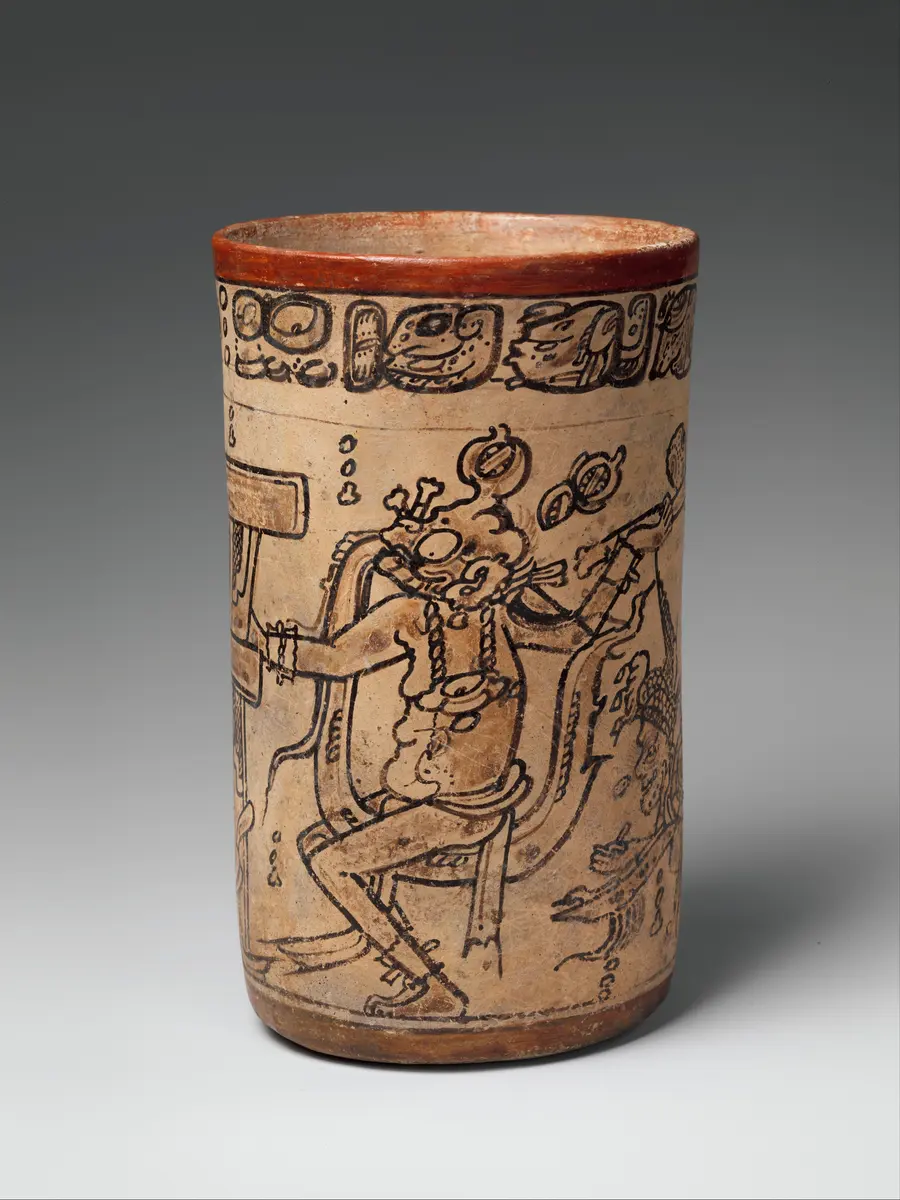
A painted drinking vessel, AD 600 to 800. The band of glyphs under the rim is a text, written round the cup. Photo: The Metropolitan Museum of Art, CC0, via The Met Open Access.
The questionHow did people learn to read Maya writing again?
For a long time, scholars could work out the numbers on Maya monuments but not much else, and most thought the inscriptions were about the stars and the gods. Then, in 1960, an architect who had spent years drawing Maya ruins noticed a pattern in the dates, and the kings of the Maya came back into history.
Fits: Primary (KS2). See Courses.
The oldest writing yet found
In 2005, at San Bartolo in Guatemala, Boris Beltrán found a stone block from a wall that had been knocked down in ancient times to build over. On it, someone had painted ten glyphs in a column, in a confident, flowing hand.1
Charcoal from the same layer was dated by radiocarbon to no earlier than 300 BC and no later than 200 BC. That makes these the oldest Maya writing yet found. Only one of the ten signs can be read for certain: AJAW, which means “lord” or “ruler”.1 So from the very start, Maya writing was already about the people in charge.
A pattern in the dates
Tatiana Proskouriakoff was an architect by training who worked on the ruins of the Maya city of Piedras Negras, in Guatemala.3 She studied the glyphs on more than 40 stelae there. Most experts at the time believed the stelae recorded the stars and the gods. Proskouriakoff looked instead at the dates.2
She found that the stelae fell into seven groups, or series. Each series began with a stela showing a figure seated in a niche, high up. She read it as a new king taking the throne. After it, a new stela went up every five years of his reign.2
- The “upended frog” glyphBorn
- The “toothache” glyphTakes the throneThe stela shows a figure seated in a niche
- Five years onA new stela
- Ten years onA new stela
If these were gods or stars, the gaps between the dates could be any length. But they were always the right length for a human life: a birth, then some years later a coming to the throne, then a reign. When she plotted the dates on a graph, the pattern held in all seven series.2
She found the same pattern at Yaxchilan, another Maya city, and picked out the name glyphs of two of its kings. She called them Shield Jaguar and Bird Jaguar, names archaeologists still use.2 She published her study in 1960.2
History, not only heaven
Proskouriakoff was not the first to wonder. In 1901 Charles Bowditch had suggested that the stelae at Piedras Negras recorded the lives of its kings.2 What she did was prove it, with an argument other scholars could check and build on. Eric Thompson and other scholars came to agree that the glyphs told the stories of the Maya.3
Her readings gave the epigraphers who came after her a framework to build on, as they learned to read the glyphs sign by sign.2 It began with a pattern of dates.
Key words
- Glyph
- A sign in a writing system. Maya glyphs can stand for whole words or for sounds.
- Stela
- A tall carved stone slab set up to mark an event. More than one are stelae.
- Decipher
- To work out how to read a writing system or code.
- Accession
- When a ruler comes to the throne.
- Ajaw
- The Maya word for lord or ruler, and the oldest Maya glyph that can be read.
- Epigrapher
- Someone who studies and reads ancient inscriptions.
Check yourself
Try to answer in your head, then open each one.
How old are the oldest Maya glyphs yet found, and where were they?
About 300 to 200 BC, painted on a wall at San Bartolo in Guatemala.
Which one of those glyphs can be read, and what does it mean?
AJAW, meaning lord or ruler.
What did most scholars think the stelae were about before 1960?
Gods, stars and the calendar: astronomical records rather than history.
What two events did Proskouriakoff find marked on the first stela in each series?
A birth (the “upended frog” glyph) and an accession, coming to the throne (the “toothache” glyph).
Go deeper
- Counting the days how the dates on the stelae work
- A king under the temple a king whose life the glyphs record
Sources for this page
Every number on this page comes from one of these. How we check.
Last reviewed 12 November 2026. Spotted a mistake? Tell us.
- Mesoweb (2006). Early Maya writing at San Bartolo, Guatemala. Report on Saturno, W. A., Stuart, D. and Beltrán, B. (2006), Early Maya writing at San Bartolo, Guatemala, Science 311, 1281–1283. www.mesoweb.org/reports/SanBartoloWriting.htmlUsed for: The ten painted glyphs at San Bartolo, dated 300 to 200 BC, of which one, AJAW, “lord”, can be read. Checked 12 November 2026.
- Archaeology Magazine. Tatiana Proskouriakoff: translating Maya history. Archive, September/October 2011. archive.archaeology.org/1109/features/tatiana_proskouriakoff.htmlUsed for: Proskouriakoff’s study of more than 40 stelae at Piedras Negras: seven series, the birth and accession glyphs, and the kings of Yaxchilan. Checked 12 November 2026.
- PBS NOVA. Cracking the Maya Code: a timeline of decipherment, entry for 1958. www.pbs.org/wgbh/nova/mayacode/time-07.htmlUsed for: Proskouriakoff showed the stelae told the lives of kings, from birth to death, and Eric Thompson and others came to agree. Checked 12 November 2026.
- The Metropolitan Museum of Art. Vessel with mythological scene. Maya, Mexico or Guatemala, ceramic, 600–800 CE. Collection record 662967, Open Access (CC0). www.metmuseum.org/art/collection/search/662967Used for: A painted drinking vessel with a band of glyphs around the rim. Checked 12 November 2026.