Chapter Four
Counting the days
From a zero day in 3114 BC to 21 December 2012
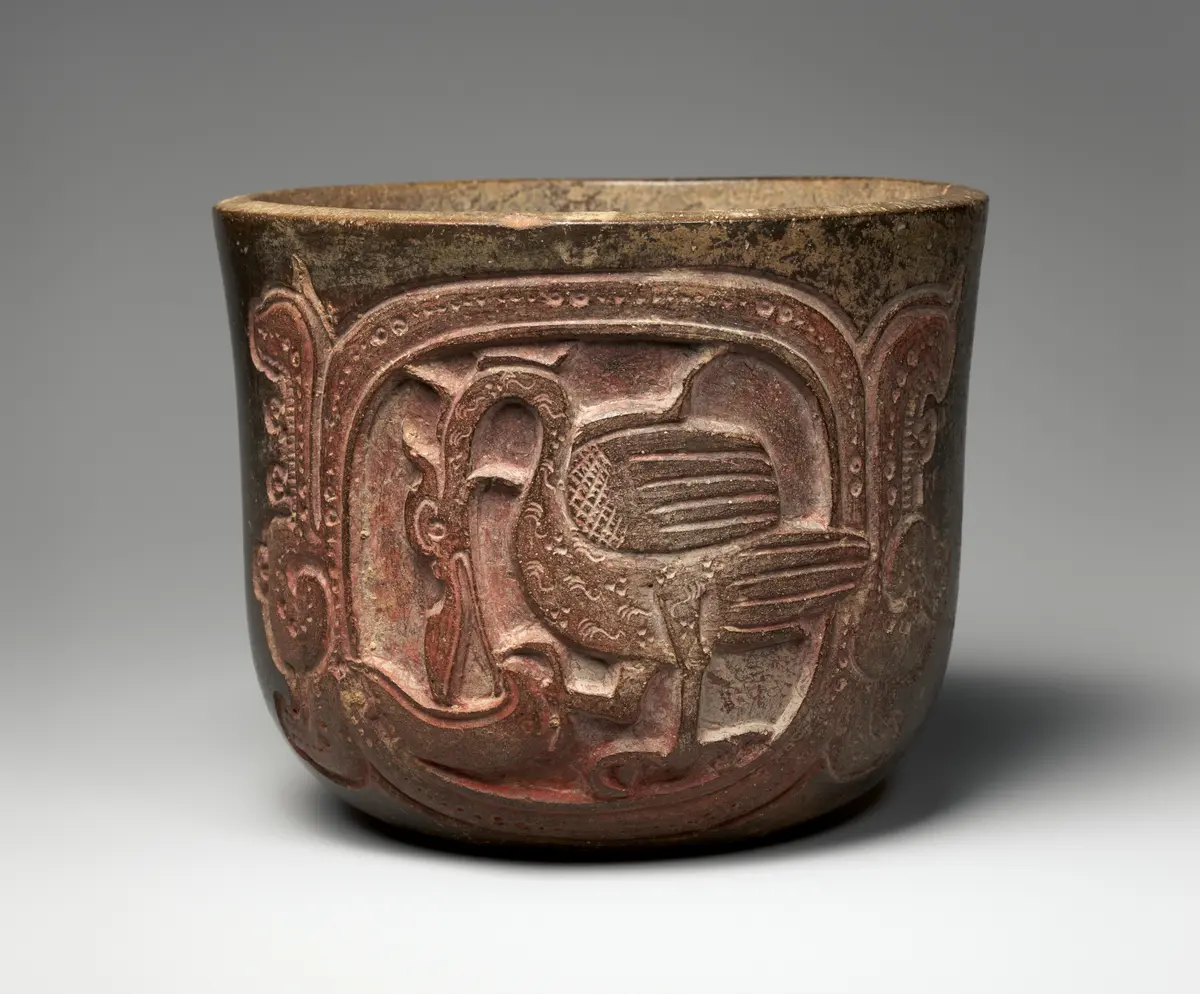
A carved bowl with a water bird and a text, AD 600 to 900. Photo: The Metropolitan Museum of Art, CC0, via The Met Open Access.
The questionHow did the Maya count time, and what really happened in 2012?
Maya monuments give their dates as a row of five numbers, such as 9.15.13.6.9. It is a count of days, from a starting day more than five thousand years ago. Once you know how it works, you can work out a Maya date yourself.
Fits: Primary (KS2). See Courses.
Counting in twenties
We count in tens. The Maya counted in twenties, and wrote their numbers with dots for ones, bars for fives and a shell for nought.3 So is seven: two dots above a bar.
The Long Count writes a date as five of these numbers, each counting a bigger unit of days: the kin, the winal, the tun, the katun and the baktun.1 Each unit is twenty of the one below, with one exception. The third place counts eighteens, so a tun is 18 winals, 360 days, close to a year.1
Work out a real date
At Yaxchilan, a stone is carved with the date 9.15.13.6.9.1 Here is how to read it.
| Maya | Number | Unit | Days in one | Days |
|---|---|---|---|---|
| 9 | Baktun20 katuns | × 144,000 | 1,296,000 | |
| 15 | Katun20 tuns | × 7,200 | 108,000 | |
| 13 | Tun18 winals | × 360 | 4,680 | |
| 6 | Winal20 kins | × 20 | 120 | |
| 9 | Kinone day | × 1 | 9 | |
| Days since day zero | 1,408,809 | |||
So 9.15.13.6.9 means 1,408,809 days after the Maya day zero. That day zero was written 13.0.0.0.0, and it fell on 11 August 3114 BC in our calendar. Count forward 1,408,809 days and you reach 19 October 744.2 No Maya scribe needed to know our calendar: the count of days was enough.
A book that kept the secret
Maya scribes also wrote books, called codices, painted on long strips folded like an accordion.3 One is the Dresden Codex. Johann Christian Götze, director of the royal library in Dresden, came across it in a private library in Vienna in 1739, on a journey to buy books in Italy, and gave it to his library in January 1740.4
A later director of the same library, Ernst Förstemann, studied it for years. In 1880 he published a copy printed in colour, and in 1892 a commentary in which he worked out more than 80 per cent of its numbers, its astronomy and its calendars. He found the Long Count in its pages. He showed that its red numbers are dates and its black numbers are the gaps between them, and he found a table that follows the planet Venus.4
The book nearly did not survive. At the end of the Second World War, when Dresden was bombed, water soaked it and washed away many of its colours and glyphs. The glass it was kept between held it together.4
What happened in 2012?
A baktun is 144,000 days, about 394 years. Day zero was written 13.0.0.0.0, and on 21 December 2012 the thirteenth baktun ended and the count read 13.0.0.0.0 again.1 It was the end of a long cycle, like a car’s milometer rolling over to a row of noughts. The next day the count carried on.
Key words
- Long Count
- The Maya way of writing a date as the number of days since a starting day.
- Kin
- One day.
- Winal
- Twenty days.
- Tun
- 360 days: eighteen winals, close to a year.
- Katun
- 7,200 days: twenty tuns, close to twenty years.
- Baktun
- 144,000 days: twenty katuns, about 394 years.
- Codex
- A handwritten book. Maya codices were painted on long strips folded like an accordion.
Check yourself
Try to answer in your head, then open each one.
What does each of the five numbers in a Long Count date count?
From the left: baktuns (144,000 days), katuns (7,200), tuns (360), winals (20) and kins (single days).
Which place breaks the pattern of twenties, and how?
The tun: it is 18 winals, not 20, making 360 days.
What happened on 21 December 2012?
The thirteenth baktun ended, and the count reached 13.0.0.0.0, like a milometer rolling over.
Who worked out the Long Count from the Dresden Codex?
Ernst Förstemann, director of the library in Dresden, in the late 1800s.
Go deeper
- Reading the glyphs how the dates on stelae revealed kings
- The Maya the chapters on the Long Count itself
Sources for this page
Every number on this page comes from one of these. How we check.
Last reviewed 13 November 2026. Spotted a mistake? Tell us.
- Elwes, R. (2026). Endless progress of time: the Mayan Long Count. Plus Magazine, University of Cambridge, 24 March 2026. plus.maths.org/endless-progress-time-mayan-long-countUsed for: The units of the Long Count, its count in twenties with eighteen in the third place, the zero date of 11 August 3114 BC, 21 December 2012, and a date from Yaxchilan. Checked 12 November 2026.
- Kennett, D. J., Hajdas, I., Culleton, B. J., Belmecheri, S., Martin, S., Neff, H., Awe, J. and others (2013). Correlating the ancient Maya and modern European calendars with high-precision AMS 14C dating. Scientific Reports 3, 1597. doi:10.1038/srep01597. www.nature.com/articles/srep01597Used for: The GMT correlation, which adds 584,283 days to a Long Count date, puts day zero at 11 August 3114 BC; radiocarbon dates from Lintel 3 at Tikal strongly support it. Checked 12 November 2026.
- Maxwell Museum of Anthropology, University of New Mexico. Maya hieroglyphs and math (learning resource). maxwellmuseum.unm.edu/sites/default/files/public/Maya%20hieroglyphs%20and%20math.pdfUsed for: Maya numbers written with dots, bars and a shell for nought, in twenties; codices as folded books; the Maya world across parts of Mexico, Belize, Guatemala, Honduras and El Salvador. Checked 12 November 2026.
- Velásquez García, E. (2017). Historia del códice de Dresde. Instituto Nacional de Antropología e Historia, Códice de Dresde (online edition). www.codicededresde.inah.gob.mx/wp-content/themes/codiceDresde/pdf_ensayos/historiadedresde.pdfUsed for: The Dresden Codex: bought in Vienna in 1739, Förstemann’s discovery of the Long Count and the Venus table in its pages, and water damage in the bombing of Dresden. Checked 12 November 2026.
- The Metropolitan Museum of Art. Cast of a bird head. Lapita people, Santa Cruz Islands, Solomon Islands; plaster, mid-20th century. Collection record 314214, Open Access (CC0). www.metmuseum.org/art/collection/search/314214Used for: A cast of a small Lapita clay bird head, 3.8 cm high. Checked 13 November 2026.