Chapter Five
A king under the temple
Buried in AD 683; found in 1952
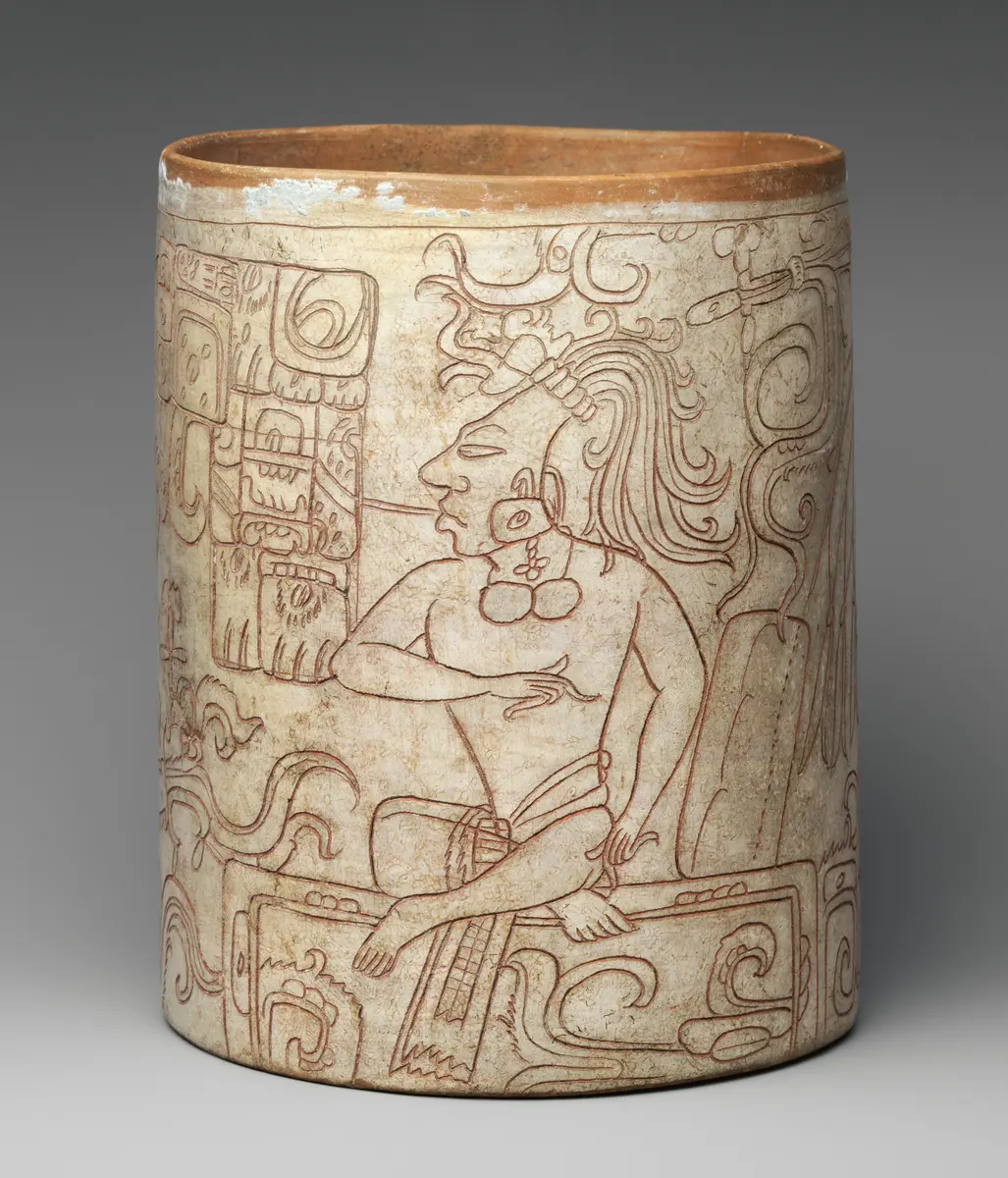
A Maya lord on a bench, carved on a drinking vessel of the 600s or 700s. Not Pakal himself. Photo: The Metropolitan Museum of Art, CC0, via The Met Open Access.
The questionWhat did archaeologists find beneath the Temple of the Inscriptions at Palenque?
A stair full of rubble
Under the Temple of the Inscriptions at Palenque, the way down to the king had been sealed with rubble. A team led by the archaeologist Alberto Ruz L’huillier spent months clearing it.1
Near the bottom they found clues that something important lay ahead: human remains covered in lime and red cinnabar. Then, on 15 June 1952, they freed a triangular stone slab that closed the way. Almost 20 metres below the temple’s entrance, Ruz stepped into a vaulted room that no one had entered since 28 August 683, the day the king’s body was laid there.1
The room and the lid
The walls of the crypt carry nine reliefs modelled in stucco: the gods of the Maya underworld, who go with the king on his journey through it. In the middle stands the sarcophagus, closed by a single carved stone lid.1
The lid is 3.8 metres long, 2.2 metres wide and 25 centimetres thick, carved on its top and its edges with glyphs.1 It took until 27 November 1952 to lift it, in great heat and damp, using jacks from lorries and tree trunks set under the stone.1
Who he was
The texts name the king: K’inich Janaab’ Pakal, ruler of Lakamha’, the city we call Palenque. They tell his life on earth and the lives of his ancestors. They also tell what came after: his rebirth, dressed as the Maize God, rising from the jaws of the creature the Maya called the Earth Monster.1
Inside lay Pakal’s bones, his funeral mask and the things buried with him. Since 1952 they have been studied again and again, for what they tell about how the people of Lakamha’ lived, governed, worshipped and buried their dead.1
Looking after a tomb
Opening a sealed room changes it. Today the crypt is studied and cared for by Mexico’s National Institute of Anthropology and History, INAH. Sensors in it measure its humidity, its temperature and the carbon dioxide in its air. Visitors can see copies of the tomb in the National Museum of Anthropology in Mexico City and in the site museum at Palenque, which is named after Alberto Ruz.1
Key words
- Sarcophagus
- A stone coffin.
- Crypt
- A room underground, used for burial.
- Cinnabar
- A bright red mineral, found on the remains outside Pakal’s crypt.
- Stucco
- A plaster that can be modelled into shapes and reliefs before it sets.
- Lakamha’
- The Maya name for the city we call Palenque.
- Conservation
- Looking after something old so that it lasts, without changing it.
Check yourself
Try to answer in your head, then open each one.
When was Pakal laid in his tomb?
On 28 August 683.
Who led the team that found the tomb, and when?
The archaeologist Alberto Ruz L’huillier, in 1952. The team entered the crypt on 15 June and lifted the lid on 27 November.
How deep under the temple’s entrance is the crypt?
Almost 20 metres.
What story do the texts on the lid tell?
Pakal’s life and his ancestors, and his rebirth as the Maize God, rising from the jaws of the Earth Monster.
Go deeper
- Reading the glyphs how texts like Pakal’s were read
- Counting the days how dates like 28 August 683 are worked out
Sources for this page
Every number on this page comes from one of these. How we check.
Last reviewed 12 November 2026. Spotted a mistake? Tell us.
- Instituto Nacional de Antropología e Historia (2023). Se cumplen 71 años del descubrimiento de la tumba de Pakal ‘el Grande’, en Palenque. Boletín 372, 15 June 2023. inah.gob.mx/images/boletines/2023/372/Boletin%20372.pdfUsed for: The tomb of K’inich Janaab’ Pakal: found by Alberto Ruz’s team on 15 June 1952, almost 20 metres down, sealed since 28 August 683, the lid 3.8 by 2.2 metres, opened on 27 November 1952. Checked 12 November 2026.
- The Metropolitan Museum of Art. Vessel with Seated Lord. Maya, Mexico, ceramic and stucco, 7th–8th century. Collection record 316711, Open Access (CC0). www.metmuseum.org/art/collection/search/316711Used for: A carved drinking vessel showing a lord on a bench, 24.1 cm high. Checked 12 November 2026.