Chapter Six
Drought, and the Maya today
About AD 800 to 1000, and today
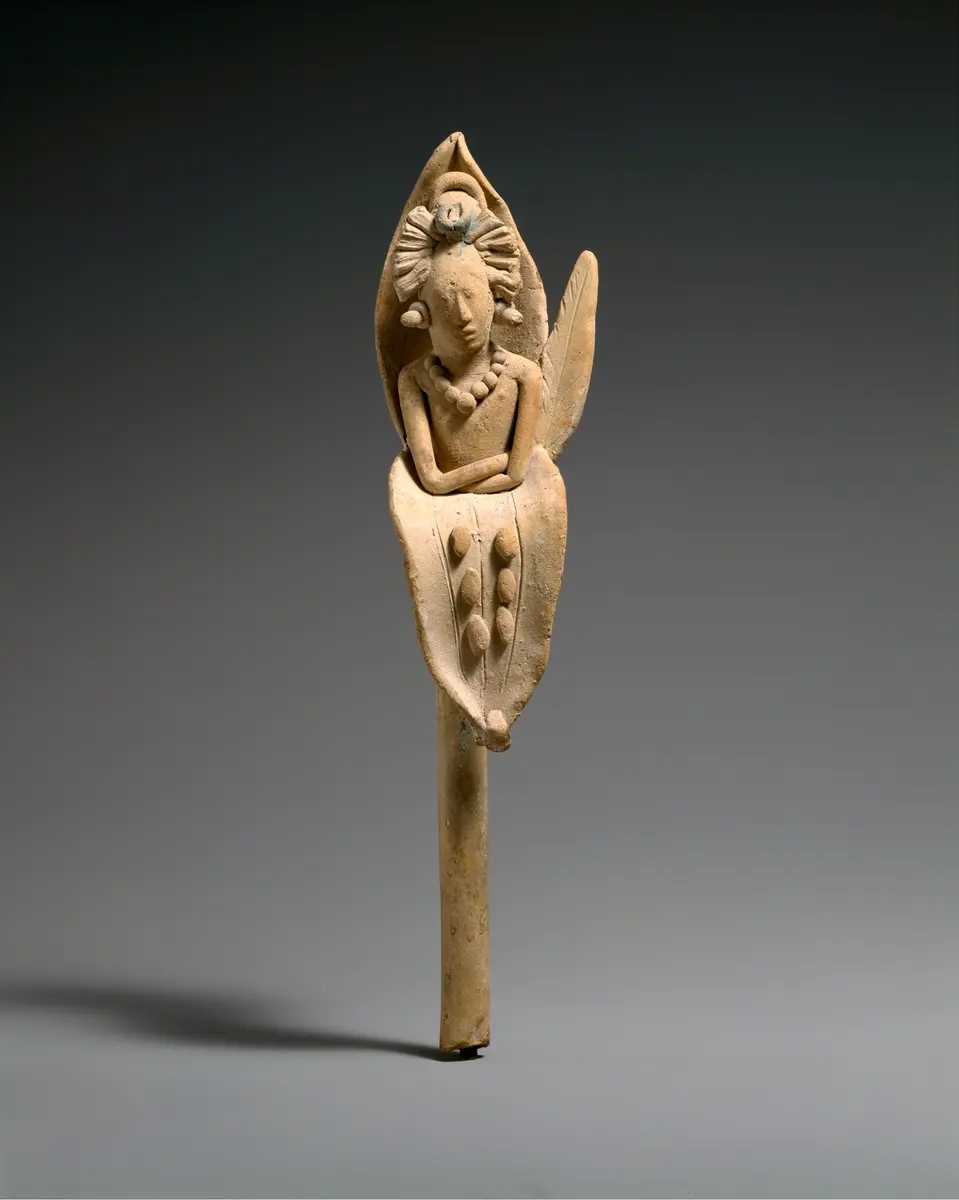
The Maize God rising from a flower, on a clay whistle of AD 600 to 900, still with traces of Maya blue. Photo: The Metropolitan Museum of Art, CC0, via The Met Open Access.
The questionWhy were the great southern cities left, and did the Maya disappear?
Between about AD 800 and 1000, the great cities of the Classic Maya fell apart. Historians call it the collapse of Classic Maya civilisation. A lake in Yucatán has kept a record of how little rain fell then. But the Maya themselves did not vanish.
Fits: Primary (KS2). See Courses.
A lake that kept a diary
Lake Chichancanab is in Yucatán, Mexico. When a lake like it dries out in a drought, a mineral called gypsum forms on its bed, and its crystals trap a little of the lake water inside them. Layer on layer, the lake mud keeps a record of dry times.1
In 2018 a team led by Nicholas Evans measured the water trapped in the gypsum laid down in the Terminal Classic period, about AD 800 to 1000, and worked out from it how much rain had fallen. Their answer: each year, between 41 and 54 per cent less rain than normal, and at the worst times up to 70 per cent less. The air was drier than today too, by 2 to 7 per cent.1
Caves tell the same story. In 2025 a University of Cambridge study of stalagmites in the cave of Grutas Tzabnah, also in Yucatán, found eight droughts in the rainy season between AD 871 and 1021, each lasting at least three years. One lasted 13 years.2
- Normal100
- About AD 800 to 100046 to 59
- At the worst30
Did the drought cause the fall?
The southern cities were crowded. At their busiest, AD 650 to 800, as many as 7 to 11 million people may have lived in the Maya lowlands, farming terraces and fields linked by roads, with defences that point to wars.3 A drought that cut the rain by half for years at a time would have hit their maize harvests hard.
Where historians disagree
The lake and the caves show how dry it was, not why each city was left.1 Many explanations have been put forward, among them changing trade routes, war and severe drought. A drought of thirteen years would have shaken any kingdom, yet the Maya also had clever ways of storing and managing water.2 Several of these may have worked together, and each city may have had its own story.
The Maya today
The great southern cities emptied, but the Maya did not disappear. In Guatemala’s census of 2018, 41.7 per cent of the people, about 6.2 million, said they were Maya.4 Guatemala has 25 official languages, and 22 of them are Maya languages, recognised by the National Languages Law of 2003, Decree 19-2003.5
And Guatemala is only part of it: the old Maya world reached into parts of Mexico, Belize, Honduras and El Salvador.6 Maya history did not end with the Classic cities. It runs on, three thousand years from Aguada Fénix to today.
Key words
- Drought
- A long time with much less rain than usual.
- Gypsum
- A mineral that forms in lakes as their water dries up. Its crystals trap a little of the lake water.
- Isotope
- A form of an element with a slightly different weight. Rain and lake water have different mixes of them, which shows how much water evaporated.
- Sediment core
- A long tube of mud drilled out of a lake bed, with the oldest layers at the bottom.
- Census
- An official count of the people in a country, with questions about who they are.
- Indigenous
- Belonging to the first peoples of a place.
Check yourself
Try to answer in your head, then open each one.
How did scientists measure the drought?
From water trapped in gypsum crystals in the mud of Lake Chichancanab, in Mexico.
By how much did rainfall fall?
By 41 to 54 per cent a year, and by up to 70 per cent in the worst times.
Did the drought on its own cause the cities to be left?
The lake shows how dry it was, not why each city was left. Changing trade routes and war have been put forward too, and several causes probably worked together.
How many Maya languages does Guatemala recognise today?
Twenty-two, among the country’s 25 official languages.
Go deeper
- Cities under the trees how many people lived in the cities before
- The Maya all six chapters
Sources for this page
Every number on this page comes from one of these. How we check.
Last reviewed 12 November 2026. Spotted a mistake? Tell us.
- Evans, N. P., Bauska, T. K., Gázquez-Sánchez, F., Brenner, M., Curtis, J. H. and Hodell, D. A. (2018). Quantification of drought during the collapse of the classic Maya civilization. Science 361 (6401), 498–501. research-portal.st-andrews.ac.uk/en/publications/quantification-of-drought-during-the-collapse-of-the-classic-maya/Used for: Rainfall fell by 41 to 54 per cent, and by up to 70 per cent at the worst, in about AD 800 to 1000, measured from gypsum in Lake Chichancanab. Checked 12 November 2026.
- Archaeology Magazine (2025). Mexican cave stalagmites suggest droughts helped fuel Maya collapse. 18 August 2025. Reporting a University of Cambridge study in Science Advances. archaeology.org/news/2025/08/18/mexican-cave-stalagmites-suggest-droughts-helped-fuel-maya-collapse/Used for: Eight wet-season droughts of three years or more between AD 871 and 1021, one lasting 13 years, from stalagmites in Grutas Tzabnah; the competing explanations for the collapse. Checked 12 November 2026.
- Tulane University News (2018). Unprecedented study confirms massive scale of lowland Maya civilization. 27 September 2018. Reporting Canuto, M. A., Estrada-Belli, F., Garrison, T. G. and others (2018), Ancient lowland Maya complexity as revealed by airborne laser scanning of northern Guatemala, Science 361, eaau0137. news.tulane.edu/pr/unprecedented-study-confirms-massive-scale-lowland-maya-civilizationUsed for: The lidar survey of northern Guatemala: more than 2,100 square kilometres, 61,480 structures, causeways, farmland, defences, and 7 to 11 million people in AD 650 to 800. Checked 12 November 2026.
- Instituto Centroamericano de Estudios Fiscales (2025). Pueblos indígenas en Guatemala: presentación, con base en datos del XII Censo de Población y VII de Vivienda (Guatemala, 2018). icefi.org/sites/default/files/presentacion_ippi_2025_0.pdfUsed for: In the 2018 census, 41.7 per cent of people in Guatemala, about 6.2 million, said they were Maya; the National Languages Law, Decree 19-2003. Checked 12 November 2026.
- Rodríguez, L. (2024). Protomaya, el origen de las lenguas mayas en Guatemala. Agencia Guatemalteca de Noticias, 24 September 2024. agn.gt/protomaya-el-origen-de-las-lenguas-mayas-en-guatemala/Used for: Guatemala’s 25 official languages, 22 of them Maya, recognised by Decree 19-2003. Checked 12 November 2026.
- Maxwell Museum of Anthropology, University of New Mexico. Maya hieroglyphs and math (learning resource). maxwellmuseum.unm.edu/sites/default/files/public/Maya%20hieroglyphs%20and%20math.pdfUsed for: Maya numbers written with dots, bars and a shell for nought, in twenties; codices as folded books; the Maya world across parts of Mexico, Belize, Guatemala, Honduras and El Salvador. Checked 12 November 2026.
- The Metropolitan Museum of Art. Whistle with the Maize God emerging from a flower. Maya, Mexico, ceramic with Maya blue, 600–900 CE. Collection record 312915, Open Access (CC0). www.metmuseum.org/art/collection/search/312915Used for: A clay whistle of the Maize God, 20.7 cm high. Checked 12 November 2026.