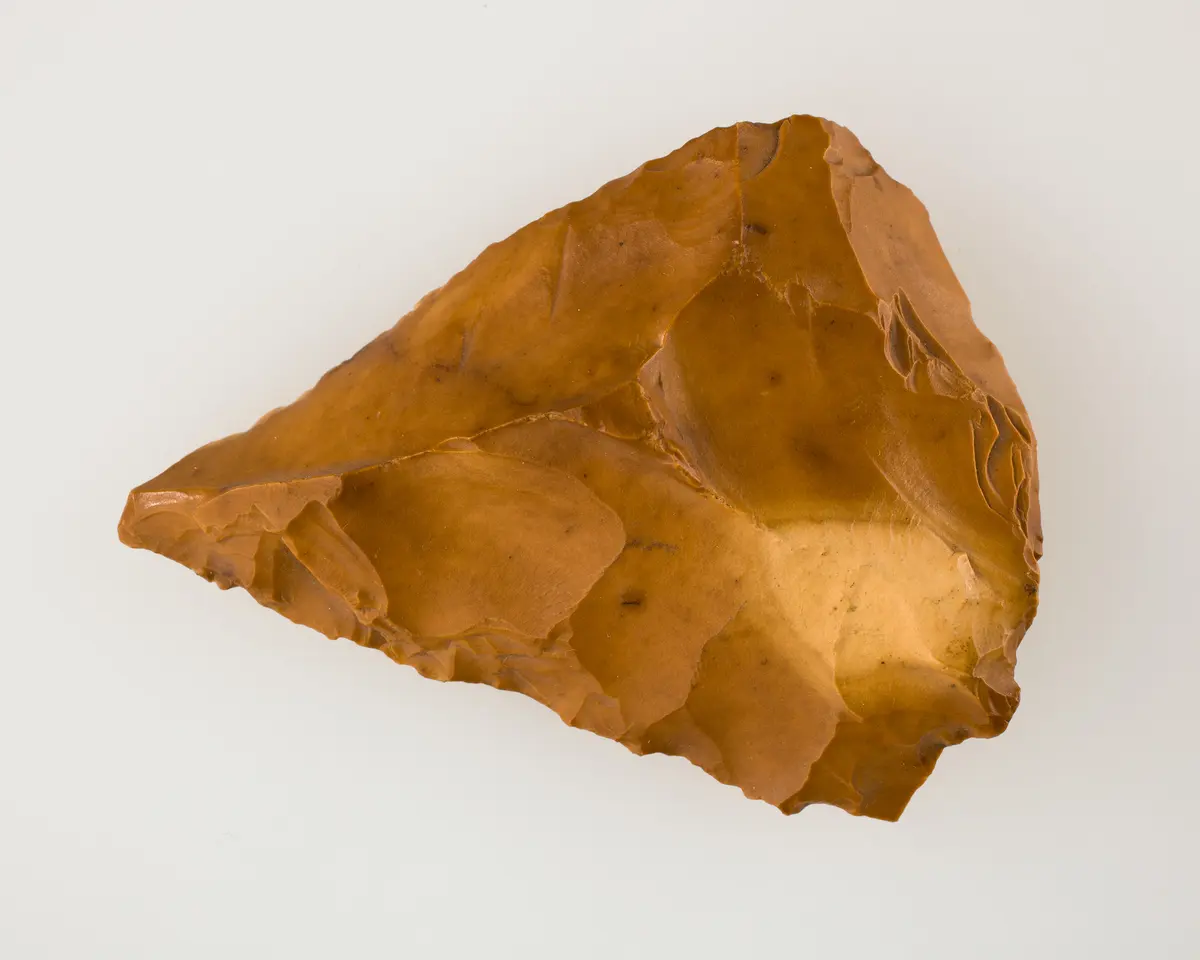
From Egypt; dated by the museum to about 90,000 to 35,000 BC
Chapter Five
One cradle or many?
About 300,000 to 100,000 years ago
A flint tool from Kharga Oasis, in what is now the desert of western Egypt, 7 cm high. At times in the past, lakes and rivers spread across north Africa. Photo: The Metropolitan Museum of Art, CC0, via The Met Open Access.
The questionDid our species begin in one place, or across all of Africa?
For a long time the story was simple: our species began in one place in East Africa, about 200,000 years ago. The fossils found since then come from opposite ends of the continent, and many researchers now tell a different story.
The old picture
Until 2017, the oldest securely dated fossils of our species came from Ethiopia, and most researchers believed that everyone alive today descends from a population that lived in East Africa about 200,000 years ago.1 Jebel Irhoud changed that. “We used to think that there was a cradle of mankind 200 thousand years ago in east Africa,” says Jean-Jacques Hublin, “but our new data reveal that Homo sapiens spread across the entire African continent around 300 thousand years ago.”1
Fossils from end to end
The early fossils of our species now come from the far north of Africa, from the east and from the south: Jebel Irhoud in Morocco, Omo Kibish and Herto in Ethiopia, and Florisbad in South Africa.1 They do not line up in a simple series from old-looking to modern. They are varied in shape, so varied that some researchers have put Jebel Irhoud and Florisbad in a separate, more primitive species.2
Many linked groups
In 2018 a group of researchers led by Eleanor Scerri brought together the fossils, the stone tools, genetics and the record of past climates. They argued that our species did not evolve in one region or one population, but within a set of linked groups living across Africa, whose links with each other changed over time.2
Africa’s climate helps to explain why. As the monsoon shifted, the Sahara at times shrank, and networks of lakes and rivers spread across much of north Africa. Habitable land opened and closed, joining groups together and then splitting them apart.2
Genetics points the same way. The KhoeSan peoples of southern Africa keep the greatest genetic diversity of any people today, and their ancestors split from other groups somewhere between 150,000 and 300,000 years ago.2
Before the first of us
Our species had ancestors in Africa long before Jebel Irhoud. Fossils from a quarry in Casablanca, Morocco, about 773,000 years old, may come from a population close to the roots of our lineage. Every securely dated fossil of our species older than 90,000 years comes from Africa or from the edge of Asia.6 The deeper story, from about 7 million years ago, is told on our companion site, Our Eons.
Key words
- Cradle
- Here, the place where a species first appeared.
- Population
- A group of people living in one area and having children together.
- Gene flow
- When people from different groups have children together, so their genes mix.
- Genetic diversity
- How varied the DNA within a group is. Older groups usually have more.
- Sahara
- The great desert of north Africa, which has been green at times in the past.
Check yourself
Try to answer in your head, then open each one.
What was the old view of where our species began?
In one place in East Africa, about 200,000 years ago.
Name three places in Africa with early fossils of our species.
Any three of: Jebel Irhoud in Morocco, Omo Kibish and Herto in Ethiopia, Florisbad in South Africa.
What is the “many linked groups” idea?
That our species formed in groups living across Africa, whose links with each other changed over time, not in one population in one place.
Why is the date for Florisbad uncertain?
The dated tooth may not belong with the skull, and the way the site’s layers formed makes the date hard to trust.
Go deeper
- Under the ash at Omo dating the Ethiopian skull
- How long is human history? our species’ whole story on one line
Sources for this page
Every number on this page comes from one of these. How we check.
Last reviewed 13 November 2026. Spotted a mistake? Tell us.
- Max Planck Society (2017). The first of our kind: scientists discover the oldest Homo sapiens fossils at Jebel Irhoud, Morocco. Research news, 7 June 2017. www.mpg.de/11322481/oldest-homo-sapiens-fossils-at-jebel-irhoud-moroccoUsed for: Jebel Irhoud known since the 1960s; new digs from 2004; fossils from six to 22, of at least five people; skulls, teeth and long bones; heated flints dated by thermoluminescence; the Irhoud 3 jaw once dated to 160,000 years; Omo Kibish 195,000 and Herto 160,000 the oldest before; quotes from Jean-Jacques Hublin and Daniel Richter; the face almost indistinguishable from people today and the long braincase, and a quote from Philipp Gunz; Florisbad and the three oldest sites across Africa; animal bones from hunting, mostly gazelle; Middle Stone Age tools, Levallois prepared cores and mostly pointed forms, of good flint brought to the site, and no hand axes; a quote from Shannon McPherron; photographs of the skull, tools and site. Checked 13 November 2026.
- Scerri, E. M. L., Thomas, M. G., Manica, A., Gunz, P., Stock, J. T., Stringer, C. and others (2018). Did our species evolve in subdivided populations across Africa, and why does it matter? Trends in Ecology and Evolution 33, 582–594. pmc.ncbi.nlm.nih.gov/articles/PMC6092560/Used for: Homo sapiens evolved within a set of interlinked groups living across Africa, whose connections changed over time, not in one region or population; early fossils (Jebel Irhoud, Florisbad, Omo Kibish, Herto) are varied in form; some researchers call Jebel Irhoud and Florisbad a more primitive species; the Sahara shrank and lakes and rivers spread across north Africa at times; the KhoeSan of southern Africa keep the greatest genetic diversity of any people today, on a branch that split 150,000 to 300,000 years ago. Checked 13 November 2026.
- Berger, L. R. and Hawks, J. (2023). Revisiting the age of the Florisbad hominin material. Homo 74, 55–60 (abstract). doi.org/10.1127/homo/2023/1541Used for: A tooth from Florisbad was dated in 1996 to 259,000 years, give or take 35,000; it may not belong with the skull; current data do not show Homo sapiens in southern Africa about 260,000 years ago. Checked 13 November 2026.
- Vidal, C. M., Lane, C. S., Asrat, A., Barfod, D. N., Mark, D. F., Tomlinson, E. L., Tadesse, A. Z., Yirgu, G., Deino, A., Hutchison, W., Mounier, A. and Oppenheimer, C. (2022). Age of the oldest known Homo sapiens from eastern Africa. Nature 601, 579–583. pmc.ncbi.nlm.nih.gov/articles/PMC8791829/Used for: Omo I found in the late 1960s in the lower Omo valley; usually dated to about 197,000 years, Herto to about 160,000 to 155,000; the KHS Tuff lies above the layer with Omo I, about 1.4 m higher, and comes from an eruption of Shala volcano; a minimum age of 233,000 years, give or take 22,000; Omo I and Herto have a tall braincase and a chin; the ash below, the Nakaa’kire Tuff, dated to about 197,000 years but its place relative to the fossils uncertain; the KHS Tuff more than 2 m thick and too fine to date directly; the chemistry of its glass matched to deposits of the Shala eruption 350 km to the north-east. Checked 13 November 2026.
- Richter, D., Grün, R. and others (2017). The age of the hominin fossils from Jebel Irhoud, Morocco, and the origins of the Middle Stone Age. Nature 546, 293–296. doi.org/10.1038/nature22335Used for: The age of the Jebel Irhoud fossils, about 315,000 years (give or take 34,000). Checked 11 November 2026.
- Hublin, J.-J., Lefèvre, D., Perini, S., Muttoni, G. and others (2026). Early hominins from Morocco basal to the Homo sapiens lineage. Nature. pmc.ncbi.nlm.nih.gov/articles/PMC12823423/Used for: Fossils from Thomas Quarry I, Casablanca, about 773,000 years old, from an African population older than our species and close to its ancestry; every securely dated Homo sapiens fossil older than 90,000 years comes from Africa or the edge of Asia. Checked 13 November 2026.
- The Metropolitan Museum of Art. Tool, flint, from Kharga Oasis, Western Desert, Egypt, dated by the museum ca. 90,000–35,000 B.C.. Collection record 590917, Open Access (CC0). www.metmuseum.org/art/collection/search/590917Used for: A flint tool, 7 cm high. Checked 13 November 2026.