Chapter Four
A face like ours
From about 300,000 years ago
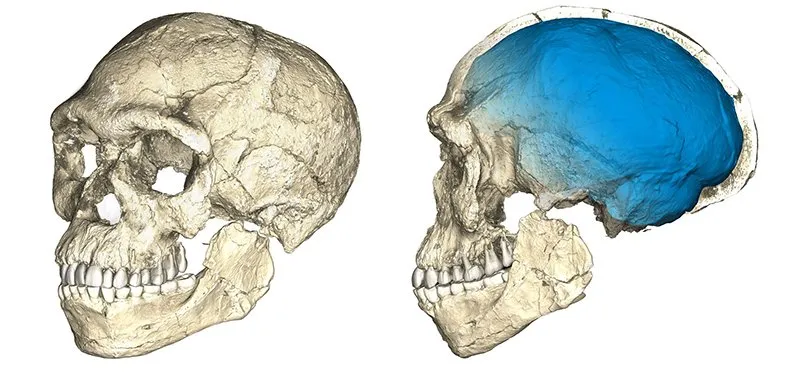
A reconstruction of the Jebel Irhoud fossils from micro-CT scans of several original bones. In blue, the shape of the inside of the braincase. Photo: Philipp Gunz, MPI EVA Leipzig, CC BY-SA 2.0, via Max Planck Society.
The questionIf the first of our species had faces like ours, why did their heads look different?
A face like ours
The skulls of people today share two things that set us apart from our fossil relatives: a small, light face, and a rounded braincase.1 Jean-Jacques Hublin’s team scanned the Jebel Irhoud fossils with micro-CT and compared their shapes using hundreds of 3D measurements. The face turned out to be almost the same as that of people living today, and so were the teeth.12
A head that was not
The braincase was another matter. It was large, but long and low, an older shape.1 “The inner shape of the braincase reflects the shape of the brain,” explains Philipp Gunz, one of the team. “Our findings suggest that modern human facial morphology was established early on in the history of our species, and that brain shape, and possibly brain function, evolved within the Homo sapiens lineage.”1
A brain that rounded out slowly
To find out when the brain took its modern shape, Simon Neubauer, Jean-Jacques Hublin and Philipp Gunz studied the insides of the braincases of 20 fossils of our species from different times, using scans to make endocasts.3 By 300,000 years ago, the brain of our species was already as big as ours. Its shape was not. Over time the forehead grew taller, the top and sides of the head bulged, the side walls became parallel, and the back of the head became rounder.3
The change was gradual. Brain shape reached the range of people today only between about 100,000 and 35,000 years ago. The team noted that this matches the time when the archaeological record shows more and more of the behaviour we think of as modern.3
Key words
- Braincase
- The part of the skull that holds the brain.
- Globular
- Rounded like a globe. Our braincases are globular; older ones are long and low.
- Endocast
- A cast, real or made on a computer, of the inside of a braincase. It shows the shape of the brain.
- Micro-CT
- A very detailed X-ray scan that builds a 3D picture of an object without harming it.
- Mosaic
- Here, made up of features that arrived at different times.
Check yourself
Try to answer in your head, then open each one.
What was modern about the Jebel Irhoud skulls, and what was not?
The face and teeth were modern; the braincase was long, not rounded.
By about 300,000 years ago, was the brain of our species as big as ours?
Yes. Its size was already within the range of people today.
When did brain shape reach the range of people today?
Between about 100,000 and 35,000 years ago.
How do researchers study the shape of a brain that rotted away long ago?
From the inside of the braincase, using endocasts made from scans.
Go deeper
- Older than anyone thought where the skulls came from
- Paint, beads and a drawing what people were doing as brain shape changed
Sources for this page
Every number on this page comes from one of these. How we check.
Last reviewed 13 November 2026. Spotted a mistake? Tell us.
- Max Planck Society (2017). The first of our kind: scientists discover the oldest Homo sapiens fossils at Jebel Irhoud, Morocco. Research news, 7 June 2017. www.mpg.de/11322481/oldest-homo-sapiens-fossils-at-jebel-irhoud-moroccoUsed for: Jebel Irhoud known since the 1960s; new digs from 2004; fossils from six to 22, of at least five people; skulls, teeth and long bones; heated flints dated by thermoluminescence; the Irhoud 3 jaw once dated to 160,000 years; Omo Kibish 195,000 and Herto 160,000 the oldest before; quotes from Jean-Jacques Hublin and Daniel Richter; the face almost indistinguishable from people today and the long braincase, and a quote from Philipp Gunz; Florisbad and the three oldest sites across Africa; animal bones from hunting, mostly gazelle; Middle Stone Age tools, Levallois prepared cores and mostly pointed forms, of good flint brought to the site, and no hand axes; a quote from Shannon McPherron; photographs of the skull, tools and site. Checked 13 November 2026.
- Hublin, J.-J., Ben-Ncer, A. and others (2017). New fossils from Jebel Irhoud, Morocco and the pan-African origin of Homo sapiens. Nature 546, 289–292. doi.org/10.1038/nature22336Used for: The Jebel Irhoud fossils as early members of our species, and the debate around them. Checked 11 November 2026.
- Neubauer, S., Hublin, J.-J. and Gunz, P. (2018). The evolution of modern human brain shape. Science Advances 4, eaao5961. pmc.ncbi.nlm.nih.gov/articles/PMC5783678/Used for: By 300,000 years ago brain size in early Homo sapiens was within the range of people today; brain shape changed gradually, from long to rounded (globular), reaching today’s range between about 100,000 and 35,000 years ago; Neanderthals and other archaic humans have long braincases. Checked 13 November 2026.
- Scerri, E. M. L., Thomas, M. G., Manica, A., Gunz, P., Stock, J. T., Stringer, C. and others (2018). Did our species evolve in subdivided populations across Africa, and why does it matter? Trends in Ecology and Evolution 33, 582–594. pmc.ncbi.nlm.nih.gov/articles/PMC6092560/Used for: Homo sapiens evolved within a set of interlinked groups living across Africa, whose connections changed over time, not in one region or population; early fossils (Jebel Irhoud, Florisbad, Omo Kibish, Herto) are varied in form; some researchers call Jebel Irhoud and Florisbad a more primitive species; the Sahara shrank and lakes and rivers spread across north Africa at times; the KhoeSan of southern Africa keep the greatest genetic diversity of any people today, on a branch that split 150,000 to 300,000 years ago. Checked 13 November 2026.