From Egypt, not from Omo: the same long age
Chapter Three
Under the ash at Omo
At least 233,000 years ago
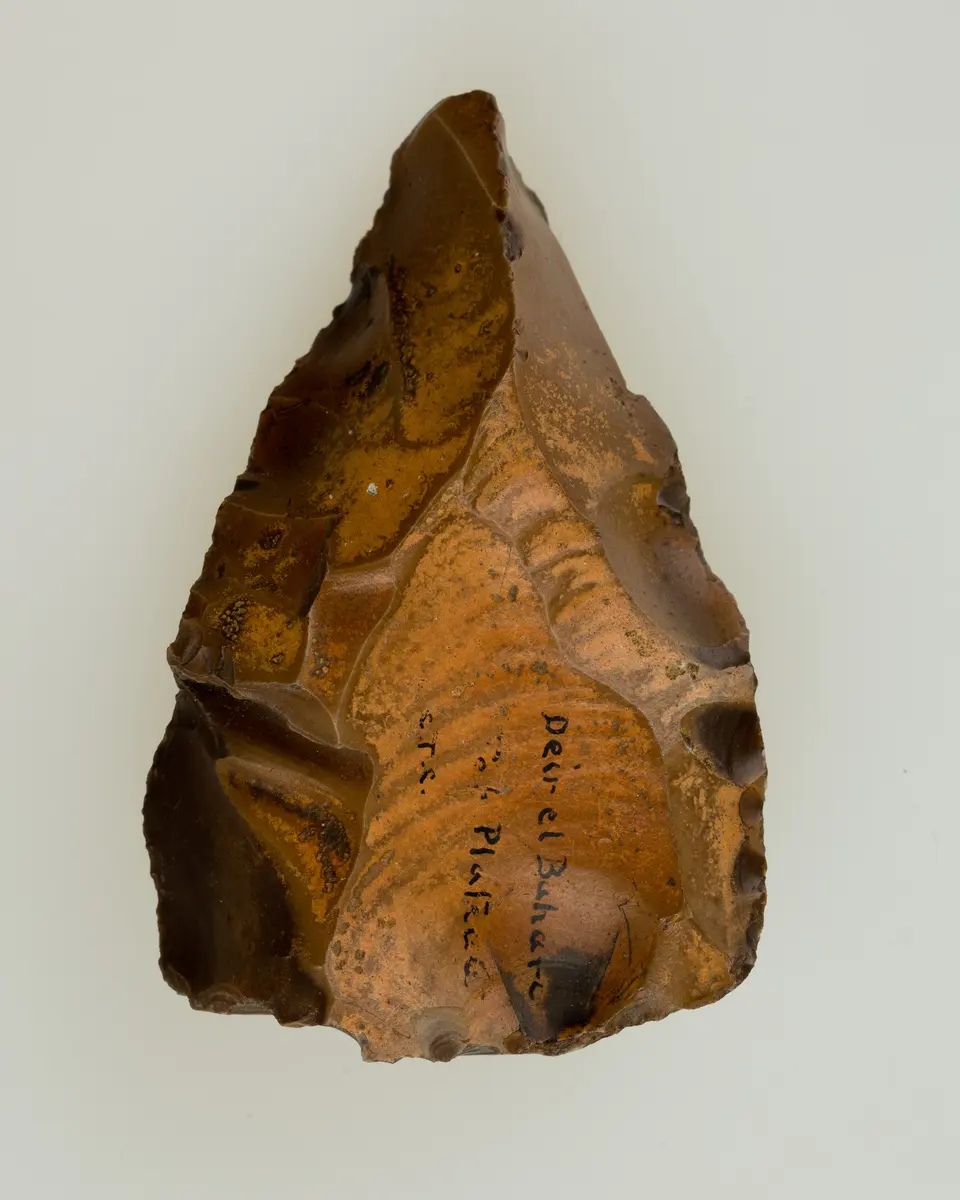
A Levallois core: a stone prepared so that flakes of the shape wanted could be struck from it. From Thebes in Egypt, 8.4 cm long, dated by the museum to about 240,000 to 40,000 years ago. Photo: The Metropolitan Museum of Art, CC0, via The Met Open Access.
The questionHow can a volcano tell us the age of a skull?
A skull in the Omo valley
The skull known as Omo I was found in the late 1960s in the lower Omo valley of southern Ethiopia, lying at the surface near the top of a layer called Member I.1 It and a find from Herto, also in Ethiopia, are the most widely accepted early fossils with the features that mark modern people: a tall braincase and a chin.1
Until 2017, Omo I was usually given as the oldest known fossil of our species, about 195,000 years old.2 But that age came from a layer of ash said to lie “near, but probably slightly below” the skull. Because no one could be sure where that ash lay compared with the fossil, the date was disputed.1
The ash above
One layer is certain. Above Member I lies a thick bed of fine volcanic ash, more than 2 metres deep, called the KHS Tuff. Omo I came from about 1.4 metres below it, so the skull must be older than the ash.1 But the ash is too fine to date directly.1
Matching the ash to its volcano
A team led by Céline Vidal set out to find the eruption that made it. Only two volcanoes in the Main Ethiopian Rift are known to have had huge eruptions between about 250,000 and 170,000 years ago: Shala and Corbetti. The team took samples from both, and from the ash at Omo, and compared the chemistry of the volcanic glass in each.1
The ash at Omo matched an eruption of Shala, 350 kilometres to the north-east, which left a layer more than 20 metres thick near the volcano. Those coarser deposits could be dated: 233,000 years ago, give or take 22,000. So Omo I is at least that old.1
Key words
- Tuff
- Rock or a layer made of volcanic ash.
- Eruption
- When a volcano throws out ash, gas and molten rock.
- Minimum age
- The youngest something can be. The real age may be older.
- Layer (stratum)
- A band of earth or rock laid down at one time. Lower layers are older.
- Chemical fingerprint
- The mix of chemical elements in a material, which can match it to its source.
Check yourself
Try to answer in your head, then open each one.
Where and when was Omo I found?
In the lower Omo valley of southern Ethiopia, in the late 1960s.
Why could the ash above the skull not be dated directly?
Its grains are too fine.
How did the team find out where the ash came from?
They matched the chemistry of its glass to the deposits of an eruption of Shala volcano, 350 km away, and dated those.
Why is 233,000 years a minimum age for Omo I?
Because the ash lies above the skull, so the skull is older than the ash.
Go deeper
- Older than anyone thought another date that moved
- One cradle or many? where Omo fits among the early fossils
Sources for this page
Every number on this page comes from one of these. How we check.
Last reviewed 13 November 2026. Spotted a mistake? Tell us.
- Vidal, C. M., Lane, C. S., Asrat, A., Barfod, D. N., Mark, D. F., Tomlinson, E. L., Tadesse, A. Z., Yirgu, G., Deino, A., Hutchison, W., Mounier, A. and Oppenheimer, C. (2022). Age of the oldest known Homo sapiens from eastern Africa. Nature 601, 579–583. pmc.ncbi.nlm.nih.gov/articles/PMC8791829/Used for: Omo I found in the late 1960s in the lower Omo valley; usually dated to about 197,000 years, Herto to about 160,000 to 155,000; the KHS Tuff lies above the layer with Omo I, about 1.4 m higher, and comes from an eruption of Shala volcano; a minimum age of 233,000 years, give or take 22,000; Omo I and Herto have a tall braincase and a chin; the ash below, the Nakaa’kire Tuff, dated to about 197,000 years but its place relative to the fossils uncertain; the KHS Tuff more than 2 m thick and too fine to date directly; the chemistry of its glass matched to deposits of the Shala eruption 350 km to the north-east. Checked 13 November 2026.
- Max Planck Society (2017). The first of our kind: scientists discover the oldest Homo sapiens fossils at Jebel Irhoud, Morocco. Research news, 7 June 2017. www.mpg.de/11322481/oldest-homo-sapiens-fossils-at-jebel-irhoud-moroccoUsed for: Jebel Irhoud known since the 1960s; new digs from 2004; fossils from six to 22, of at least five people; skulls, teeth and long bones; heated flints dated by thermoluminescence; the Irhoud 3 jaw once dated to 160,000 years; Omo Kibish 195,000 and Herto 160,000 the oldest before; quotes from Jean-Jacques Hublin and Daniel Richter; the face almost indistinguishable from people today and the long braincase, and a quote from Philipp Gunz; Florisbad and the three oldest sites across Africa; animal bones from hunting, mostly gazelle; Middle Stone Age tools, Levallois prepared cores and mostly pointed forms, of good flint brought to the site, and no hand axes; a quote from Shannon McPherron; photographs of the skull, tools and site. Checked 13 November 2026.
- The Metropolitan Museum of Art. Levallois core, flint, from Thebes, Egypt, dated by the museum ca. 240,000–40,000. Collection record 573093, Open Access (CC0). www.metmuseum.org/art/collection/search/573093Used for: A Levallois core, 8.4 cm long. Checked 13 November 2026.