Chapter Two
A new way to make tools
By about 320,000 years ago
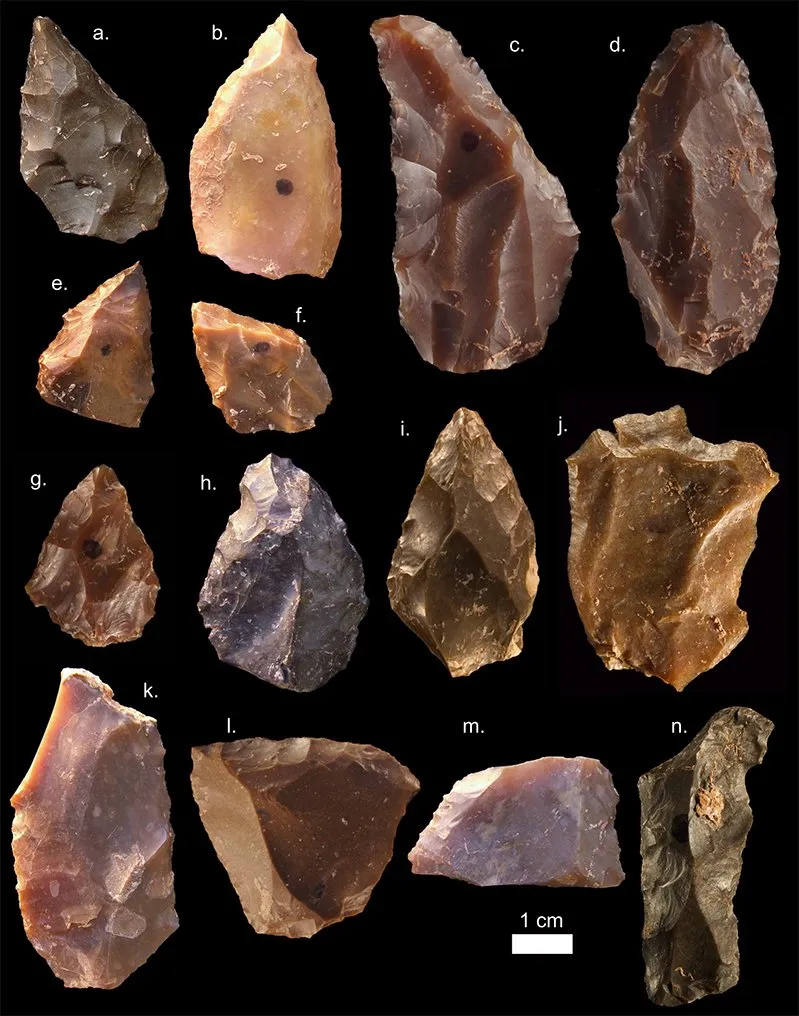
Middle Stone Age tools from Jebel Irhoud, Morocco, about 315,000 years old: points (a to i) and flakes struck from prepared Levallois cores (j and k). Photo: Mohammed Kamal, MPI EVA Leipzig, CC BY-SA 2.0, via Max Planck Society.
The questionWhat changed when people stopped making hand axes?
For hundreds of thousands of years, people in Africa made the same kind of tool: the hand axe. Then, in a basin in Kenya, the hand axes stop. In their place come smaller, carefully planned tools, red pigment, and stone carried from far away.
The end of the hand axe
The Acheulean, the tradition of making hand axes, was a way of making stone tools that hardly changed for an extraordinarily long time. At Olorgesailie, a basin in the Rift Valley of southern Kenya, its last tools date from 615,000 to 499,000 years ago. After that, both the tools and the animals in the ground change. By about 320,000 years ago, and certainly by 305,000, people there were making Middle Stone Age tools, with no hand axes among them.1
Planned tools, red pigment and far-off stone
The people of the early Middle Stone Age at Olorgesailie, between at least 295,000 and about 320,000 years ago, did several new things at once. They prepared cores so that each blow struck off a flake of the shape they wanted, and they made points. They took iron-rich rocks to get red pigment. And they brought stone for their tools from 25 to 50 kilometres away, or further. The animal bones show that they hunted large and small animals alike.2
The team argued that these habits imply real changes in how people related to the land around them and to one another.2
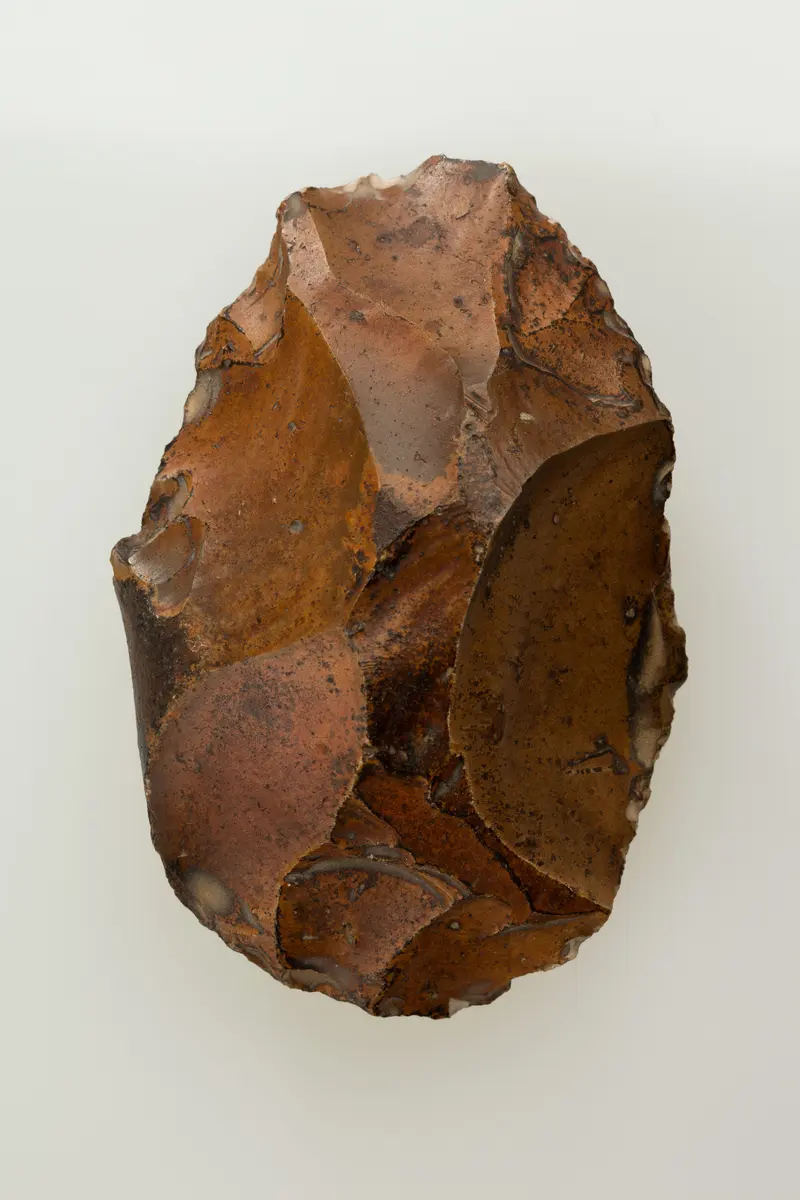 Hand axe, 11.9 cm long
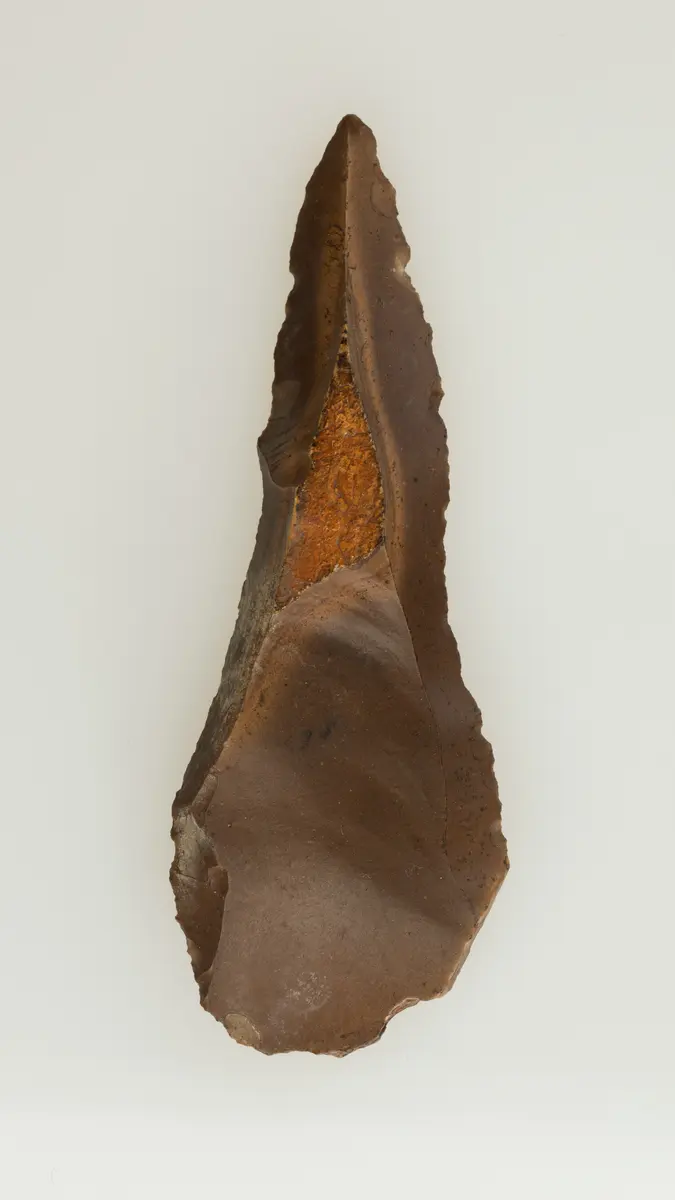 Levallois point, 10.9 cm long
The same toolkit, across Africa
Far to the north-west, the tools found with the oldest fossils of our species at Jebel Irhoud in Morocco are also Middle Stone Age: mostly points, many from prepared cores, and no hand axes.3 “The stone artefacts from Jebel Irhoud look very similar to ones from deposits of similar age in east Africa and in southern Africa,” says the archaeologist Shannon McPherron. “It is likely that the technological innovations of the Middle Stone Age in Africa are linked to the emergence of Homo sapiens.”3
In southern Africa the Middle Stone Age lasted until about 50,000 years ago.4
Key words
- Hand axe
- A stone tool shaped on both sides into a teardrop, held in the hand. The main tool of the Acheulean.
- Acheulean
- The long tradition of making hand axes, older than the Middle Stone Age.
- Prepared core
- A stone shaped first, so that one blow strikes off a flake of the size and shape wanted.
- Pigment
- A coloured powder, such as ground red ochre.
Check yourself
Try to answer in your head, then open each one.
What tool did the Middle Stone Age replace?
The hand axe, the tool of the Acheulean.
By when had the Middle Stone Age begun at Olorgesailie?
Most likely by about 320,000 years ago, and at least by 305,000.
Name two new things people did at Olorgesailie in the early Middle Stone Age.
Any two of: made prepared cores and points, got red pigment from iron-rich rocks, carried stone from 25 to 50 km away, hunted both large and small animals.
Why do the tools of Jebel Irhoud matter to this story?
They are Middle Stone Age tools of the same age as the oldest fossils of our species, and look like tools of similar age in eastern and southern Africa.
Go deeper
- Older than anyone thought the fossils found with tools like these
- Paint, beads and a drawing what red pigment was used for, 200,000 years later
Sources for this page
Every number on this page comes from one of these. How we check.
Last reviewed 13 November 2026. Spotted a mistake? Tell us.
- Deino, A. L., Behrensmeyer, A. K., Brooks, A. S., Yellen, J. E., Sharp, W. D. and Potts, R. (2018). Chronology of the Acheulean to Middle Stone Age transition in eastern Africa. Science 360, 95–98 (abstract). doi.org/10.1126/science.aao2216Used for: At Olorgesailie, Kenya, late Acheulean tools from 615,000 to 499,000 years ago; Middle Stone Age without Acheulean tools most likely by about 320,000 years ago and at least by 305,000. Checked 13 November 2026.
- Brooks, A. S., Yellen, J. E., Potts, R., Behrensmeyer, A. K., Deino, A. L., Leslie, D. E., Ambrose, S. H. and others (2018). Long-distance stone transport and pigment use in the earliest Middle Stone Age. Science 360, 90–94 (abstract). doi.org/10.1126/science.aao2646Used for: Middle Stone Age sites at Olorgesailie from at least 295,000 to about 320,000 years ago; prepared cores and points; red pigment from iron-rich rocks; stone brought from 25 to 50 km away or more; large and small prey. Checked 13 November 2026.
- Max Planck Society (2017). The first of our kind: scientists discover the oldest Homo sapiens fossils at Jebel Irhoud, Morocco. Research news, 7 June 2017. www.mpg.de/11322481/oldest-homo-sapiens-fossils-at-jebel-irhoud-moroccoUsed for: Jebel Irhoud known since the 1960s; new digs from 2004; fossils from six to 22, of at least five people; skulls, teeth and long bones; heated flints dated by thermoluminescence; the Irhoud 3 jaw once dated to 160,000 years; Omo Kibish 195,000 and Herto 160,000 the oldest before; quotes from Jean-Jacques Hublin and Daniel Richter; the face almost indistinguishable from people today and the long braincase, and a quote from Philipp Gunz; Florisbad and the three oldest sites across Africa; animal bones from hunting, mostly gazelle; Middle Stone Age tools, Levallois prepared cores and mostly pointed forms, of good flint brought to the site, and no hand axes; a quote from Shannon McPherron; photographs of the skull, tools and site. Checked 13 November 2026.
- Douze, K., Wurz, S. and Henshilwood, C. S. (2015). Techno-cultural characterization of the MIS 5 (c. 105–90 ka) lithic industries at Blombos Cave, South Africa. PLOS ONE 10, e0142151. pmc.ncbi.nlm.nih.gov/articles/PMC4651340/Used for: Blombos Cave lies in an old sea cliff about 100 m from the Indian Ocean, 34.5 m above the sea, with an opening 1 to 1.5 m high before digging began in 1991; the Still Bay layers (about 78,000 to 71,000 years ago) hold engraved ochre, marine shell beads, bone tools and heat-treated points; the Middle Stone Age of South Africa lasted from about 300,000 to 50,000 years ago. Checked 13 November 2026.
- The Metropolitan Museum of Art. Biface (hand axe), flint, from Thebes, Egypt, dated by the museum ca. 400,000–240,000 B.C.. Collection record 573096, Open Access (CC0). www.metmuseum.org/art/collection/search/573096Used for: A hand axe, 11.9 cm long. Checked 13 November 2026.
- The Metropolitan Museum of Art. Retouched Levallois point, flint, from Thebes, Egypt, dated by the museum ca. 240,000–40,000 B.C.. Collection record 573092, Open Access (CC0). www.metmuseum.org/art/collection/search/573092Used for: A retouched Levallois point, 10.9 cm long. Checked 13 November 2026.