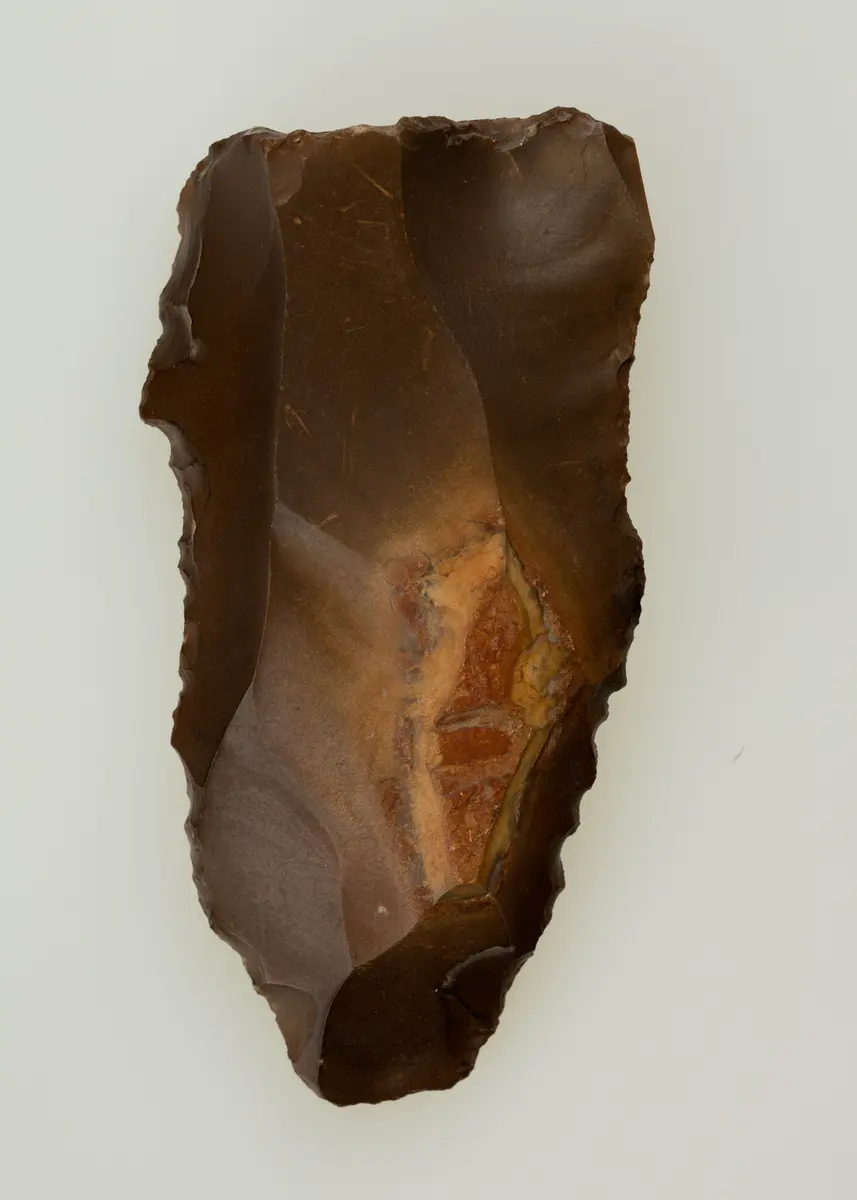
From Egypt, not Blombos; dated by the museum to about 240,000 to 40,000 BC
Chapter Six
Paint, beads and a drawing
About 100,000 to 73,000 years ago
A flint tool with a toothed (denticulated) edge, from Thebes in Egypt, 11 cm long. We could not find a photograph from Blombos Cave with an open licence, so none is shown. Photo: The Metropolitan Museum of Art, CC0, via The Met Open Access.
The questionWhen did people start to make marks that meant something?
In a cave in a sea cliff on the south coast of South Africa, people mixed red paint in shells 100,000 years ago. Much later, in the same cave, someone drew a pattern of crossed lines on a flake of stone. It is the oldest drawing known.
A cave in a sea cliff
Blombos Cave lies in an ancient sea cliff about 100 metres from the Indian Ocean, 34.5 metres above the sea. Before digging began in 1991, its opening was only 1 to 1.5 metres high.1 Its layers hold the Middle Stone Age of southern Africa, which lasted from about 300,000 to 50,000 years ago.1
A paint workshop in two shells
In 2008, Christopher Henshilwood’s team uncovered a workshop about 100,000 years old. Someone had made a liquid mixture rich in ochre and kept it in two abalone shells. Around them lay the toolkit: ochre, bone, charcoal, grindstones and hammerstones.2 Nobody knows what the paint was for. It might have decorated bodies or things, or protected skin.2 The team saw the ability to find, mix and store materials like this as a landmark in the evolution of complex human thinking.2
Patterns, beads and a drawing
Higher in the cave, in layers of the Still Bay tradition from about 78,000 to 71,000 years ago, people left more marks of the same kind: pieces of ochre engraved with geometric patterns, beads made from sea shells, and bone tools, some of them engraved too.1 Two of the engraved pieces of ochre, published in 2002, come from layers dated to an average of 77,000 years.3
Then, in 2018, the team reported a flake of silcrete stone with a cross-hatched pattern drawn on it in red, about 73,000 years old. Tests under the microscope and of the chemistry showed that red ochre had been put on the flake deliberately, with an ochre crayon. It is older than any drawing known before by at least 30,000 years.4
Key words
- Ochre
- An earth rich in iron, red or yellow, ground to make pigment.
- Abalone
- A large sea snail with a wide, shallow shell.
- Engraving
- A pattern cut or scratched into a surface.
- Still Bay
- A tradition of stone tools in southern Africa, about 78,000 to 71,000 years ago, named after a place.
- Abstract
- Not a picture of anything we can recognise, such as a pattern of lines.
Check yourself
Try to answer in your head, then open each one.
What was found in two abalone shells at Blombos?
An ochre-rich liquid mixture, made and stored there about 100,000 years ago.
What else was found with the shells?
Ochre, bone, charcoal, grindstones and hammerstones.
What is the drawing, and how old is it?
A cross-hatched pattern drawn with an ochre crayon on a flake of stone, about 73,000 years old.
How did the team know the lines were drawn on purpose?
Microscope and chemical tests showed red ochre had been applied to the flake with an ochre crayon.
Go deeper
- The first hands hand stencils, among the oldest pictures
- A new way to make tools red pigment 200,000 years earlier
Sources for this page
Every number on this page comes from one of these. How we check.
Last reviewed 13 November 2026. Spotted a mistake? Tell us.
- Douze, K., Wurz, S. and Henshilwood, C. S. (2015). Techno-cultural characterization of the MIS 5 (c. 105–90 ka) lithic industries at Blombos Cave, South Africa. PLOS ONE 10, e0142151. pmc.ncbi.nlm.nih.gov/articles/PMC4651340/Used for: Blombos Cave lies in an old sea cliff about 100 m from the Indian Ocean, 34.5 m above the sea, with an opening 1 to 1.5 m high before digging began in 1991; the Still Bay layers (about 78,000 to 71,000 years ago) hold engraved ochre, marine shell beads, bone tools and heat-treated points; the Middle Stone Age of South Africa lasted from about 300,000 to 50,000 years ago. Checked 13 November 2026.
- Henshilwood, C. S., d’Errico, F., van Niekerk, K. L., Coquinot, Y., Jacobs, Z., Lauritzen, S.-E. and others (2011). A 100,000-year-old ochre-processing workshop at Blombos Cave, South Africa. Science 334, 219–222 (abstract). doi.org/10.1126/science.1211535Used for: Found in 2008: an ochre-rich liquid mixture made and stored in two abalone shells 100,000 years ago, with ochre, bone, charcoal, grindstones and hammerstones; its use unknown, perhaps decoration or protecting skin. Checked 13 November 2026.
- Henshilwood, C. S., d’Errico, F., Yates, R., Jacobs, Z., Tribolo, C., Duller, G. A. T., Mercier, N. and others (2002). Emergence of modern human behavior: Middle Stone Age engravings from South Africa. Science 295, 1278–1280 (abstract). doi.org/10.1126/science.1067575Used for: Two pieces of red ochre engraved with abstract patterns from Blombos Cave; the layers dated by thermoluminescence of burnt stone to a mean of 77,000 years. Checked 13 November 2026.
- Henshilwood, C. S., d’Errico, F., van Niekerk, K. L., Dayet, L., Queffelec, A. and Pollarolo, L. (2018). An abstract drawing from the 73,000-year-old levels at Blombos Cave, South Africa. Nature 562, 115–118 (abstract). doi.org/10.1038/s41586-018-0514-3Used for: A cross-hatched pattern drawn with an ochre crayon on a ground silcrete flake, about 73,000 years old; from Still Bay levels with shell beads and engraved ochre; at least 30,000 years older than the earliest drawings known before. Checked 13 November 2026.
- The Metropolitan Museum of Art. Denticulated tool, flint, from Thebes, Egypt, dated by the museum ca. 240,000–40,000 B.C.. Collection record 573090, Open Access (CC0). www.metmuseum.org/art/collection/search/573090Used for: A flint tool with a toothed edge, 11 cm long. Checked 13 November 2026.