Chapter One
Older than anyone thought
About 315,000 years ago
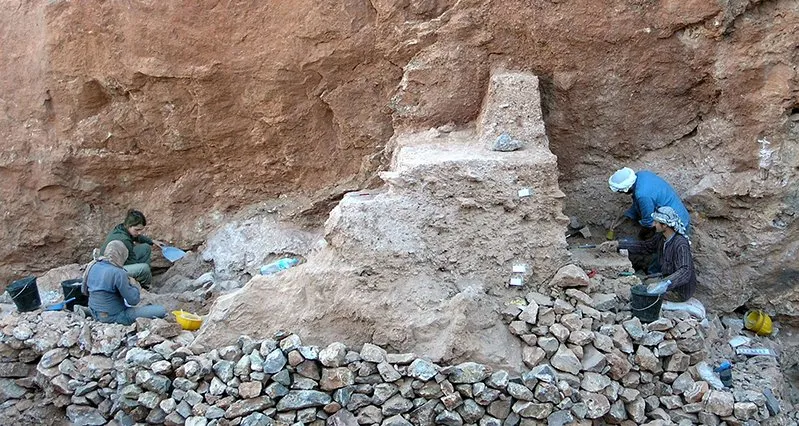
Excavators at Jebel Irhoud. The new fossils were found in the sediments in front of the two working on the left. Photo: Shannon McPherron, MPI EVA Leipzig, CC BY-SA 2.0, via Max Planck Society.
The questionHow did a site in Morocco push our species back by 100,000 years?
For decades the oldest fossils of our species came from Ethiopia, about 200,000 years old. Then new digs at a hill in Morocco, and some flints that had been dropped in a fire, pushed the date back by more than 100,000 years.
A hill in Morocco
Jebel Irhoud has been known since the 1960s for its human fossils and its stone tools. But nobody could be sure how old they were.1 Until 2017 the oldest fossils known to belong to our species came from Omo Kibish in Ethiopia, dated to about 195,000 years, and Herto, also in Ethiopia, at about 160,000. Most researchers thought that everyone alive today descends from people who lived in East Africa about 200,000 years ago.1
In 2004 a team led by Jean-Jacques Hublin, of the Max Planck Institute for Evolutionary Anthropology, and Abdelouahed Ben-Ncer, of Morocco’s National Institute for Archaeology and Heritage, began to dig again. They found new fossils in place in the ground, raising the number from the site from six to 22: parts of skulls, teeth and long bones from at least five people.1
Clocks in burnt flint
To date the fossils, the team turned to the flint tools lying in the same layers. Many had been burnt. Thermoluminescence dates when a flint was last heated, so a tool dropped into a fire records the time of that fire.2 “Well dated sites of this age are exceptionally rare in Africa, but we were fortunate that so many of the Jebel Irhoud flint artefacts had been heated in the past,” said the geochronologist Daniel Richter.1
Taken together, the flints gave an age of 315,000 years, give or take 34,000. The team also recalculated the age of a jaw found at the site in the 1960s, known as Irhoud 3. It had been dated to about 160,000 years. With new measurements of the radioactivity in the ground, its age came out at 286,000 years, give or take 32,000, in line with the flints.21
What lay with them
The fossils lay among animal bones from hunting, most often of gazelle. The stone tools belong to the Middle Stone Age: most are points, many made by the Levallois method of preparing a stone before striking a flake from it, and most were made of good flint brought to the site from elsewhere. There were no hand axes, the tool of older sites.1
The flints date the Middle Stone Age at Jebel Irhoud too, making it one of the oldest directly dated sites of that age in Africa. The team argued that our species and the Middle Stone Age appeared at about the same time, and probably across a large part of Africa, not in one place.2
Key words
- Fossil
- The remains of a living thing preserved in rock or earth, such as bone turned to stone.
- Excavation
- Digging carefully, layer by layer, recording where everything lies.
- Thermoluminescence
- A way of dating something that was heated, such as a burnt flint, by measuring the energy it has stored since.
- Flint
- A hard stone that breaks with sharp edges, used for making tools.
- Middle Stone Age
- In Africa, the long stretch of time after the age of hand axes, from about 300,000 to 50,000 years ago.
Check yourself
Try to answer in your head, then open each one.
Before 2017, where were the oldest known fossils of our species from, and how old were they?
From Omo Kibish in Ethiopia, about 195,000 years old.
What did the team date at Jebel Irhoud, and how?
Flint tools that had been heated in fires, by thermoluminescence.
What happened to the age of the Irhoud 3 jaw?
It was recalculated from about 160,000 years to about 286,000 years.
Why do some researchers not call the Irhoud people Homo sapiens?
Because their braincase is long, not rounded like ours, so they see them as a more primitive species.
Go deeper
- A face like ours what the Irhoud skulls show
- A new way to make tools the kind of tools found with them
Sources for this page
Every number on this page comes from one of these. How we check.
Last reviewed 13 November 2026. Spotted a mistake? Tell us.
- Max Planck Society (2017). The first of our kind: scientists discover the oldest Homo sapiens fossils at Jebel Irhoud, Morocco. Research news, 7 June 2017. www.mpg.de/11322481/oldest-homo-sapiens-fossils-at-jebel-irhoud-moroccoUsed for: Jebel Irhoud known since the 1960s; new digs from 2004; fossils from six to 22, of at least five people; skulls, teeth and long bones; heated flints dated by thermoluminescence; the Irhoud 3 jaw once dated to 160,000 years; Omo Kibish 195,000 and Herto 160,000 the oldest before; quotes from Jean-Jacques Hublin and Daniel Richter; the face almost indistinguishable from people today and the long braincase, and a quote from Philipp Gunz; Florisbad and the three oldest sites across Africa; animal bones from hunting, mostly gazelle; Middle Stone Age tools, Levallois prepared cores and mostly pointed forms, of good flint brought to the site, and no hand axes; a quote from Shannon McPherron; photographs of the skull, tools and site. Checked 13 November 2026.
- Richter, D., Grün, R. and others (2017). The age of the hominin fossils from Jebel Irhoud, Morocco, and the origins of the Middle Stone Age. Nature 546, 293–296. doi.org/10.1038/nature22335Used for: The age of the Jebel Irhoud fossils, about 315,000 years (give or take 34,000). Checked 11 November 2026.
- Hublin, J.-J., Ben-Ncer, A. and others (2017). New fossils from Jebel Irhoud, Morocco and the pan-African origin of Homo sapiens. Nature 546, 289–292. doi.org/10.1038/nature22336Used for: The Jebel Irhoud fossils as early members of our species, and the debate around them. Checked 11 November 2026.
- Scerri, E. M. L., Thomas, M. G., Manica, A., Gunz, P., Stock, J. T., Stringer, C. and others (2018). Did our species evolve in subdivided populations across Africa, and why does it matter? Trends in Ecology and Evolution 33, 582–594. pmc.ncbi.nlm.nih.gov/articles/PMC6092560/Used for: Homo sapiens evolved within a set of interlinked groups living across Africa, whose connections changed over time, not in one region or population; early fossils (Jebel Irhoud, Florisbad, Omo Kibish, Herto) are varied in form; some researchers call Jebel Irhoud and Florisbad a more primitive species; the Sahara shrank and lakes and rivers spread across north Africa at times; the KhoeSan of southern Africa keep the greatest genetic diversity of any people today, on a branch that split 150,000 to 300,000 years ago. Checked 13 November 2026.