Lesson 1 of 3 · 315,000 years ago to now

How long is human history?

Far longer than the part anyone wrote down. Here it is on one line, at its true length, zooming in a step at a time.

Now
The line covers the last 315,000 years. Drawn to scale: equal distances are equal lengths of time.

315,000 years ago

The oldest of us found so far

In 2017 a team working at Jebel Irhoud, in Morocco, dated skull and jaw bones of early humans to about 315,000 years ago, give or take 34,000.1 That pushed the earliest known members of our species back by about 100,000 years.2

That is the left-hand end of the line. Everything else on this page happens to the right of it.

At least 67,800 years ago

Hands on the wall

On the island of Muna, in Indonesia, someone blew paint around their hand on a cave wall at least 67,800 years ago. It is the oldest dated cave art yet reported.3 Nearby, on Sulawesi, a painted scene of people and a pig is at least 51,200 years old.4 In Spain, a hand stencil at El Castillo is at least 37,300.5

These are the first marks on this line that still say: a person was here. The first hands has the full story.

About 11,700 years ago

The ice age ends

Ice cores from Greenland show the climate warming sharply about 11,700 years ago. Geologists start the present age of the Earth, the Holocene, from that moment.6

Soon after, at Göbekli Tepe in what is now Türkiye, people who lived by hunting and gathering raised rings of carved stone pillars, from about 9600 BC.7 By now we have zoomed in more than twenty times.

3400 BC onwards

Writing, at last

The oldest known writing is on clay tablets from Uruk, in Iraq, made between 3400 and 3200 BC. Egypt had writing by the end of that millennium too. China followed in the second millennium BC, and Mesoamerica by the middle of the first.8910

On the full line, all of this sits in the last 1.7 per cent. Everything before it is known only from bones, tools, paint and buildings.

About AD 100

A letter from Britain

At Vindolanda, near what would become Hadrian’s Wall, Claudia Severa sent a birthday invitation to her friend Sulpicia Lepidina, some time between AD 97 and 105.11 Building of the Wall itself began some twenty years later, about AD 122 to 126.12

Two thousand years feels like a long time. On the full line it is less than one per cent.

20 July 1969

One lifetime

People first walked on the Moon in 1969.13 Plenty of people alive today remember it. At this zoom the line is one hundred years long, and the whole of it would be too thin to see on the first line we drew.
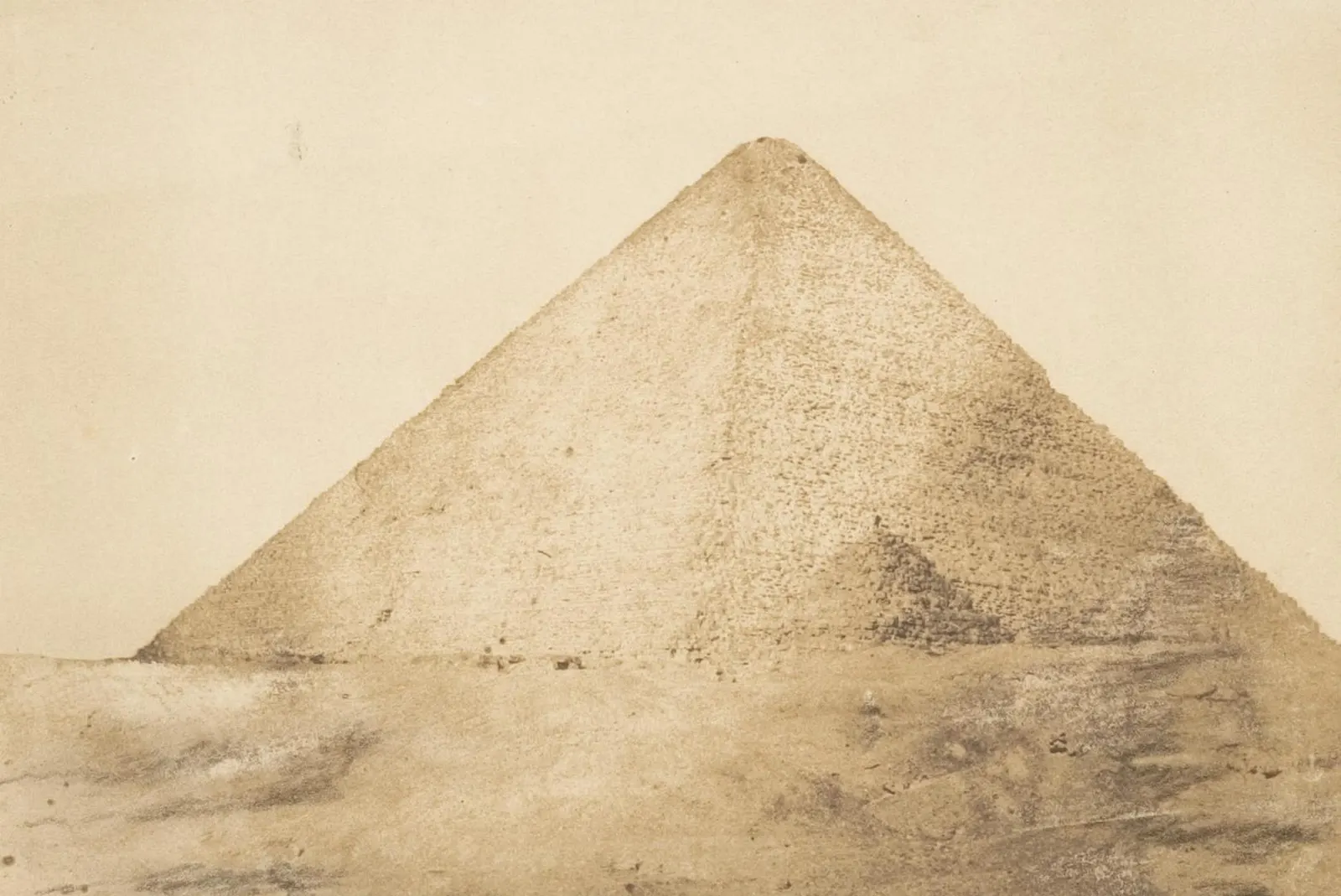
A faded brown photograph of the Great Pyramid seen from one corner
The Great Pyramid, photographed by Maxime Du Camp in December 1849.Photo: Maxime Du Camp, The Met, CC0, via The Met Open Access

Even the pyramids are recent

The Great Pyramid was built for the king Khufu, who reigned from about 2551 BC.14 That is about 4,576 years ago. It feels like the deep past, but it sits in the last 1.5 per cent of our species’ time. On the line above, it would be a mark almost touching the right-hand end.

Read the chapter on the town that built it

If it were one day

Squash the 315,000 years into a single day, starting at midnight with the people of Jebel Irhoud. Each hour is then 13,125 years and each minute about 219.

Time on the clockWhat happened
18:50The oldest dated hand stencil, at least 67,800 years ago
23:06The last ice age ends, about 11,700 years ago
23:35Writing, in Mesopotamia, 3400 to 3200 BC
23:51Hadrian’s Wall, from about AD 122
23:59:44People walk on the Moon, 20 July 1969

Clock times are worked out on this page from the dates above: time = 24 hours × (1 − years ago ÷ 315,000).

00:0006:0012:0018:0023:35writing begins
The red arc is the time since writing began. The two dots mark the oldest hand stencil and the end of the ice age.

Where experts disagree

Are the Jebel Irhoud people really us?

Yes, an early form.Their faces and teeth fall within the range of people today. The team that described them calls them early members of Homo sapiens.2

Not quite, say others.Their braincases are longer and lower than ours, as the same team notes. Some researchers would rather call them close relatives of our species than members of it.2

Either way, the dates stand. The line on this page would only get a little shorter, not change its shape: writing would still be a sliver at the very end.

And our species is itself the end of a much longer line. The millions of years before us are told on our companion site, Our Eons, in Before us.

Key words

Homo sapiens
Our species. The oldest fossils found so far, from Jebel Irhoud in Morocco, are about 315,000 years old.
Prehistory
The time before writing. Almost all of the human story.
True scale
Drawn so that equal lengths stand for equal amounts of time, however small the recent part looks.
Dating
Working out how old something is. Each date on the line comes from a scientific method or a written record, with a source.

Check yourself

Try to answer in your head, then open each one.

How old are the oldest known fossils of our species, and where were they found?

About 315,000 years old, at Jebel Irhoud in Morocco.

On the line, how much of the human story has any written record?

Only a tiny sliver at the very end: writing began around 3400 BC, about 5,400 years ago.

If all of human history were one day, when would writing appear?

In the last half-hour or so before midnight. The page works out the exact minute.

So how do we know about the rest?

From what people left behind: bones, tools, paintings, buildings, and the places they lived.

Sources for this page

Every number on this page comes from one of these. How we check.

Last reviewed 12 November 2026. Spotted a mistake? Tell us.

  1. Richter, D., Grün, R. and others (2017). The age of the hominin fossils from Jebel Irhoud, Morocco, and the origins of the Middle Stone Age. Nature 546, 293–296. doi.org/10.1038/nature22335Used for: The age of the Jebel Irhoud fossils, about 315,000 years (give or take 34,000). Checked 11 November 2026.
  2. Hublin, J.-J., Ben-Ncer, A. and others (2017). New fossils from Jebel Irhoud, Morocco and the pan-African origin of Homo sapiens. Nature 546, 289–292. doi.org/10.1038/nature22336Used for: The Jebel Irhoud fossils as early members of our species, and the debate around them. Checked 11 November 2026.
  3. Oktaviana, A. A., Joannes-Boyau, R. and others (2026). Rock art from at least 67,800 years ago in Sulawesi. Nature 650, 652–656. doi.org/10.1038/s41586-025-09968-yUsed for: The hand stencil in Liang Metanduno, Muna, dated to at least 67,800 years ago. Checked 11 November 2026.
  4. Oktaviana, A. A., Joannes-Boyau, R. and others (2024). Narrative cave art in Indonesia by 51,200 years ago. Nature 631, 814–818. doi.org/10.1038/s41586-024-07541-7Used for: The painted scene at Leang Karampuang, Sulawesi, at least 51,200 years old. Checked 11 November 2026.
  5. Pike, A. W. G., Hoffmann, D. L. and others (2012). U-series dating of Paleolithic art in 11 caves in Spain. Science 336, 1409–1413. doi.org/10.1126/science.1219957Used for: El Castillo: a red disc at least 40,800 years old and a hand stencil at least 37,300 years old; how uranium-series dating gives a minimum age. Checked 11 November 2026.
  6. Walker, M., Johnsen, S. and others (2009). Formal definition and dating of the GSSP for the base of the Holocene using the Greenland NGRIP ice core. Journal of Quaternary Science 24, 3–17. doi.org/10.1002/jqs.1227Used for: The end of the last ice age, dated to 11,700 years before AD 2000. Checked 11 November 2026.
  7. UNESCO World Heritage Centre. Göbekli Tepe (inscribed 2018). whc.unesco.org/en/list/1572Used for: Göbekli Tepe as one of the earliest known monumental sites. Checked 11 November 2026.
  8. Woods, C. (ed.) (2010). Visible Language: Inventions of Writing in the Ancient Middle East and Beyond. Oriental Institute Museum Publications 32. Exhibition story on Google Arts & Culture. artsandculture.google.com/story/rwWhZTdobl0nLAUsed for: Four independent inventions of writing; the Uruk tablets, 3400–3200 BC; Egypt by the end of the 4th millennium BC; China in the 2nd millennium BC; Mesoamerica by the mid 1st millennium BC. Checked 11 November 2026.
  9. British Library, Asian and African Studies blog (2014). The Couling-Chalfant collection of oracle bones in the British Library. britishlibrary.typepad.co.uk/asian-and-african/2014/06/the-couling-chalfant-collection-of-oracle-bones-in-the-british-library.htmlUsed for: Shang oracle bones as the oldest known Chinese writing, and the ancestor of today’s characters. Checked 11 November 2026.
  10. Saturno, W. A., Stuart, D. and Beltrán, B. (2006). Early Maya writing at San Bartolo, Guatemala. Science 311, 1281–1283. doi.org/10.1126/science.1121745Used for: Maya writing at San Bartolo, about 300 to 200 BC. Checked 11 November 2026.
  11. Roman Inscriptions of Britain online. Tab. Vindol. 291: Birthday invitation of Sulpicia Lepidina. Translation after A. K. Bowman and J. D. Thomas. romaninscriptionsofbritain.org/inscriptions/TabVindol291Used for: The text, date, handwriting and present home of the birthday invitation. Checked 11 November 2026.
  12. Newcastle City Council, Sitelines (Tyne and Wear HER 196). Hadrian’s Wall. sitelines.newcastle.gov.uk/SMR/196Used for: The Wall’s length (about 73.5 miles, Wallsend to Bowness-on-Solway) and the start of building, about AD 122 to 126. Checked 11 November 2026.
  13. NASA. Apollo 11 mission page. www.nasa.gov/mission/apollo-11/Used for: The first Moon landing, 20 July 1969. Checked 11 November 2026.
  14. The Metropolitan Museum of Art. Relief fragment with king Khufu’s cattle. Dynasty 4, reign of Khufu, ca. 2551–2528 BC. Collection record 543890, Open Access (CC0). www.metmuseum.org/art/collection/search/543890Used for: The dates of Khufu’s reign, and a block from his time reused at Lisht. Checked 12 November 2026.
  15. The Metropolitan Museum of Art. Maxime Du Camp, Vue de la grande pyramide (Chéops) prise à l’angle S.E., December 1849. Collection record 287082, Open Access (CC0). www.metmuseum.org/art/collection/search/287082Used for: A photograph of the Great Pyramid taken in December 1849. Checked 12 November 2026.