Chapter Two
Bronze for the ancestors
About 1300 to 1041 BC; Lady Hao’s tomb found 1976
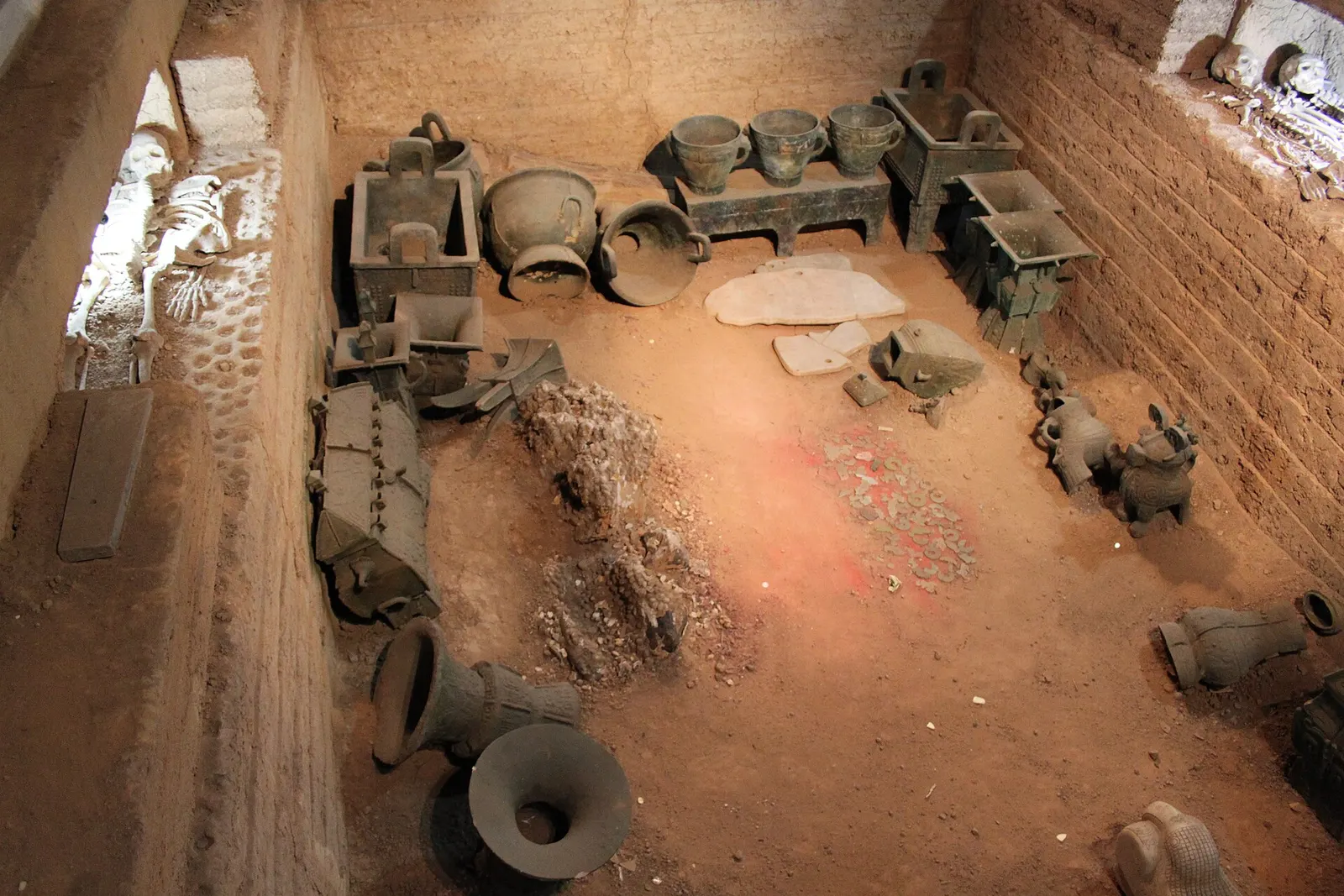
Lady Hao’s tomb at Anyang, set out again with copies; the real objects are in museums in Beijing and Zhengzhou. Photo: Gary Todd, CC0, via Wikimedia Commons.

The questionWhat were the Shang bronzes for, and what did a queen take to her grave?
The Shang made some of the finest bronze in the ancient world, and they did not make it for everyday cooking. These vessels held food and wine for the ancestors, and they were buried with the people who used them. One tomb, found in 1976, still had everything in it.
Fits: Primary (KS2). See Courses.
The story
To the Shang kings, the dead were not gone. Dead kings and queens could send rain or drought, sickness or victory, and they expected to be fed. The oracle bones are full of questions about which ancestor wanted an offering, and what it should be.11 The offerings were made in bronze.
Set the table
Nine Shang bronzes from the Met, side by side at their true sizes compared with each other. Each step on the scale is ten centimetres.
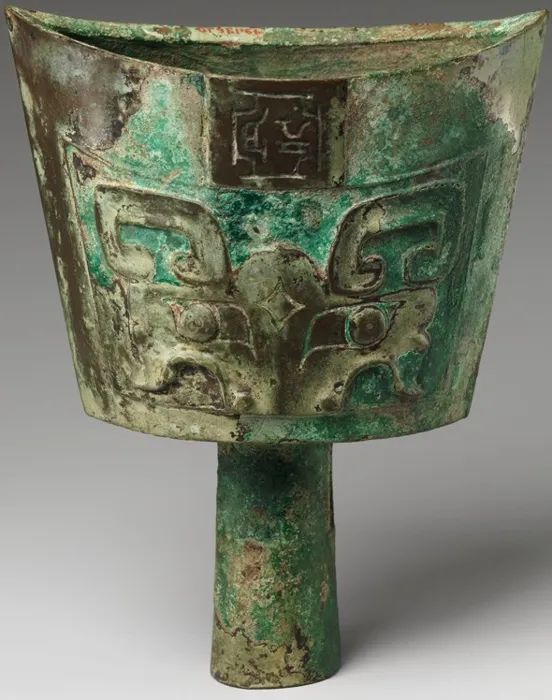 MusicBellnao · 15.4 cm
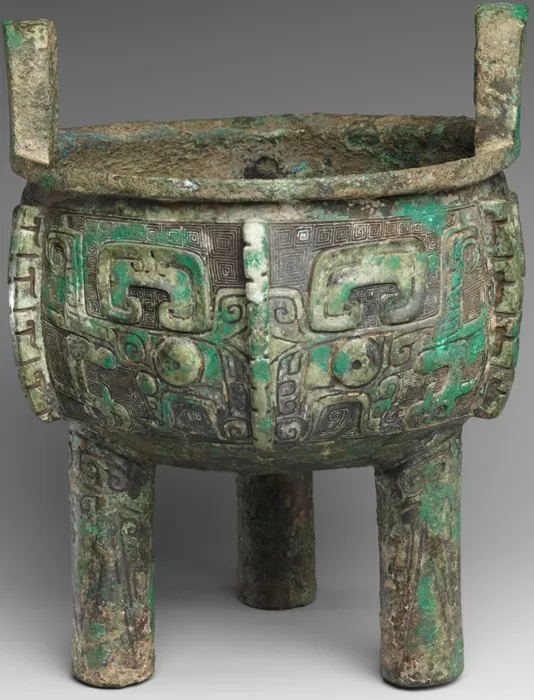 FoodCauldronding · 25.4 cm
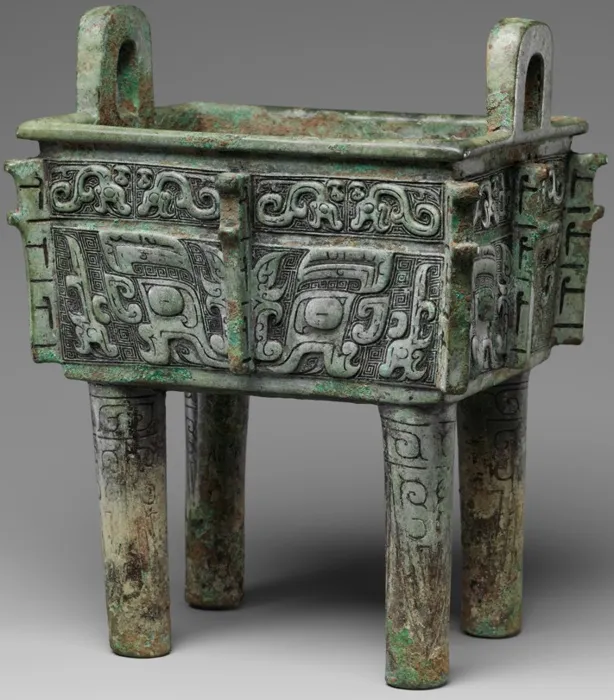 FoodSquare cauldronfangding · 22.9 cm
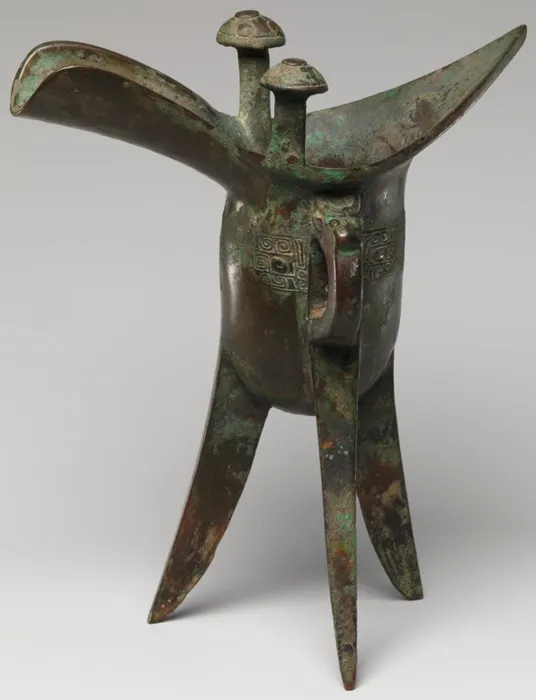 WineWine warmerjue · 11.4 cm
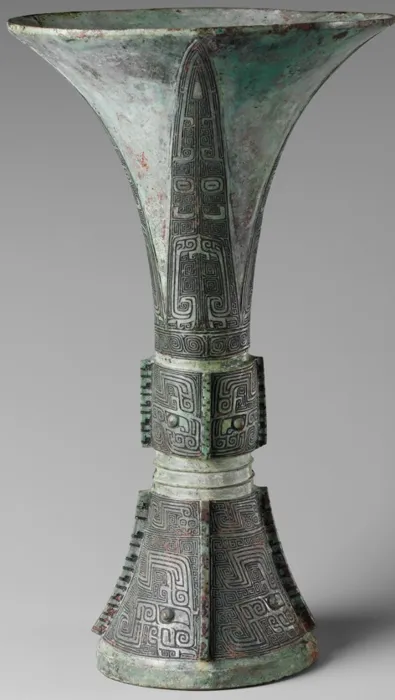 WineWine beakergu · 26.4 cm
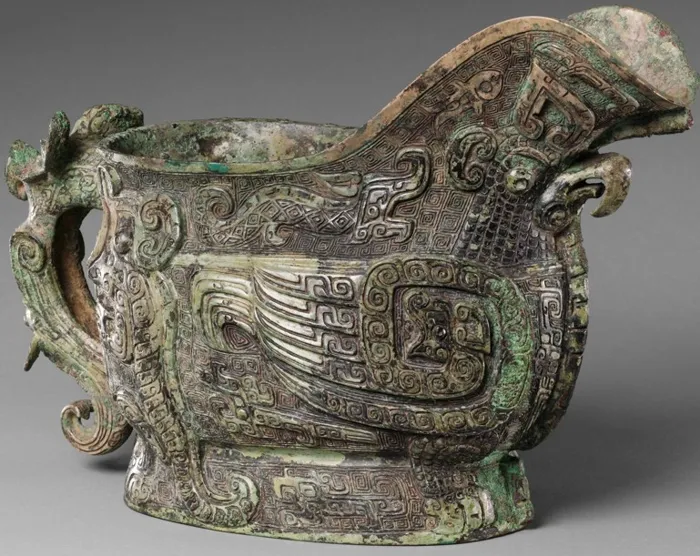 WineWine pourergong · 21.6 cm
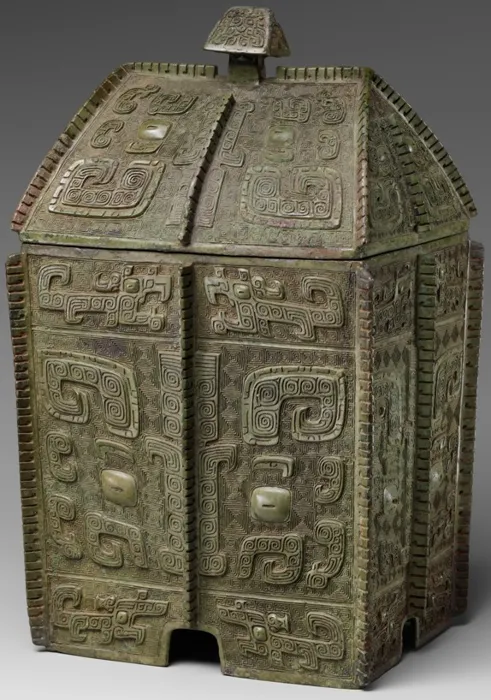 WineWine containerfangyi · 25.4 cm
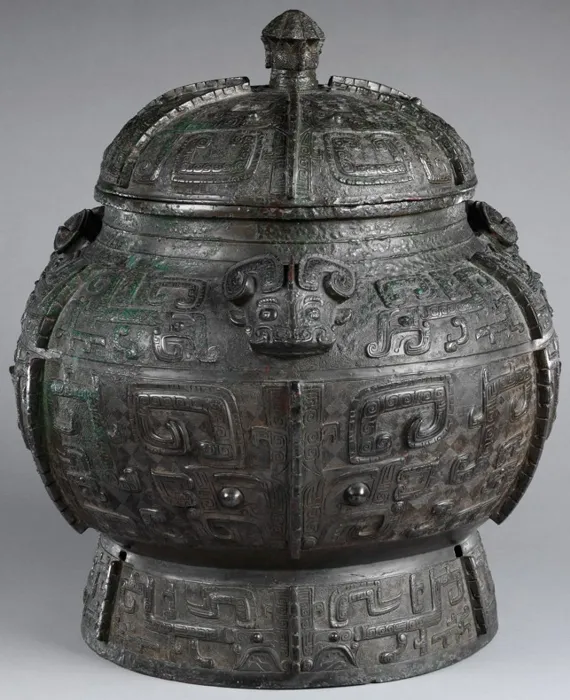 WineWine jarpou · 54 cm
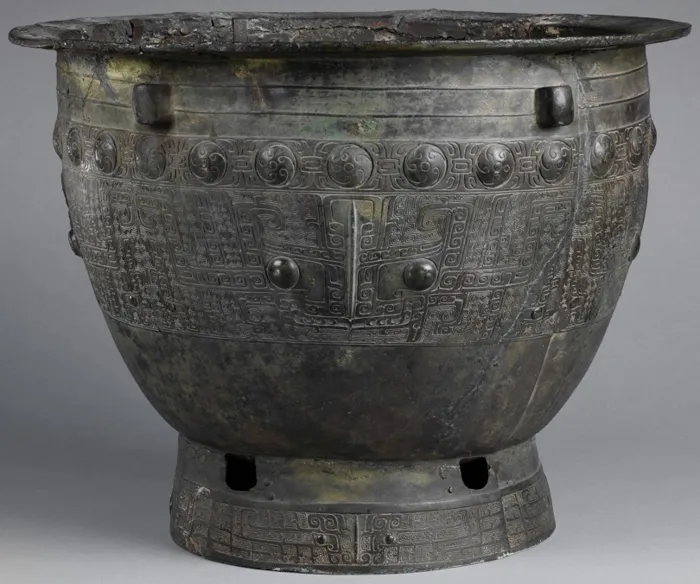 WaterWater basinyu · 36.8 cm
Most of the table is for wine: beakers, a warmer, a pourer and jars. The cauldrons, ding, held food, and the basin held water. Even the bell belonged to the ceremony.1,7,9
The biggest of all
The Met’s great wine jar is more than half a metre tall. The largest Shang bronze known, the Houmuwu cauldron, is 133 centimetres tall and weighs 832.84 kilograms.10
A queen’s tomb
Almost every Shang royal tomb was robbed long ago. One was not. In 1976 archaeologists at Anyang found a tomb, numbered Tomb 5, that no one had emptied.13 Inscriptions on its bronzes named its owner: Lady Hao, one of the consorts of King Wu Ding.12 It is the only Shang royal tomb found untouched.12
Lady Hao is also in the oracle bones. They show that she was more than a king’s wife: she led armies in war.12 Her tomb held hundreds of bronzes and hundreds of jades. It also held the skeletons of sixteen people and six dogs, killed to go with her.12
Where experts disagree: is Tomb 5 really from Wu Ding’s time?
Some doubted it.A Lady Hao is named in more than one group of oracle bones, and some scholars dated one of those groups much later than Wu Ding. If they were right, the tomb might be later too. Robert Thorp reviewed the argument soon after the tomb was published.13
Radiocarbon now points to Wu Ding.A 2021 study dated that disputed group of bones and found it most probably belongs to the time of Wu Ding and the king after him.14
Key words
- Bronze
- A metal made by melting copper with tin. It can be cast into detailed shapes.
- Ritual
- A ceremony done the same way each time. Shang rituals fed and honoured the ancestors.
- Ding
- A cauldron on legs, for food. The most important kind of Shang vessel.
- Consort
- A wife of a king. Wu Ding had several.
- Sacrifice
- Something, or someone, killed or given up as an offering.
Check yourself
Try to answer in your head, then open each one.
What did most of the vessels on the table hold?
Wine: 5 of the 9.
How tall is the Houmuwu cauldron, and how heavy?
133 centimetres tall, and 832.84 kilograms.
Why is Lady Hao’s tomb so important?
It is the only Shang royal tomb found that robbers had not emptied, so archaeologists saw it as it was left.
What do the oracle bones say Lady Hao did?
She was one of Wu Ding’s consorts, and she led soldiers.
Go deeper
- Asking the ancestors the bones that name Lady Hao
- Technology other things people made
Sources for this page
Every number on this page comes from one of these. How we check.
Last reviewed 12 November 2026. Spotted a mistake? Tell us.
- The Metropolitan Museum of Art. Ritual tripod cauldron (ding). Shang dynasty, 12th–11th century BCE. Collection record 61239, Open Access (CC0). www.metmuseum.org/art/collection/search/61239Used for: A round cauldron on three legs, 25.4 cm high. Checked 12 November 2026.
- The Metropolitan Museum of Art. Rectangular cauldron (fangding). Shang dynasty, 12th–11th century BCE. Collection record 60594, Open Access (CC0). www.metmuseum.org/art/collection/search/60594Used for: A four-legged cauldron, 22.9 cm high. Checked 12 November 2026.
- The Metropolitan Museum of Art. Rectangular wine container (fangyi). Shang dynasty, 12th century BCE. Collection record 44776, Open Access (CC0). www.metmuseum.org/art/collection/search/44776Used for: A lidded wine container, 25.4 cm high. Checked 12 November 2026.
- The Metropolitan Museum of Art. Wine beaker (gu). Shang dynasty, 13th century BCE. Collection record 44774, Open Access (CC0). www.metmuseum.org/art/collection/search/44774Used for: A tall wine beaker, 26.4 cm high. Checked 12 November 2026.
- The Metropolitan Museum of Art. Ritual wine warmer (jue). Shang dynasty, ca. 1600–1046 BCE. Collection record 61034, Open Access (CC0). www.metmuseum.org/art/collection/search/61034Used for: A three-legged wine warmer, 11.4 cm high. Checked 12 November 2026.
- The Metropolitan Museum of Art. Wine container (pou). Shang dynasty, 13th century BCE. Collection record 52617, Open Access (CC0). www.metmuseum.org/art/collection/search/52617Used for: A large lidded wine jar, 54 cm high. Checked 12 November 2026.
- The Metropolitan Museum of Art. Ritual water container (yu). Shang dynasty, 13th–12th century BCE. Collection record 61117, Open Access (CC0). www.metmuseum.org/art/collection/search/61117Used for: A wide water basin, 36.8 cm high. Checked 12 November 2026.
- The Metropolitan Museum of Art. Wine pouring vessel (gong). Shang dynasty, 13th–11th century BCE. Collection record 44781, Open Access (CC0). www.metmuseum.org/art/collection/search/44781Used for: A wine pourer shaped with animal heads, 21.6 cm high. Checked 12 November 2026.
- The Metropolitan Museum of Art. Upright bell (nao). Shang dynasty, 13th century BCE. Collection record 61245, Open Access (CC0). www.metmuseum.org/art/collection/search/61245Used for: A bell held mouth upwards, 15.4 cm high. Checked 12 November 2026.
- Li Song (2011). Chinese Bronze Ware. Cambridge: Cambridge University Press, pages 28 to 30. search.worldcat.org/search?q=Chinese%20Bronze%20Ware%20Li%20Song%202011Used for: The great Houmuwu cauldron: its size, weight and inscription. Checked 12 November 2026.
- Keightley, D. N. (1978). Sources of Shang History: The Oracle-Bone Inscriptions of Bronze Age China. Berkeley: University of California Press. search.worldcat.org/search?q=Sources%20of%20Shang%20History%20Keightley%201978Used for: How a divination was made and recorded, what the kings asked about, and the inscription about Lady Hao’s childbirth (Heji 14002). Checked 12 November 2026.
- Ebrey, P. B. (2006). The Cambridge Illustrated History of China. Cambridge: Cambridge University Press, pages 26 to 27. search.worldcat.org/search?q=Cambridge%20Illustrated%20History%20of%20China%20EbreyUsed for: Lady Hao as a consort of Wu Ding and a military leader, and her tomb as the only Shang royal tomb found unlooted. Checked 12 November 2026.
- Thorp, R. L. (1981). The date of Tomb 5 at Yinxu, Anyang: a review article. Artibus Asiae 43(3), 239–246. doi.org/10.2307/3249839Used for: The debate over when Tomb 5, Lady Hao’s tomb, was made. Checked 12 November 2026.
- Liu, K., Wu, X., Guo, Z., Yuan, S. and others (2021). Radiocarbon dating of oracle bones of Late Shang period in ancient China. Radiocarbon 63(1), 155–175. doi.org/10.1017/RDC.2020.90Used for: Radiocarbon dates for King Wu Ding’s reign (1254 to 1197 BC) and for the end of the Shang (about 1041 BC). Checked 12 November 2026.