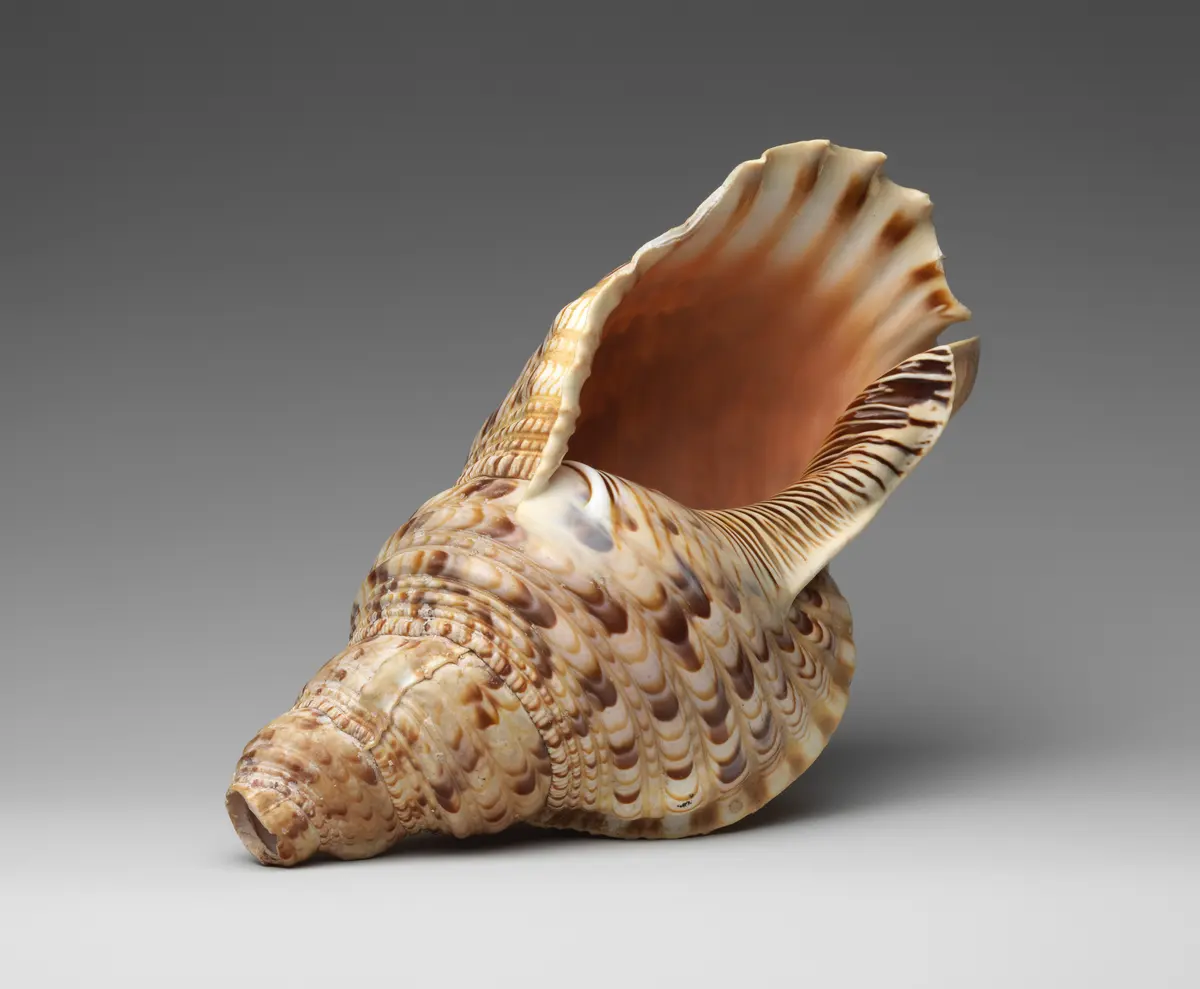
Made in the late 1800s, about 2,900 years after the Teouma burials
Landfall Four
Teouma, the oldest cemetery
About 3,000 years ago; found in 2003
A conch shell trumpet made in Vanuatu in the late 1800s, long after the Teouma burials. No picture of the burials is shown here. Photo: The Metropolitan Museum of Art, CC0, via The Met Open Access.
The questionWhat does the oldest cemetery in the Pacific tell us about the first people of Vanuatu?
A bulldozer and a shrimp farm
Teouma lies close to Port Vila, the capital of Vanuatu. In 2003 a bulldozer driver digging land for a shrimp farm spotted pieces of pottery. From 2004 to 2010, archaeologists from the Australian National University, among them Matthew Spriggs, dug the site with experts from the Vanuatu Cultural Centre. People from the local community, school students among them, joined the excavations.1
Graves without heads
The team found 68 graves and the remains of about a hundred people. Every adult was missing their head. Some had been laid face down. The heads are thought to have been taken away after the flesh had decayed, a practice found in the Pacific for a very long time.1
Some heads were brought back. Three skulls had been laid on the chest of an old man, and three between the legs of another person. A seventh skull was found inside one of the finely decorated pots that seem to have been part of Lapita burials.1
The cemetery held more than a hundred pots and plates, six of them complete: the largest collection of Lapita pottery found anywhere in the Pacific.1
What they ate
Next to the cemetery was the midden of a village. It shows that the settlers ate sea turtles, reef fish and fruit bats. They brought farmed plants and animals with them, but chemical tests on teeth from Teouma show they also lived off what they found. Some of the animals they ate are now extinct: a giant tortoise, a crocodile that lived on land, and several birds that could not fly. They were hunted until none were left.1
What their DNA says
Ancient DNA from Lapita burials was the first full set of genes ever read from people buried in the tropics. It showed that the first people of Vanuatu came originally from Taiwan or the northern Philippines.1 Their ancestry was largely East Asian, with almost nothing from the Papuan peoples of New Guinea.2
Most people in Vanuatu today have mainly Near Oceanian ancestry instead. A study in 2018 found why. A person of Papuan-related ancestry was living in Vanuatu by about 2,500 years ago, so newcomers from the Bismarck Archipelago began arriving soon after the first settlers. They kept coming for centuries, and slowly their ancestry replaced most of the first settlers’.2
Yet the languages did not change family. More than 120 languages are spoken in Vanuatu today, all descended from the Austronesian language of the first settlers. Vanuatu has more languages for its number of people than anywhere else on Earth.2
| When | Ancestry | Language |
|---|---|---|
| About 3,000 years ago | Mostly East Asian ancestry, from the Austronesian spread | An Austronesian language |
| By about 2,500 years ago | Papuan-related newcomers from the Bismarck Archipelago begin to arrive | Still Austronesian |
| Today | Mostly Near Oceanian (Papuan-related) ancestry | More than 120 languages, all descended from that first Austronesian one |
Key words
- Cemetery
- A place where the dead are buried together.
- Midden
- An ancient rubbish heap, full of shells, bones and broken things that show what people ate and used.
- Ancient DNA
- Genetic material recovered from very old bones or teeth.
- Ancestry
- Where a person’s forebears came from, as their DNA shows it.
- Extinct
- Gone for ever: no living animals of that kind are left.
Check yourself
Try to answer in your head, then open each one.
How was Teouma found?
In 2003 a bulldozer driver, clearing land for a shrimp farm, spotted pieces of pottery.
What was unusual about the adults buried there?
All of them were missing their heads, which were probably removed after the flesh had decayed.
Name two animals the first settlers ate that are now extinct.
Any two of: a giant tortoise, a crocodile that lived on land, and flightless birds.
What changed in Vanuatu after the first settlers, and what stayed the same?
Most of the ancestry changed, as Papuan-related people arrived over many centuries, but the Austronesian languages carried on.
Go deeper
- Pots stamped with teeth the pottery found in the graves
- Out of the Bismarcks where the first settlers’ ancestors came from
Sources for this page
Every number on this page comes from one of these. How we check.
Last reviewed 13 November 2026. Spotted a mistake? Tell us.
- Australian Academy of the Humanities (2021). On a Melanesian island, the Pacific’s oldest cemetery helps solve a mystery. Discovering Humanities series, October 2021. humanities.org.au/power-of-the-humanities/on-a-melanesian-island-the-pacifics-oldest-cemetery-helps-solve-a-mystery/Used for: Teouma, Efate: found by a bulldozer driver in 2003; dug from 2004 to 2010 by ANU and Vanuatu Cultural Centre teams; 68 graves and about 100 people, the adults without their heads; three skulls on an old man’s chest; a skull inside a pot; more than 100 pots and plates, six complete; animals hunted to extinction; first ancestry from Taiwan or the northern Philippines. Checked 13 November 2026.
- Max Planck Institute for the Science of Human History (2018). Ancient DNA reveals genetic replacement despite language continuity in the South Pacific. Press release, 27 February 2018, on Posth, C., Nägele, K. and others (2018), Nature Ecology & Evolution 2, 731–740. www.shh.mpg.de/851473/genetic-replacement-despite-language-continuity-in-the-South-PacificUsed for: The Austronesian expansion from about 5,500 years ago, probably from Taiwan; the first people of Vanuatu, about 3,000 years ago, of largely East Asian ancestry; Papuan-related people arriving by about 2,500 years ago; ancestry replaced over time while the languages carried on, more than 120 of them today. Checked 13 November 2026.
- The Metropolitan Museum of Art. Conch shell trumpet. Vanuatu; conch shell, late 19th century. Collection record 501400, Open Access (CC0). www.metmuseum.org/art/collection/search/501400Used for: A conch shell trumpet from Vanuatu, 30.5 cm long. Checked 13 November 2026.