Landfall One
Out of the Bismarcks
From about 1350 BC
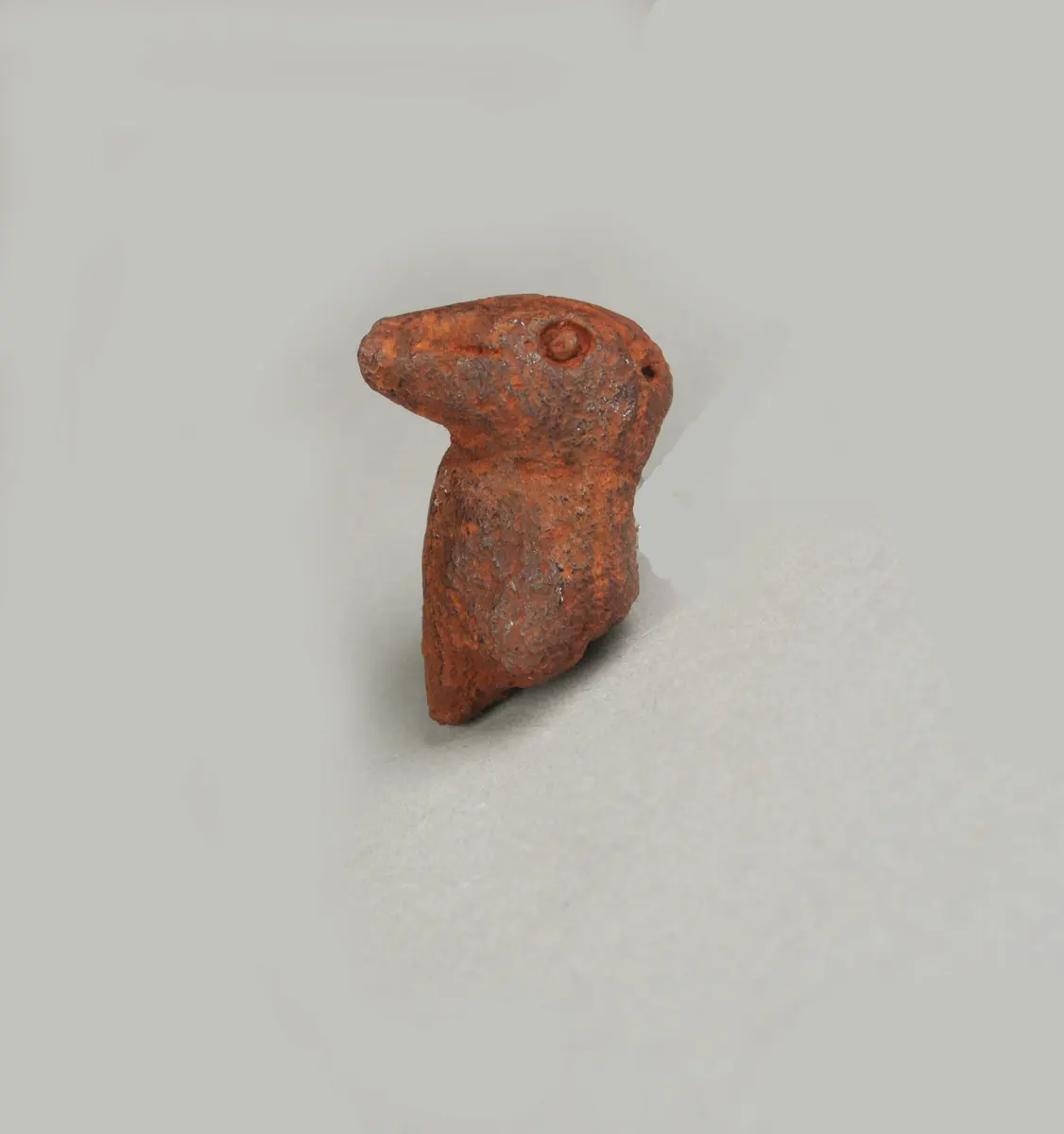
A cast of a small Lapita clay bird head, 3.8 cm high, from the Santa Cruz Islands. Photo: The Metropolitan Museum of Art, CC0, via The Met Open Access.
The questionWhere did the Lapita voyagers come from?
The islands north-east of New Guinea had been home to people for tens of thousands of years. Then, around 1350 BC, something new appeared there: villages on the beach, and pots stamped with rows of tiny dots. Their makers would become the first people to sail into the open Pacific.
People were already there
The first people reached this corner of the Pacific about 40,000 years ago. The sea was lower then, so New Guinea, Australia and Tasmania were one landmass, and the gaps between islands were smaller. People spread as far as the Bismarck Archipelago, north of New Guinea, and the Solomon Islands.1 Archaeologists call this part of the Pacific Near Oceania.
Then the spread stopped. East of the main chain of the Solomon Islands, the sea gap to the next islands became an invisible boundary. For 30,000 years nobody crossed it.1
- About 40,000 years agoNew Guinea, the Bismarck Archipelago and the Solomon IslandsThe first people reach Near Oceania, when the sea was lower and New Guinea, Australia and Tasmania were one land.1
- About 5,500 years agoProbably TaiwanFarming, seafaring people begin to spread south and east, speaking Austronesian languages.3
- LaterIsland Southeast AsiaThey spread through the islands, carrying farming with them, and reach Near Oceania, where Papuan peoples already live.3
- About 1350 BCThe Bismarck ArchipelagoLapita pottery appears. Soon its makers begin to sail east.2
Something new on the beach
Around 1350 BC, a new kind of pottery appeared in the Bismarck Archipelago, decorated with fine stamped patterns. Archaeologists call it Lapita. Soon after it began, the people who made it started to move east, in a spread of settlement that would stretch 4,500 kilometres.2
Lapita villages were built close to the beach. In Near Oceania they were mostly on small islands just off the coast. The people fished and farmed. Their tools included fish hooks made of shell, nets, spears and stone adzes.1
A language from Taiwan
The Lapita people spoke an Austronesian language. That family of languages is huge: today it has more than a thousand languages, from Madagascar to Rapa Nui. When linguists trace them back to a shared ancestor, Taiwan comes out as the most likely place they began.1
The spread probably began in Taiwan about 5,500 years ago. Farming, seafaring people moved out across Island Southeast Asia and in time reached Near Oceania, where they met the Papuan peoples of New Guinea and the Bismarck Archipelago.3
A branch to the west
Not every journey went east. For a long time no Lapita site was known on the New Guinea mainland at all. Then, at Caution Bay on the south coast of Papua New Guinea, archaeologists found Lapita pottery dated to about 950 to 550 BC.2
Key words
- Near Oceania
- New Guinea, the Bismarck Archipelago and the Solomon Islands: the part of the Pacific people reached about 40,000 years ago.
- Remote Oceania
- The islands further out, from Vanuatu and New Caledonia east, that no one reached until the Lapita voyagers.
- Archipelago
- A group of islands.
- Austronesian
- A family of more than a thousand languages, spoken from Madagascar to Rapa Nui.
- Adze
- A cutting tool like an axe, with the blade set across the handle, for shaping wood.
Check yourself
Try to answer in your head, then open each one.
When did Lapita pottery first appear, and where?
Around 1350 BC, in the Bismarck Archipelago north-east of New Guinea.
Were the Bismarck islands empty when the Lapita appeared?
No. People had lived in Near Oceania for about 40,000 years.
Where did the Austronesian languages most likely begin?
In Taiwan.
Where did Lapita people like to build their villages?
Close to the beach, and in Near Oceania mostly on small islands just off the coast.
Go deeper
- Pots stamped with teeth the pottery that gave them their name
- The human story how our species spread across the world
Sources for this page
Every number on this page comes from one of these. How we check.
Last reviewed 13 November 2026. Spotted a mistake? Tell us.
- Meduna, V. (2016). Tracking the Lapita expansion across the Pacific. Our Changing World, Radio New Zealand, 2 November 2016. Interviews with Patrick Kirch and Matthew Spriggs. www.rnz.co.nz/news/ourchangingworld/546545/tracking-the-lapita-expansion-across-the-pacificUsed for: The first settlers of Near Oceania about 40,000 years ago; the sea gap east of the Solomons as a boundary for 30,000 years; Kirch on pull, not push; coastal sites, fish hooks, nets and adzes; the oldest pots most richly decorated; Taiwan as the likely origin of Austronesian languages; Spriggs on the threshold beyond Tonga and Samoa. Checked 13 November 2026.
- McNiven, I. J., David, B., Richards, T., Aplin, K., Asmussen, B., Mialanes, J., Leavesley, M., Faulkner, P. and Ulm, S. (2011). New direction in human colonisation of the Pacific: Lapita settlement of south coast New Guinea. Australian Archaeology 72, 1–6. researchonline.jcu.edu.au/17433/1/mcniven_etal_2011.pdfUsed for: Lapita pottery arose in the Bismarck Archipelago about 3300 cal BP; first dates for the Reef and Santa Cruz Islands (3200), Vanuatu, New Caledonia and Fiji (3000), Tonga (2900) and Samoa (2700 cal BP); a colonisation 4,500 km long; Lapita sites on the south coast of New Guinea, 2900 to 2500 cal BP. Checked 13 November 2026.
- Max Planck Institute for the Science of Human History (2018). Ancient DNA reveals genetic replacement despite language continuity in the South Pacific. Press release, 27 February 2018, on Posth, C., Nägele, K. and others (2018), Nature Ecology & Evolution 2, 731–740. www.shh.mpg.de/851473/genetic-replacement-despite-language-continuity-in-the-South-PacificUsed for: The Austronesian expansion from about 5,500 years ago, probably from Taiwan; the first people of Vanuatu, about 3,000 years ago, of largely East Asian ancestry; Papuan-related people arriving by about 2,500 years ago; ancestry replaced over time while the languages carried on, more than 120 of them today. Checked 13 November 2026.
- Montenegro, Á., Callaghan, R. T. and Fitzpatrick, S. M. (2016). Using seafaring simulations and shortest-hop trajectories to model the prehistoric colonization of Remote Oceania. Proceedings of the National Academy of Sciences 113 (45), 12685–12690. pmc.ncbi.nlm.nih.gov/articles/PMC5111695/Used for: Computer-simulated voyages: seasons and El Niño years shaped Pacific voyaging; eastward crossings towards Samoa could be made by sailing downwind in spells of westerly wind lasting three to five days; Samoa as the likely starting point for East Polynesia. Checked 13 November 2026.
- The Metropolitan Museum of Art. Cast of a bird head. Lapita people, Santa Cruz Islands, Solomon Islands; plaster, mid-20th century. Collection record 314214, Open Access (CC0). www.metmuseum.org/art/collection/search/314214Used for: A cast of a small Lapita clay bird head, 3.8 cm high. Checked 13 November 2026.