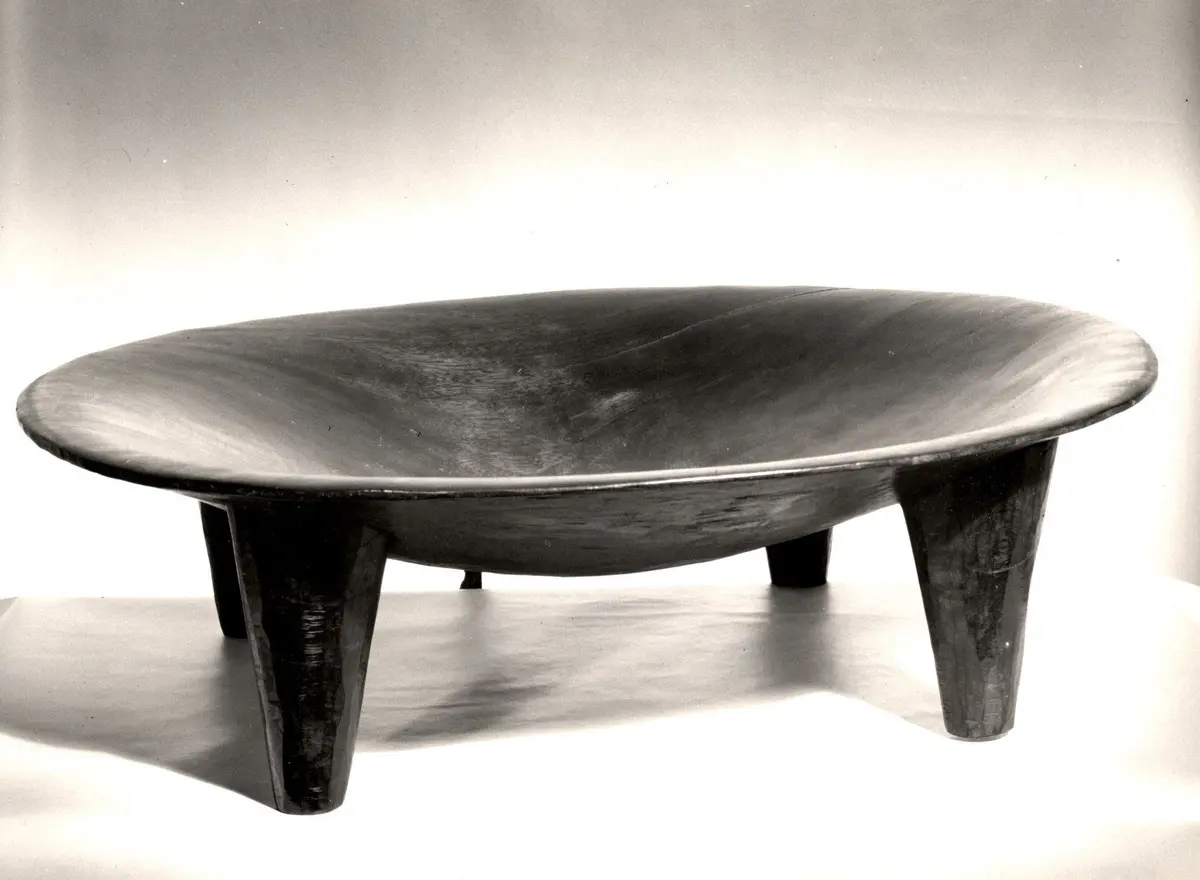
Carved in the 1800s, about 2,600 years after the Lapita reached Samoa
Landfall Six
The long pause
About 750 BC to AD 1290
A kava bowl from Samoa or Fiji, carved in wood in the 1800s, 61.9 cm across. The Lapita trail ended in these islands. Photo: The Metropolitan Museum of Art, CC0, via The Met Open Access.
The questionWhy did the voyagers stop at Tonga and Samoa for so long, and who did they become?
The Lapita voyages reached Tonga and Samoa, and then stopped. For about eighteen centuries no one settled the islands to the east. When the voyaging began again, Polynesian sailors found almost every island left in the Pacific within a few hundred years.
The end of the Lapita road
The Lapita spread into the empty islands of the Pacific ended in Tonga and Samoa. Patrick Kirch puts its end at about 800 BC;1 the earliest Lapita dates from Samoa are about 750 BC.2 Lapita pottery was still made there, in changing forms, for a few centuries, until sometime between 650 and 250 BC.2
The people did not leave. Many cultures across the Pacific today claim Lapita ancestry, the Polynesian peoples among them.6 In Tonga and Samoa, the descendants of the Lapita voyagers became the first Polynesians.6
- The Lapita spreadabout 1350 BC to about 750 BC: about 600 years
- The long pauseabout 750 BC to about AD 1025: about 1,774 years
- East Polynesia settledabout AD 1025 to about AD 1290: about 265 years
Why stop?
The archaeologist Matthew Spriggs points out that once you go beyond Samoa and Tonga, the area of sea compared with the area of land “increases massively and there was probably a threshold of relatively easy travel back and forth”.1
Five hundred islands
When the voyaging began again, it was fast. After the Society Islands, between 70 and 265 years passed, and then, in one great surge between about AD 1190 and 1290, Polynesians reached all the remaining islands of East Polynesia, including New Zealand, Hawaiʻi and Rapa Nui. These were the last places on Earth where people could live to be settled.4
Almost all of the 500 or so islands were found, scattered across an area of ocean the size of North America. The team thought the voyagers may have been helped by better canoes and sailing craft, and by favourable winds in years of El Niño.3 A computer study of voyages in 2016 found that Samoa was the most likely place they set out from.5
Key words
- West Polynesia
- Tonga, Samoa and nearby islands: the first part of Polynesia to be settled.
- East Polynesia
- The islands further east, from the Society Islands to Hawaiʻi, Rapa Nui and New Zealand.
- Chronology
- The order and dates of events.
- Short-lived sample
- Something that lived only a short time, so its radiocarbon date is close to the time it died.
- Staging area
- A place where a journey is prepared and from which it sets out.
Check yourself
Try to answer in your head, then open each one.
Where did the Lapita voyages end?
In Tonga and Samoa, around 800 to 750 BC.
When were the Society Islands first settled, according to the 2011 study?
About AD 1025 to 1120.
Why might the voyagers have stopped at Tonga and Samoa?
Beyond them, there is much more sea for each piece of land, so easy back-and-forth travel between islands came to an end.
Why did the 2011 study give a later date than earlier studies?
It used only reliable radiocarbon dates, from short-lived things, and set aside dates from materials with large errors.
Go deeper
- Landfall in Tonga where Polynesia began
- The Lapita voyagers the whole voyage on one chart
Sources for this page
Every number on this page comes from one of these. How we check.
Last reviewed 13 November 2026. Spotted a mistake? Tell us.
- Meduna, V. (2016). Tracking the Lapita expansion across the Pacific. Our Changing World, Radio New Zealand, 2 November 2016. Interviews with Patrick Kirch and Matthew Spriggs. www.rnz.co.nz/news/ourchangingworld/546545/tracking-the-lapita-expansion-across-the-pacificUsed for: The first settlers of Near Oceania about 40,000 years ago; the sea gap east of the Solomons as a boundary for 30,000 years; Kirch on pull, not push; coastal sites, fish hooks, nets and adzes; the oldest pots most richly decorated; Taiwan as the likely origin of Austronesian languages; Spriggs on the threshold beyond Tonga and Samoa. Checked 13 November 2026.
- McNiven, I. J., David, B., Richards, T., Aplin, K., Asmussen, B., Mialanes, J., Leavesley, M., Faulkner, P. and Ulm, S. (2011). New direction in human colonisation of the Pacific: Lapita settlement of south coast New Guinea. Australian Archaeology 72, 1–6. researchonline.jcu.edu.au/17433/1/mcniven_etal_2011.pdfUsed for: Lapita pottery arose in the Bismarck Archipelago about 3300 cal BP; first dates for the Reef and Santa Cruz Islands (3200), Vanuatu, New Caledonia and Fiji (3000), Tonga (2900) and Samoa (2700 cal BP); a colonisation 4,500 km long; Lapita sites on the south coast of New Guinea, 2900 to 2500 cal BP. Checked 13 November 2026.
- University of Hawaiʻi at Mānoa (2011). East Polynesia colonized faster and more recently than previously thought. UH News, 3 January 2011. www.hawaii.edu/news/article.php?aId=4097Used for: Polynesian ancestors settled in Samoa around 800 BC; nearly all of the 500 or so islands of East Polynesia were found, across an area of ocean the size of North America; better canoes and El Niño winds may have helped. Checked 13 November 2026.
- Wilmshurst, J. M., Hunt, T. L., Lipo, C. P. and Anderson, A. J. (2011). High-precision radiocarbon dating shows recent and rapid initial human colonization of East Polynesia. Proceedings of the National Academy of Sciences 108 (5), 1815–1820. pmc.ncbi.nlm.nih.gov/articles/PMC3033267/Used for: 1,434 radiocarbon dates sifted; East Polynesia first settled in the Society Islands about AD 1025 to 1120, then everywhere else, including New Zealand, Hawaiʻi and Rapa Nui, about AD 1190 to 1290. Checked 13 November 2026.
- Montenegro, Á., Callaghan, R. T. and Fitzpatrick, S. M. (2016). Using seafaring simulations and shortest-hop trajectories to model the prehistoric colonization of Remote Oceania. Proceedings of the National Academy of Sciences 113 (45), 12685–12690. pmc.ncbi.nlm.nih.gov/articles/PMC5111695/Used for: Computer-simulated voyages: seasons and El Niño years shaped Pacific voyaging; eastward crossings towards Samoa could be made by sailing downwind in spells of westerly wind lasting three to five days; Samoa as the likely starting point for East Polynesia. Checked 13 November 2026.
- Burley, D., Weisler, M. I. and Zhao, J. (2012). High precision U/Th dating of first Polynesian settlement. PLoS ONE 7 (11), e48769. pmc.ncbi.nlm.nih.gov/articles/PMC3492438/Used for: Nukuleka on Tongatapu as the founding settlement of Polynesia; uranium-thorium dates on 13 coral files put first landfall at 2830 to 2846 BP, a window of 16 years, and trace the site over the next 250 years. Checked 13 November 2026.
- The Metropolitan Museum of Art. Kava bowl. Samoa or Fiji; wood, fibre, 19th century. Collection record 313657, Open Access (CC0). www.metmuseum.org/art/collection/search/313657Used for: A four-legged wooden kava bowl, 61.9 cm across. Checked 13 November 2026.