Landfall Two
Pots stamped with teeth
About 1350 to 750 BC
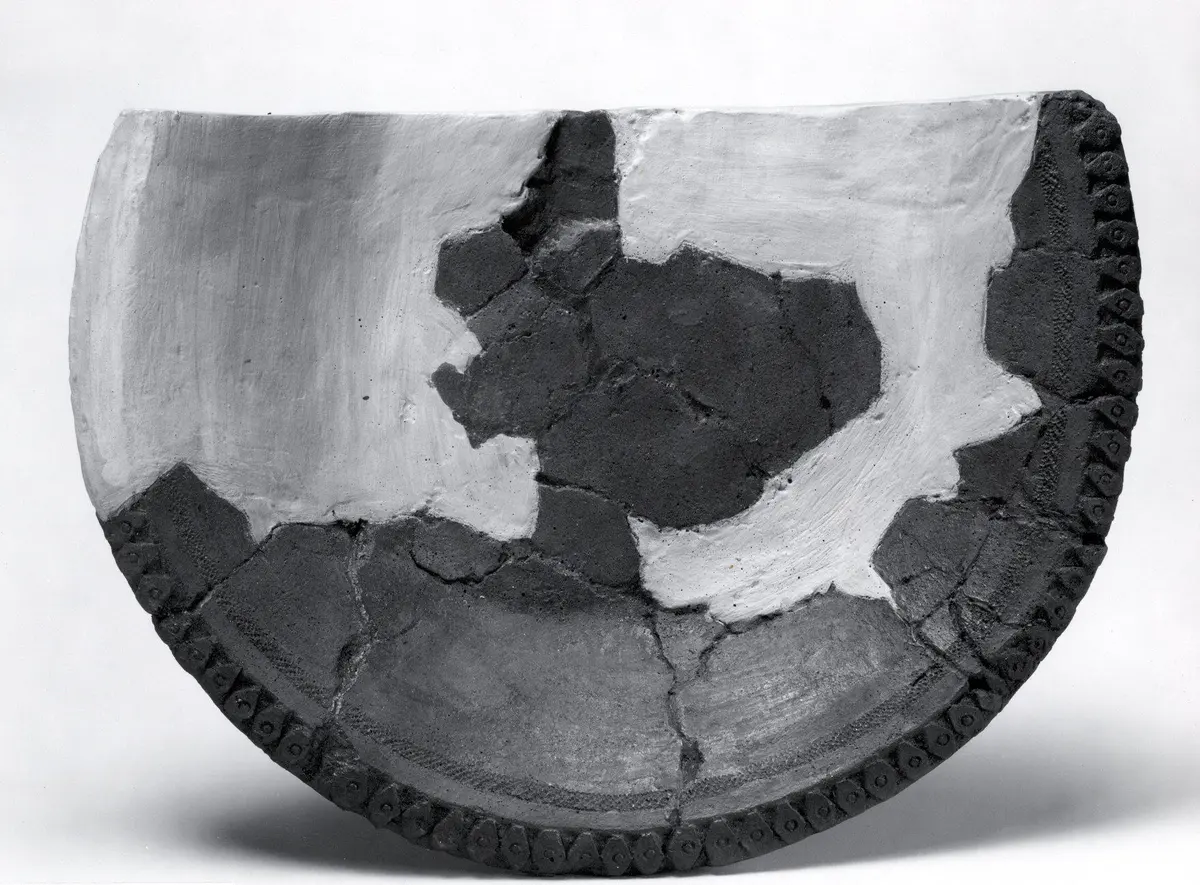
A cast of a Lapita dish, pieced together from broken sherds, 17.5 cm high. Santa Cruz Islands. Photo: The Metropolitan Museum of Art, CC0, via The Met Open Access.
The questionHow can broken pots show where people sailed?
Lapita potters decorated their pots with rows of tiny marks, pressed into the clay with a toothed edge, in bands, curves and faces. Because the style is so distinctive, a single broken piece is enough to show that Lapita people were there.
Rows of tiny teeth
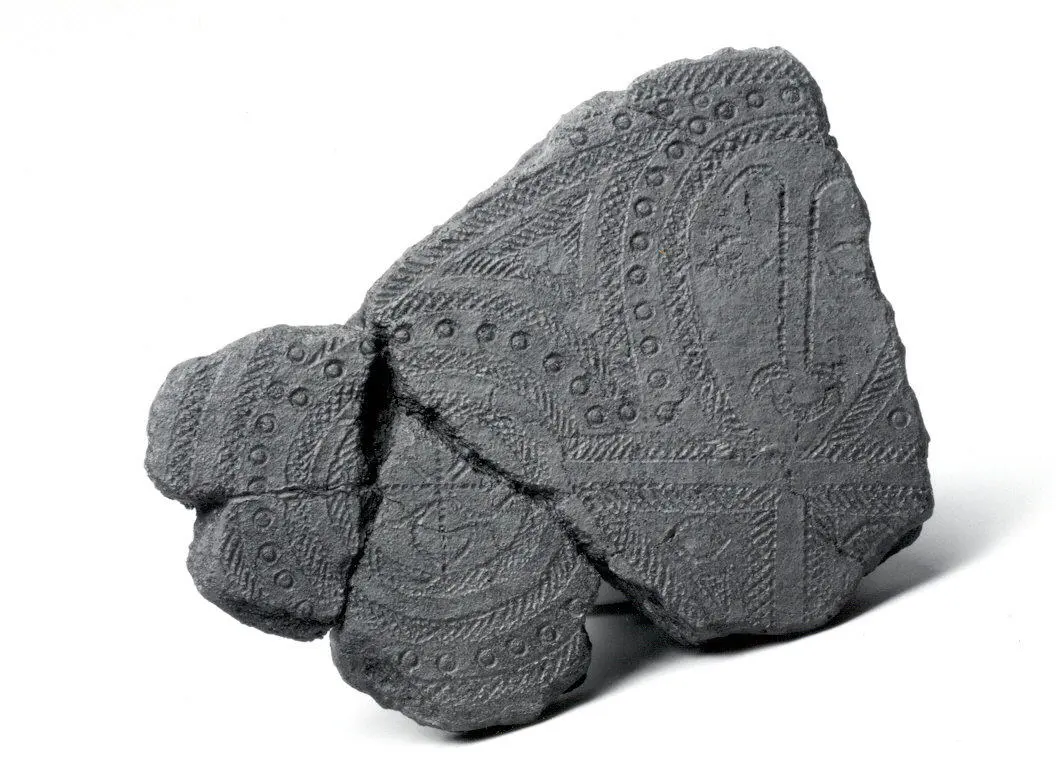
The mark of a Lapita pot is its decoration: patterns made of rows of tiny stamped marks, from a tool edged with tooth-like points. Archaeologists call this dentate stamping, from the Latin word for a tooth.1
When archaeologists recorded 2,297 sherds from sites in the Mussau Islands, Talepakemalai among them, they sorted the decoration into fine and coarse dentate stamping, incised lines, cut-outs and marks made with a shell. They also noted whether white lime had been pressed into the marks to make them stand out, and whether the pot had a coat of red slip.2
Bowls, dishes and stands
Lapita potters made many shapes: simple bowls and bowls with a sharp shoulder, bowls on tall pedestals, flat-bottomed dishes with flaring sides, large jars, narrow-necked jars, cylinder-shaped stands and lids.2
A trail across the sea
Because the style is so distinctive, Lapita pottery is the clearest sign that its makers were there. Patrick Kirch, an archaeologist of the Pacific, explains: “You can use the pottery and other material culture to trace the movement very clearly and with the assistance of radio carbon dating we’ve put a timeframe on that.”1
The trail runs from the Bismarck Archipelago, where the pottery began around 1350 BC, to Samoa, reached around 750 BC. In various forms Lapita pottery went on being made until sometime between 650 and 250 BC.3
The archaeologists who study it prefer to speak of the Lapita Cultural Complex rather than the Lapita people. They did not want to suggest that one kind of pot made one single people. The voyagers also carried skills in open-ocean navigation, boat-building, fishing and farming.1
Why did the patterns fade?
The most complex decoration is found at the oldest sites. In later settlements, plain pots and simply decorated ones make up more and more of what is found. Nobody yet knows why the Lapita gave up a style they had valued so much.1
Key words
- Dentate
- Toothed. Dentate stamping makes rows of tiny marks with a toothed edge.
- Sherd
- A broken piece of pottery.
- Slip
- A thin coat of liquid clay painted on a pot before firing. Lapita slip was often red.
- Lime
- A white powder. Pressed into the stamped marks, it made the pattern show white.
- Assemblage
- All the objects of one kind found together at a site, such as all its pottery.
Check yourself
Try to answer in your head, then open each one.
What does “dentate” mean?
Toothed. The marks were made with a toothed edge.
Name three ways Lapita potters decorated a pot.
Any three of: fine dentate stamping, coarse dentate stamping, incising, cut-outs, shell impressions, red slip, and lime pressed into the marks.
Why is Lapita pottery so useful for tracing where people went?
Its style is so distinctive that even small sherds can be recognised, and radiocarbon dates from the same layers show when.
How did the decoration change over time?
The most complex patterns are at the oldest sites. Later sites have more plain pots and simpler decoration.
Go deeper
- Teouma, the oldest cemetery where Lapita pots were used in burials
- Across the gap the voyages the pots let us trace
Sources for this page
Every number on this page comes from one of these. How we check.
Last reviewed 13 November 2026. Spotted a mistake? Tell us.
- Meduna, V. (2016). Tracking the Lapita expansion across the Pacific. Our Changing World, Radio New Zealand, 2 November 2016. Interviews with Patrick Kirch and Matthew Spriggs. www.rnz.co.nz/news/ourchangingworld/546545/tracking-the-lapita-expansion-across-the-pacificUsed for: The first settlers of Near Oceania about 40,000 years ago; the sea gap east of the Solomons as a boundary for 30,000 years; Kirch on pull, not push; coastal sites, fish hooks, nets and adzes; the oldest pots most richly decorated; Taiwan as the likely origin of Austronesian languages; Spriggs on the threshold beyond Tonga and Samoa. Checked 13 November 2026.
- Kirch, P. V., Chiu, S. and others. Talepakemalai: Lapita and its transformations in the Mussau Islands of Near Oceania. Cotsen Institute of Archaeology Press, digital edition (DIG), chapter “Ceramic methods”. dig.ucla.edu/talepakemalai/node/921Used for: How Lapita pots from Mussau were recorded: fine and coarse dentate stamping, incising and cutouts, lime infilling, red slip, and the shapes of the pots, from bowls on pedestals to flat-bottomed dishes and cylinder stands. Checked 13 November 2026.
- McNiven, I. J., David, B., Richards, T., Aplin, K., Asmussen, B., Mialanes, J., Leavesley, M., Faulkner, P. and Ulm, S. (2011). New direction in human colonisation of the Pacific: Lapita settlement of south coast New Guinea. Australian Archaeology 72, 1–6. researchonline.jcu.edu.au/17433/1/mcniven_etal_2011.pdfUsed for: Lapita pottery arose in the Bismarck Archipelago about 3300 cal BP; first dates for the Reef and Santa Cruz Islands (3200), Vanuatu, New Caledonia and Fiji (3000), Tonga (2900) and Samoa (2700 cal BP); a colonisation 4,500 km long; Lapita sites on the south coast of New Guinea, 2900 to 2500 cal BP. Checked 13 November 2026.
- Australian Academy of the Humanities (2021). On a Melanesian island, the Pacific’s oldest cemetery helps solve a mystery. Discovering Humanities series, October 2021. humanities.org.au/power-of-the-humanities/on-a-melanesian-island-the-pacifics-oldest-cemetery-helps-solve-a-mystery/Used for: Teouma, Efate: found by a bulldozer driver in 2003; dug from 2004 to 2010 by ANU and Vanuatu Cultural Centre teams; 68 graves and about 100 people, the adults without their heads; three skulls on an old man’s chest; a skull inside a pot; more than 100 pots and plates, six complete; animals hunted to extinction; first ancestry from Taiwan or the northern Philippines. Checked 13 November 2026.
- The Metropolitan Museum of Art. Cast of a dish. Lapita people, Santa Cruz Islands, Solomon Islands; plaster, mid-20th century. Collection record 314216, Open Access (CC0). www.metmuseum.org/art/collection/search/314216Used for: A cast of a Lapita dish pieced together from sherds, 17.5 cm high. Checked 13 November 2026.
- The Metropolitan Museum of Art. Cast of a pot sherd. Lapita people, Santa Cruz Islands, Solomon Islands; plaster, mid-20th century. Collection record 314215, Open Access (CC0). www.metmuseum.org/art/collection/search/314215Used for: A cast of a dentate-stamped Lapita sherd, 7.3 cm high. Checked 13 November 2026.