Chapter One
Who came after Rome?
About AD 410 to 650
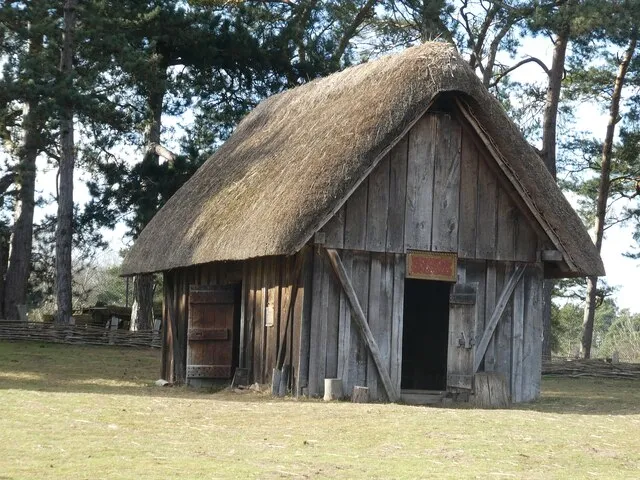
The rebuilt hall at West Stow, Suffolk. Photo: Rob Farrow, CC BY-SA 2.0, via Geograph.
The questionWho were the Anglo-Saxons, and how did they live?
Roman rule in Britain ended in about 410. Over the next centuries, people from across the North Sea settled in the east and south, and the kingdoms that became England began. One monk told the story in a few lines. The ground tells it more slowly.
Fits: Primary (KS2). See Courses.
The story
English Heritage describes the early medieval period as the era between the end of Roman rule in Britain in about AD 410 and the Norman Conquest in 1066. At its end, England was one kingdom. At its start, it was a country of separate kingdoms.1
Bede’s story
The best-known account was written by Bede, a monk in Northumbria. In the year 449, he says, “the nation of the Angles, or Saxons, being invited by the aforesaid king, arrived in Britain with three long ships”. Their first commanders, he says, “are said to have been Hengist and Horsa”.2
Bede then explains where the peoples of his own day came from. They came, he writes, from “the three most powerful nations of Germany”.2
Jutes
- the people of Kent
- the Isle of Wight
Saxons
- the East Saxons
- the South Saxons
- the West Saxons
Angles
- the East Angles
- the Midland Angles
- the Mercians
- the Northumbrians
What historians think now
Bede’s neat story, the archaeologist Catherine Hills writes, “shortens a process that took centuries, and a different course in different parts of Britain”. The archaeological evidence suggests that Britain’s people were “much more mixed”. Studies of modern DNA have so far given some contradictory results.3
A village on a sandy knoll
West Stow lies about 10 kilometres north of Bury St Edmunds, on a low sandy knoll. In 1947 Basil Brown, who had found the Sutton Hoo ship eight years before, noticed early Anglo-Saxon finds there. The main excavation, led by Stanley West, ran from 1965 to 1972.4
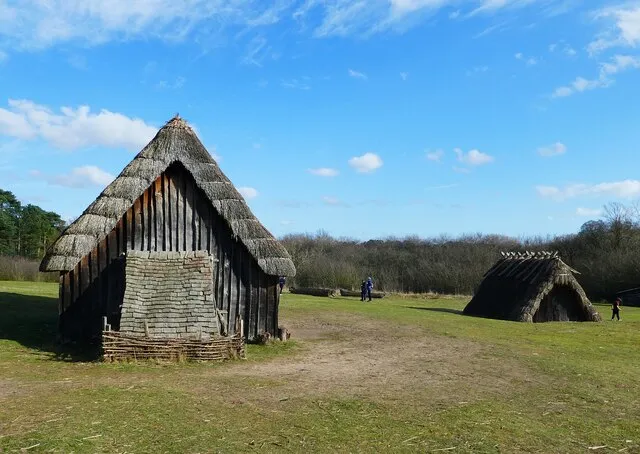
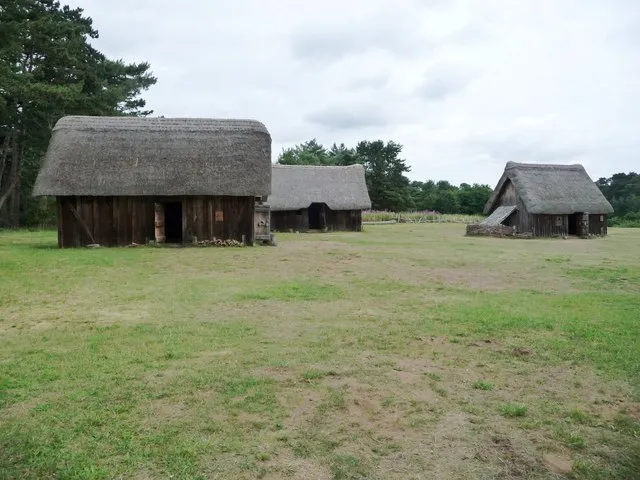
The village was lived in from about 420 until the early 600s. The diggers found two kinds of building. Seven halls, 8 to 15 metres long and about half as wide, most with a door on the south side and a hearth in the middle. And the hollows of 68 smaller “sunken-featured buildings”, typically about 4 metres long and 3 wide, clustered around the halls.4
The halls are thought to have been the centres of extended families, with the small buildings around them used as homes, workshops and stores. Only two or three such family groups lived there at any one time, and the village moved around the knoll over its 200 years as buildings rotted and were replaced.4
Building it again
When the digging finished, the team began an experiment that started in 1973 and still continues: building Anglo-Saxon houses on the site to test their ideas. By 2015, ten had been rebuilt.4 The finds overturned an old view of Anglo-Saxons as people who lived in holes in the ground: burnt remains showed that the “sunken” buildings had timber walls and wooden floors over the hollows.4
Key words
- Anglo-Saxons
- The name we give to the people of England between the end of Roman rule and 1066, many of them descended from settlers from across the North Sea.
- Migration
- People moving to live in a new place. This one took centuries, not a single voyage.
- Bede
- A monk in Northumbria who wrote a history of the English church and people.
- Sunken-featured building
- A small building over a hollow in the ground, used as a workshop, store or home. Archaeologists find the hollows.
- Experimental archaeology
- Testing ideas about the past by rebuilding and using things, like the houses at West Stow.
Check yourself
Try to answer in your head, then open each one.
According to Bede, which three peoples came to Britain?
The Saxons, the Angles and the Jutes.
Why do historians not simply accept Bede’s story?
Because the archaeology shows a slower, more mixed change that took centuries and differed from place to place.
What two kinds of building were found at West Stow?
Timber halls, 8 to 15 metres long, and smaller sunken-featured buildings over hollows about 4 by 3 metres.
How do we know what the West Stow houses looked like?
We do not know for sure. Since 1973, archaeologists have rebuilt them in different ways to test the ideas.
Go deeper
- How Roman Britain ended the chapter before this one
- The ship in the field Basil Brown, who also dug at West Stow
Sources for this page
Every number on this page comes from one of these. How we check.
Last reviewed 12 November 2026. Spotted a mistake? Tell us.
- English Heritage. The Story of England: Early Medieval England. www.english-heritage.org.uk/learn/story-of-england/early-medieval/Used for: The span from the end of Roman rule in about 410 to 1066, Augustine in 597, Whitby in 664 and the Viking attack of 793. Checked 12 November 2026.
- Bede, Ecclesiastical History of the English People, Book I, chapter 15. Internet Medieval Sourcebook, Fordham University. sourcebooks.fordham.edu/basis/bede-book1.aspUsed for: Bede’s account of the coming of the Angles, Saxons and Jutes, and the peoples he said came from each. Checked 12 November 2026.
- Hills, C. (McDonald Institute for Archaeological Research, University of Cambridge). The Anglo-Saxon invasion and the beginnings of the “English”. Our Migration Story. www.ourmigrationstory.org.uk/oms/anglo-saxon-migrationsUsed for: That the change took centuries and differed across Britain, and that the archaeology shows a more mixed population than Bede describes. Checked 12 November 2026.
- Hoggett, R. (2015). From hollow to house: 50 years of discovery at West Stow. British Archaeology, September/October 2015. Republished by Suffolk Heritage Explorer. heritage.suffolk.gov.uk/media/pdfs/2015_west_stow_british_archaeology.pdfUsed for: West Stow: its dates, its halls and sunken-featured buildings, the 1965–72 excavation and the rebuilt houses. Checked 12 November 2026.