Chapter Three
Saints and raiders
AD 635 to 875
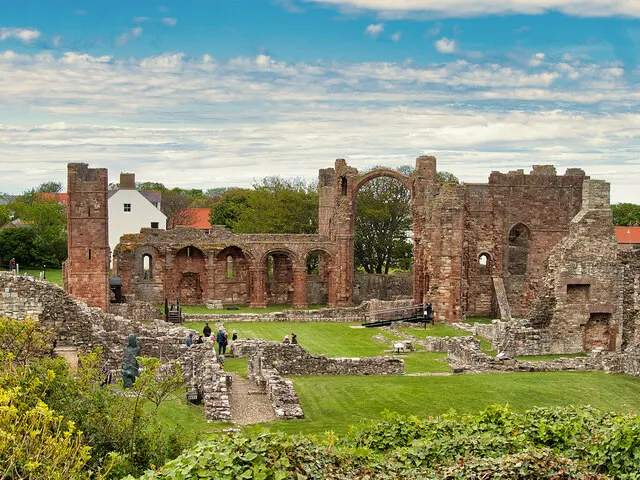
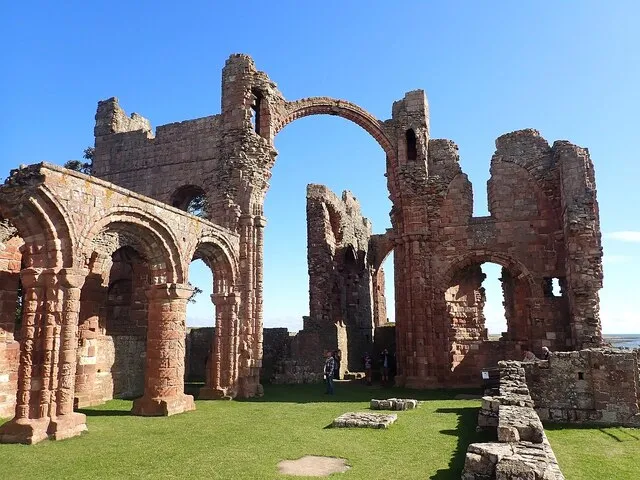
The ruins of the later priory on Lindisfarne. Photo: David Dixon, CC BY-SA 2.0, via Geograph.
The questionWhy did the Viking raid on Lindisfarne shock Europe?
Christianity came to the Anglo-Saxon kingdoms from two directions: from Rome in the south, and from Ireland in the north. On a tidal island off Northumbria, Irish monks built a monastery where one of the most famous books of the age was made. Then it became one of the first targets of the Vikings.
Fits: Primary (KS2). See Courses.
The story
In the south, Christianity is linked with the arrival of St Augustine’s mission from Rome in 597.2 In the north, it came from Ireland. In 635 Oswald, king of Northumbria, summoned an Irish monk named Aidan from the monastery on Iona, and granted him and his companions the small tidal island of Lindisfarne to found a monastery.1
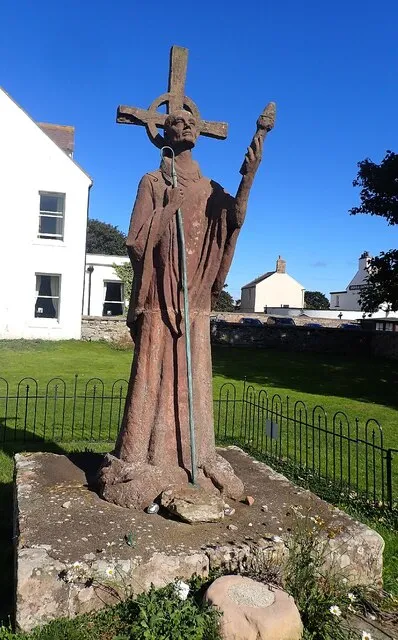
Cuthbert and the Gospels
Lindisfarne’s most famous monk, Cuthbert, died in 687 and was buried in a stone coffin in the church. When the monks opened his tomb in 698, they were delighted to find that his body had not decayed: it was “incorrupt”. He became the island’s saint.1 In the early 700s, the masterpiece we call the Lindisfarne Gospels was made here. It is now in the British Library in London.1
8 June 793
On 8 June 793 Lindisfarne suffered a devastating raid by Viking pirates.1 English Heritage calls it an attack that “sent a shockwave through Europe”.2 The scholar Alcuin wrote:
“Pagans have desecrated God’s sanctuary, shed the blood of saints around the altar … What assurance can the churches of Britain have …”
Alcuin, 793, quoted by English Heritage1
Leaving the island
The community lasted another eighty years. In 875 the monks decided to leave Lindisfarne for good, carrying Cuthbert’s coffin with them. After seven years of wandering they settled at Chester-le-Street, building a church inside the old Roman fort. In 995 his relics were moved again, and were finally enshrined at Durham, where they remain.1
Key words
- Monastery
- A community of monks living, praying and working together under a rule.
- Saint
- A holy person honoured by the church. Cuthbert of Lindisfarne is one of the best known in England.
- Gospels
- The four books of the Bible about the life of Jesus. The Lindisfarne Gospels are a hand-made, painted copy.
- Relics
- The body or belongings of a saint, kept and honoured.
- Viking
- A seaborne raider or trader from Scandinavia. Many later settled in England.
Check yourself
Try to answer in your head, then open each one.
Who invited Aidan to Northumbria, and where did he come from?
King Oswald of Northumbria, in 635. Aidan came from the monastery on Iona.
What did the monks find when they opened Cuthbert’s tomb in 698?
That his body had not decayed. They called it “incorrupt”, and took it as a sign of holiness.
Why did the raid of 793 shock people so much?
It was a devastating attack on a famous holy place, and English Heritage says it sent a shockwave through Europe. Alcuin wrote that pagans had desecrated God’s sanctuary.
What happened to Cuthbert’s body after the monks left in 875?
They carried his coffin for seven years, settled at Chester-le-Street, and in 995 his relics were moved to Durham, where they still are.
Go deeper
- The ship in the field a king buried before Aidan came
- The timeline Lindisfarne against the rest of the world
Sources for this page
Every number on this page comes from one of these. How we check.
Last reviewed 12 November 2026. Spotted a mistake? Tell us.
- Story, J. History of Lindisfarne Priory. English Heritage. www.english-heritage.org.uk/visit/places/lindisfarne-priory/history/Used for: Aidan’s monastery from 635, Cuthbert, the Gospels, the raid of 8 June 793, Alcuin’s letter and the monks’ leaving in 875. Checked 12 November 2026.
- English Heritage. The Story of England: Early Medieval England. www.english-heritage.org.uk/learn/story-of-england/early-medieval/Used for: The span from the end of Roman rule in about 410 to 1066, Augustine in 597, Whitby in 664 and the Viking attack of 793. Checked 12 November 2026.