Chapter Two
The ship in the field
About AD 625, dug 1938 to 1939
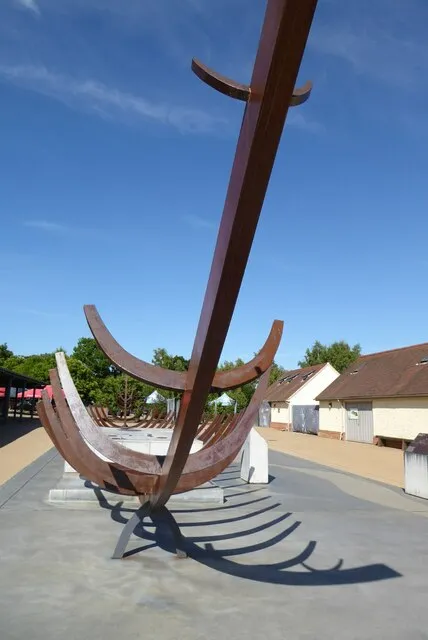
A sculpture at Sutton Hoo showing the outline of the buried ship. Photo: Philip Halling, CC BY-SA 2.0, via Geograph.
The questionWhat does Sutton Hoo tell us about Anglo-Saxon kings?
In 1938 a landowner in Suffolk asked a local archaeologist to dig into the mounds on her land. The next summer he found the shape of a ship under one of them, and in the middle of it, a burial chamber that nobody had touched for 1,300 years.
Fits: Primary (KS2). See Courses.
The story
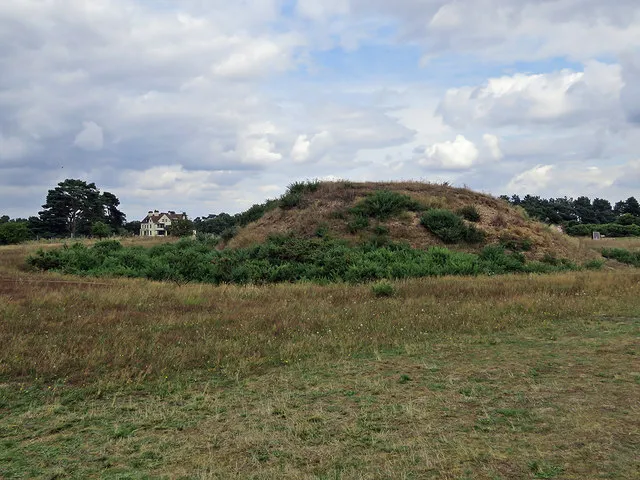
Sutton Hoo is a group of burial mounds on a ridge in Suffolk. In the 1930s the land belonged to Edith Pretty, and she appointed a local archaeologist, Basil Brown, to dig into them. In 1938 he opened three: Mounds 2, 3 and 4.2
A ghost of a ship
In May 1939 Brown turned to Mound 1. The ship’s timbers had rotted away in the sandy soil, but its iron rivets were still exactly where they had been, so the shape of the ship could be traced in the sand.2 In June, archaeologists carefully brushed away the layers to reveal it.1
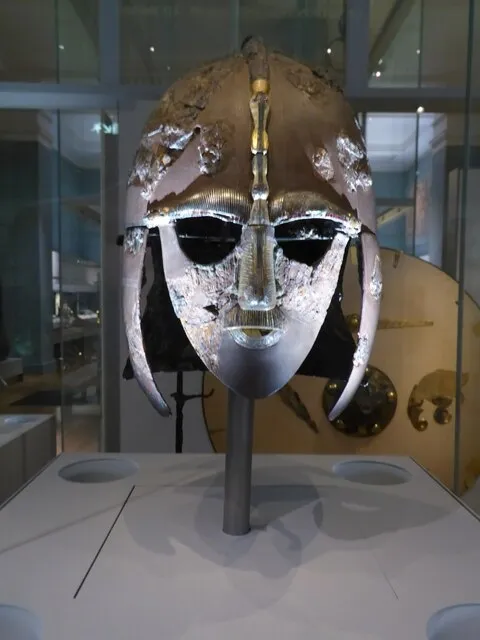
On 14 June 1939 they reached the burial chamber in the middle of the ship. It was undisturbed. The archaeologist Charles Phillips took over the dig, and 263 finds came out of it. The National Trust calls it the richest grave ever excavated in Europe.2
Whose grave?
Coins found in the burial place it around the year 625. No name was written on anything, so the person buried there is not known for certain. The leading theory is King Rædwald of East Anglia.1
Still digging
Archaeologists came back. From 1965 to 1971 a team led by Bruce-Mitford found phosphate traces of a body in the ship burial. From 1983 to 1993 a team led by Carver found a second ship burial, and the shapes of people whose bodies had left only stains in the sand, the “sand bodies”.2
Key words
- Burial mound
- A heap of earth raised over a grave. Sutton Hoo has a group of them.
- Ship burial
- Burying an important person in a ship, with their belongings, under a mound.
- Rivet
- A metal pin that held the ship’s planks together. The wood had rotted, but the iron rivets stayed in place.
- Grave goods
- Objects buried with the dead.
- Conservation
- The careful work of cleaning, repairing and protecting objects so they last.
Check yourself
Try to answer in your head, then open each one.
Who asked Basil Brown to dig at Sutton Hoo?
Edith Pretty, who owned the land.
How did the diggers know there had been a ship, when the wood had gone?
Its iron rivets were still in place in the sand, showing its shape.
How is the burial dated to about 625?
From the coins found in it.
Who was probably buried there?
The leading theory is King Rædwald of East Anglia, but it is not certain.
Go deeper
- Who came after Rome? Basil Brown at West Stow
- Saints and raiders the next chapter
Sources for this page
Every number on this page comes from one of these. How we check.
Last reviewed 12 November 2026. Spotted a mistake? Tell us.
- National Trust. History of Sutton Hoo. www.nationaltrust.org.uk/visit/suffolk/sutton-hoo/history-of-sutton-hooUsed for: The date of the ship burial from its coins, Rædwald as the leading theory, and the helmet in more than 100 fragments. Checked 12 November 2026.
- National Trust. History of archaeology at Sutton Hoo. www.nationaltrust.org.uk/visit/suffolk/sutton-hoo/history-of-archaeology-at-sutton-hooUsed for: Edith Pretty, Basil Brown, the digs of 1938 and 1939, and the later excavations. Checked 12 November 2026.