Chapter One
The gift of the river
About 2000 BC
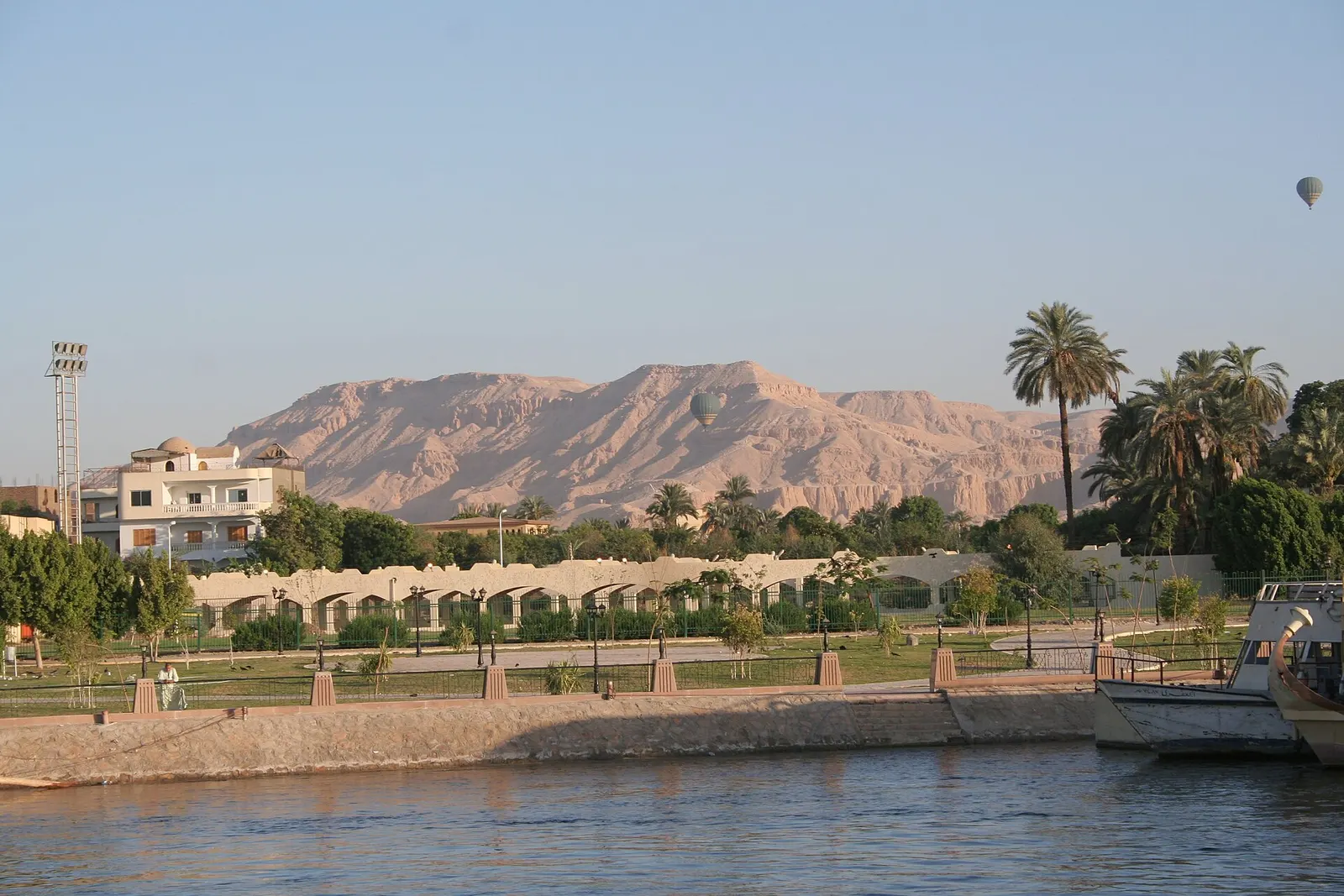
The Nile at Luxor today: water, a green strip, and then desert. Photo: Merlin UK, CC BY-SA 3.0, via Wikimedia Commons.

The questionWhy did everything in Egypt depend on the Nile?
Egypt is mostly desert. The ancient Egyptians lived on a thin green strip along one river, and almost everything they made, ate and believed was shaped by it. The best way to see that strip is through the things they left: here, a set of painted wooden models made for one official’s tomb, about 4,000 years ago.
Fits: Primary (KS2). See Courses.
The story
When a Greek traveller, Herodotus, went to Egypt and asked about the country, he agreed with what he was told. Anyone with sense, he wrote, could see that the Egypt the Greeks sailed to was
“land acquired by the Egyptians, given them by the river”
Herodotus, Histories 2.51
He meant the Nile. Every year the river rose, spread over the fields and sank back, leaving them wet and covered in new mud. Herodotus describes farmers who barely had to plough: the river
“rises of itself, waters the fields, and then sinks back again; thereupon each man sows his field and sends swine into it to tread down the seed, and waits for the harvest”
Herodotus, Histories 2.141
Herodotus was a visitor, and he was not always right. But on the river, the evidence agrees with him. To see what life on that green strip involved, look at what one man took with him to his tomb.
Meketre’s tomb
Meketre was an official who lived about 4,000 years ago, under a king called Amenemhat I. When archaeologists from the Metropolitan Museum of Art dug at his tomb at Thebes in 1920, they found a hidden room full of wooden models: small painted scenes of people at work.2 The granary alone is 75 centimetres long, and full of figures about 20 centimetres tall.2
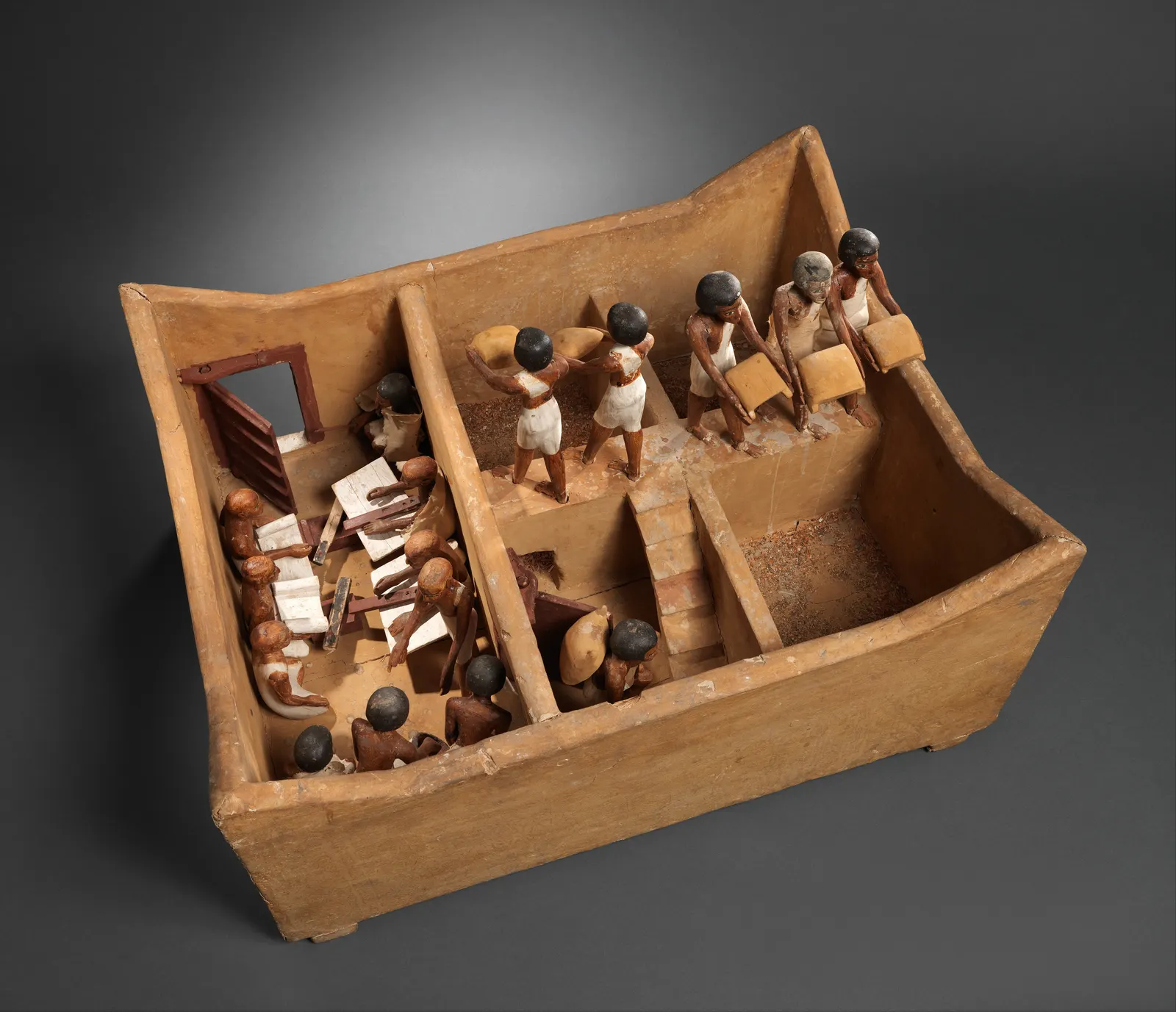
The granary matters most, because grain was food. Notice the scribes. Someone had to write down how much came in and how much went out, and in the model they have a room of their own.2
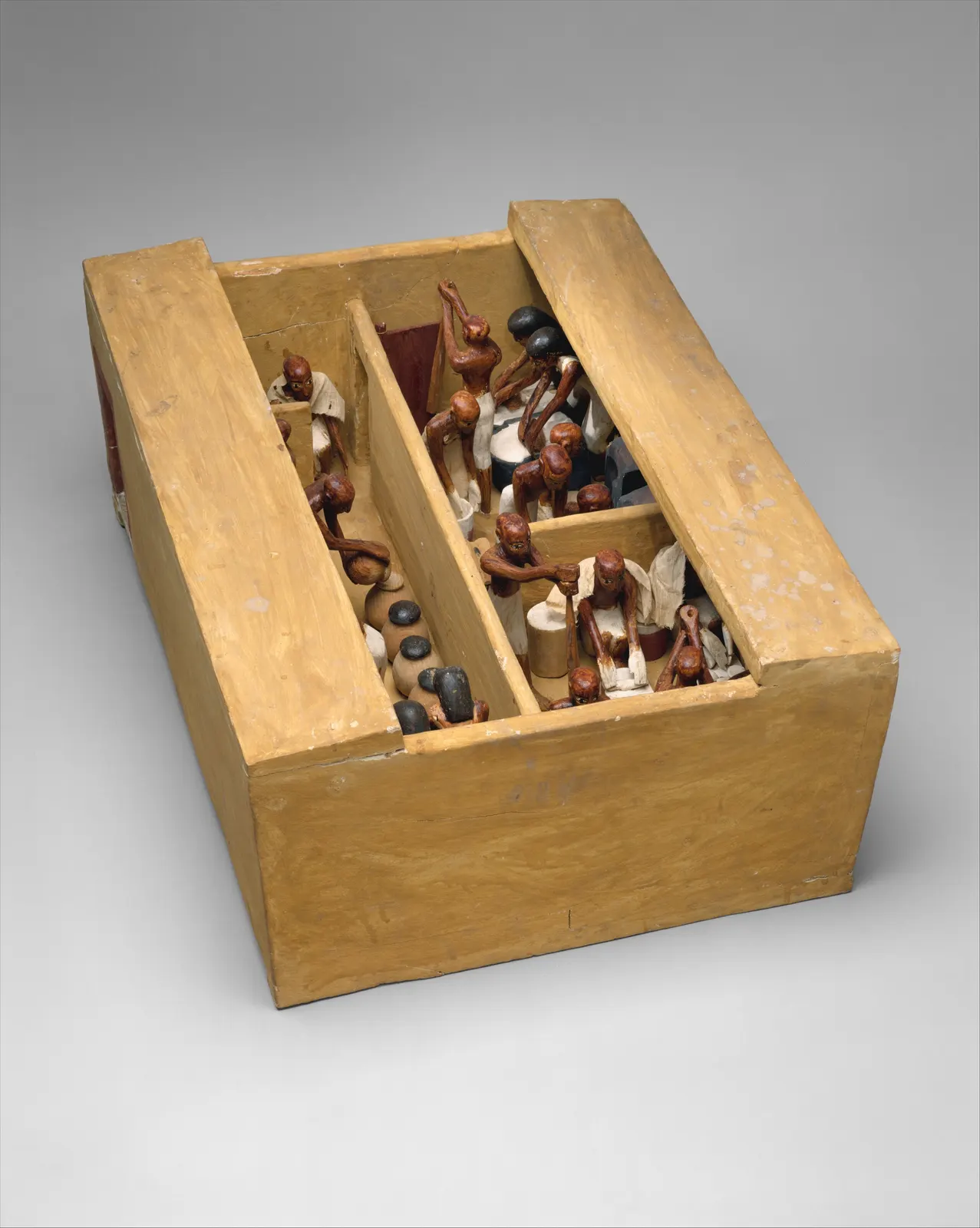
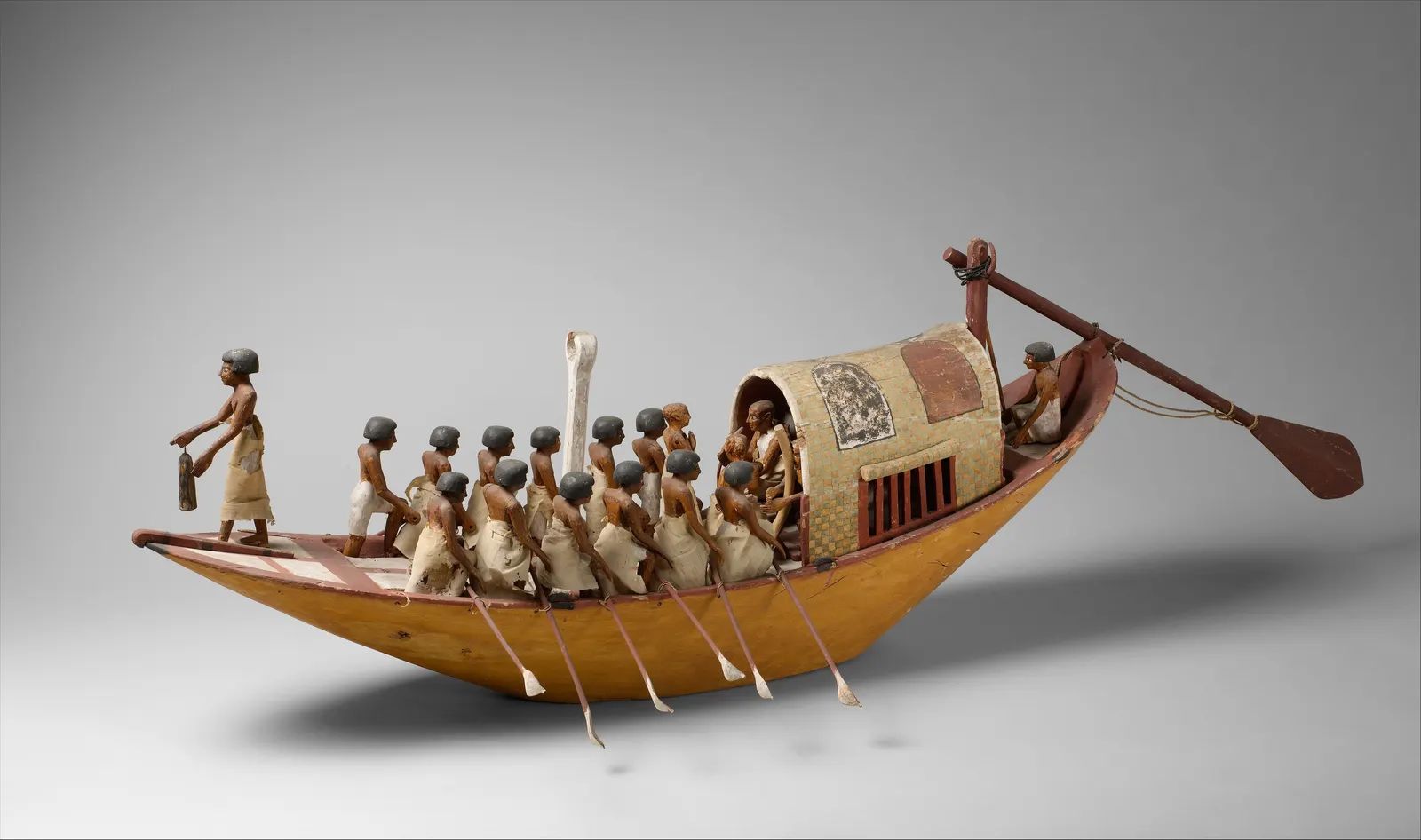
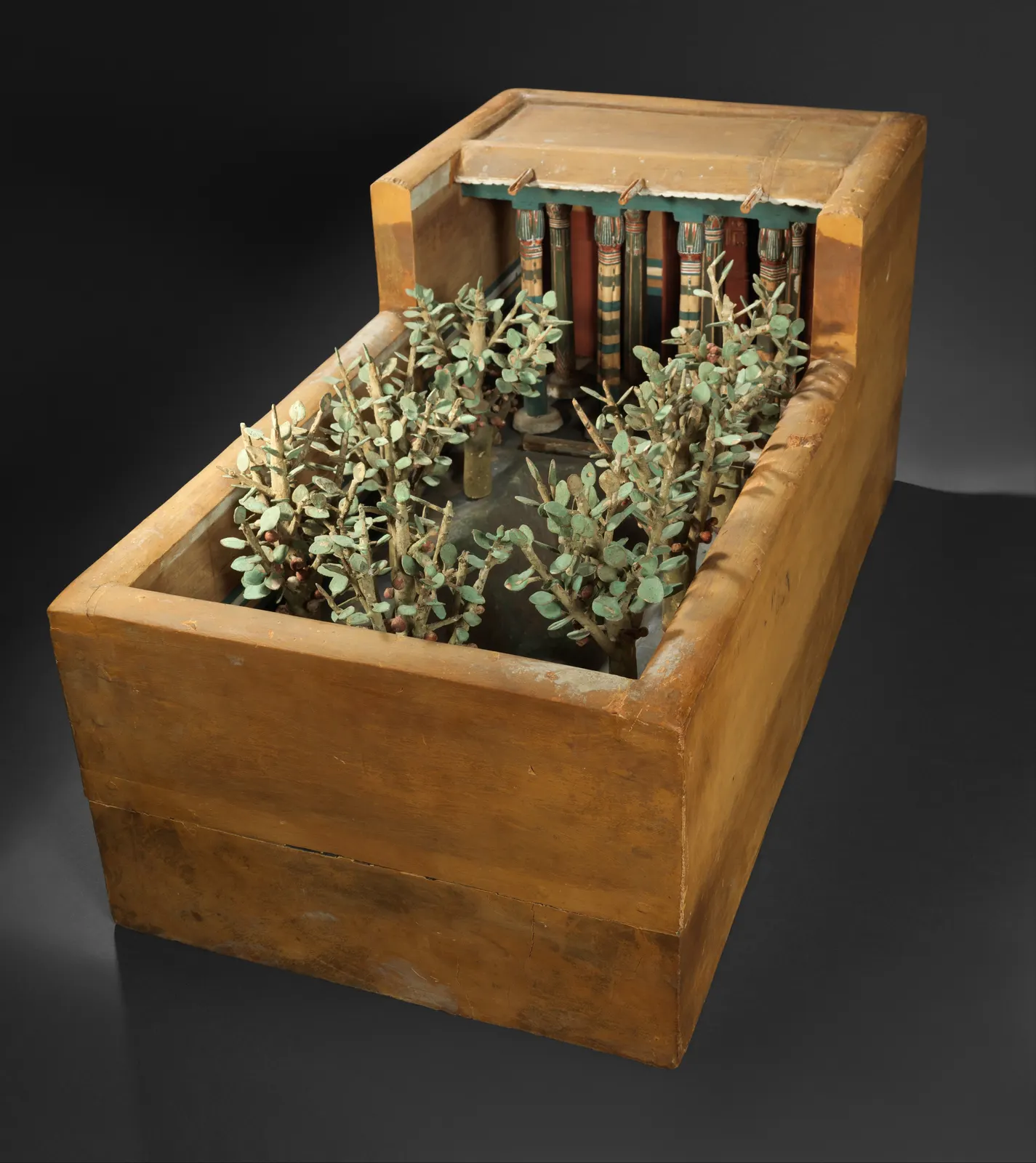
Grain went to the bakery and the brewery, and it went by water.3,4 The Nile ran the length of the country, and a boat on it was the easy way to travel. Even the garden in Meketre’s models depends on water: a porch with painted columns opens onto trees.5
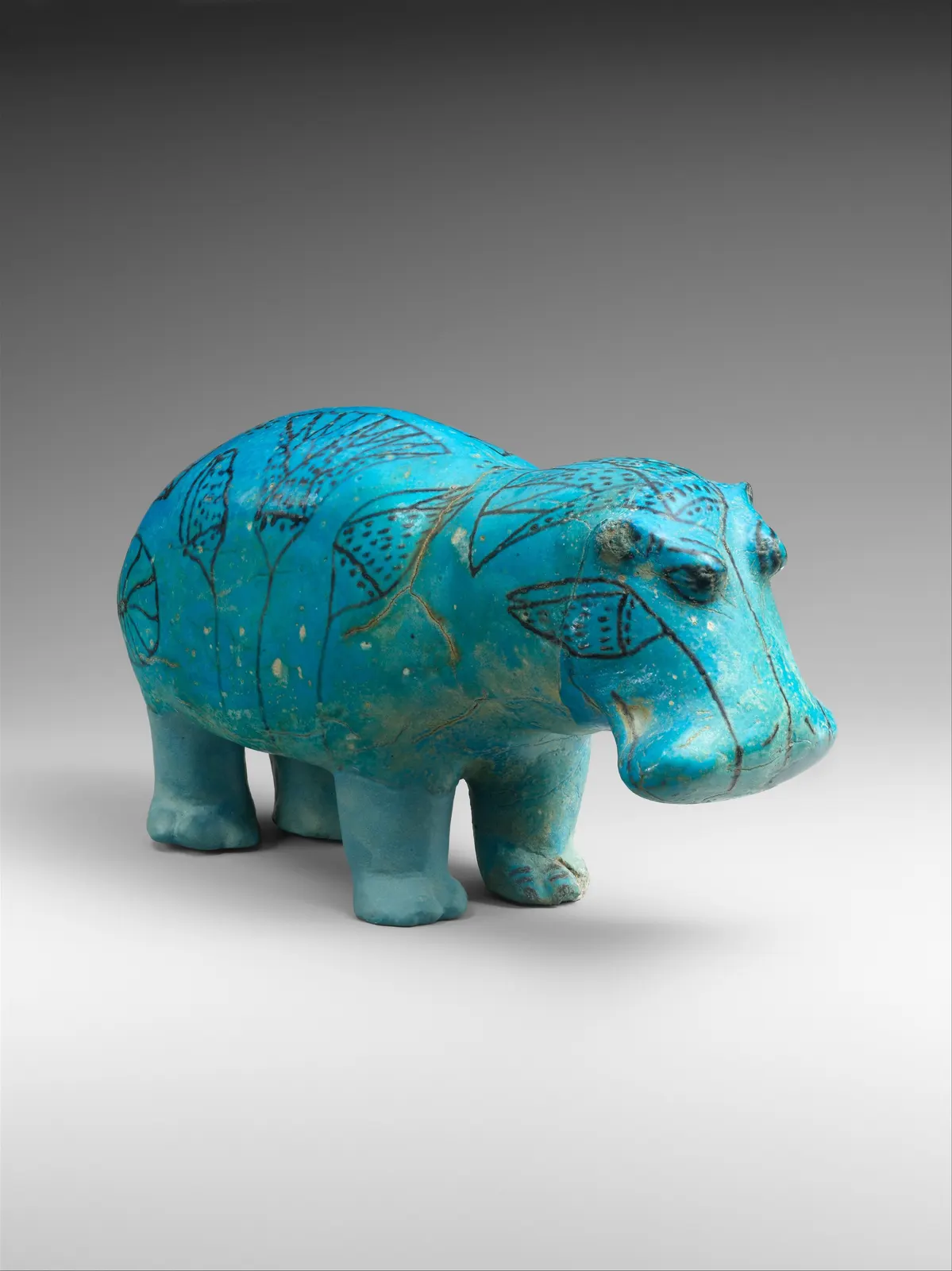
The river had its animals too. This little blue hippopotamus, made for another tomb at about the same time, is covered in painted plants, as if standing in a marsh.6
Key words
- Nile
- The river that runs north through Egypt to the Mediterranean. Without it, there would be no farms there at all.
- Flood (inundation)
- The river rising every year and spreading over the fields, leaving water and fresh mud behind.
- Granary
- A store for grain, the food almost everyone depended on.
- Scribe
- Someone trained to write. Scribes kept the records: how much grain came in, and who was given what.
- Faience
- A glazed material made from crushed quartz, often bright blue or green. Not pottery, and not glass.
Check yourself
Try to answer in your head, then open each one.
What did Herodotus mean when he said Egypt was “given them by the river”?
That the farmland of Egypt only existed because of the Nile: without its water and mud, it would be desert.
According to Herodotus, what did farmers do after the flood went down?
Sowed their fields, sent pigs in to tread the seed down, waited for the harvest, and had the pigs thresh the grain.
Name three things Meketre’s models show.
Any three of: a granary with scribes, a bakery and brewery, a boat being rowed, a porch and garden.
About how old are Meketre’s models?
About 4,000 years: they date to about 1981 to 1975 BC.
Go deeper
- The town that built the pyramids bread and beer for a workforce
- The map Thebes and Meir, at about 1980 BC
Sources for this page
Every number on this page comes from one of these. How we check.
Last reviewed 12 November 2026. Spotted a mistake? Tell us.
- Herodotus, The Histories, Book 2, sections 5 and 14. Translated by A. D. Godley (Loeb Classical Library, 1920), on LacusCurtius. penelope.uchicago.edu/Thayer/E/Roman/Texts/Herodotus/2A*.htmlUsed for: Egypt as land “given them by the river”, and farmers waiting for the flood. Checked 12 November 2026.
- The Metropolitan Museum of Art. Model of a Granary with Scribes, from the tomb of Meketre, Thebes. Dynasty 12, reign of Amenemhat I, ca. 1981–1975 BC. Collection record 545281, Open Access (CC0). www.metmuseum.org/art/collection/search/545281Used for: Meketre’s models: their date and where they were found. Checked 12 November 2026.
- The Metropolitan Museum of Art. Model Bakery and Brewery from the Tomb of Meketre. Dynasty 12, ca. 1981–1975 BC. Collection record 544258, Open Access (CC0). www.metmuseum.org/art/collection/search/544258Used for: Making bread and beer, as modelled for Meketre’s tomb. Checked 12 November 2026.
- The Metropolitan Museum of Art. Travelling Boat being Rowed, from the tomb of Meketre. Dynasty 12, ca. 1981–1975 BC. Collection record 544214, Open Access (CC0). www.metmuseum.org/art/collection/search/544214Used for: Travel on the Nile, as modelled for Meketre’s tomb. Checked 12 November 2026.
- The Metropolitan Museum of Art. Model of a Porch and Garden, from the tomb of Meketre. Dynasty 12, ca. 1981–1975 BC. Collection record 544256, Open Access (CC0). www.metmuseum.org/art/collection/search/544256Used for: A house and garden with a pool, as modelled for Meketre’s tomb. Checked 12 November 2026.
- The Metropolitan Museum of Art. Hippopotamus (“William”), from the tomb of Senbi II at Meir. Dynasty 12, ca. 1961–1878 BC. Collection record 544227, Open Access (CC0). www.metmuseum.org/art/collection/search/544227Used for: The faience hippopotamus and where it was found. Checked 12 November 2026.