Chapter Three
Reading the Rosetta Stone
196 BC, and 1799 to 1822
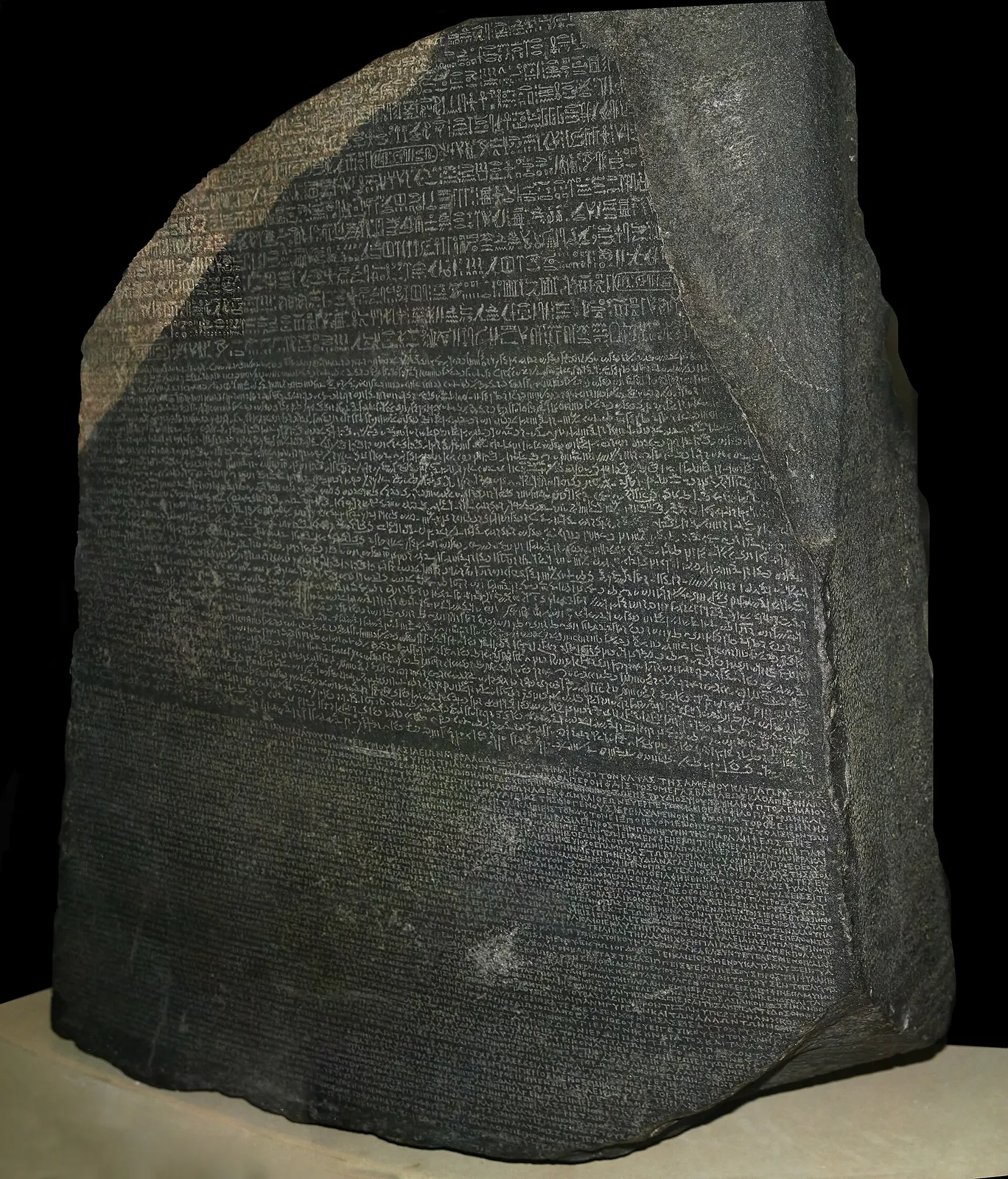
The Rosetta Stone in the British Museum. Photo: Hans Hillewaert, CC BY-SA 4.0, via Wikimedia Commons.

The questionHow did anyone learn to read hieroglyphs again?
The story
In 196 BC, a council of Egyptian priests issued a decree praising their young king, Ptolemy V. The Rosetta Stone is a broken piece of a larger slab of dark granodiorite carved with that decree and set up at a temple.1
What makes it special is that the decree is written three times, in three scripts.1
Hieroglyphsthe sacred picture script, for temples and tombs
14 lines
Demoticthe everyday Egyptian handwriting of the time
32 lines
Greekthe one scholars in 1799 could read
53 lines
A stone in a wall
Hieroglyphs went out of use. The last known hieroglyphic inscription was carved around AD 400.1 Around 1470, builders putting up a fort near the port of Rashid, which Europeans called Rosetta, built the broken slab into a wall. It stayed there until July 1799, when a member of a French team found it. The French agreed to give it up to the British, and it arrived in England in February 1802.1
Reading it
Scholars could read the Greek. The question was how the Egyptian scripts matched it. The English scientist Thomas Young noticed that the same group of signs, inside an oval ring called a cartouche, kept appearing, and concluded that it spelled the king’s name, Ptolemy. He also suggested that hieroglyphs could, in rare cases, stand for sounds. He published his findings in the Encyclopaedia Britannica in 1819.1
The French scholar Jean-François Champollion went further, drawing on his deep knowledge of Coptic, the last form of the Egyptian language. On 14 September 1822, the story goes, he burst into his brother’s office in Paris shouting “Je tiens mon affaire!”, “I’ve got it!”, and fainted. On 27 September he announced that he could read hieroglyphs.1
Key words
- Hieroglyphs
- The Egyptian script made of pictures. Some signs stand for whole words, and some for sounds.
- Demotic
- A quick, joined-up Egyptian handwriting, used for everyday writing by the time of the Rosetta Stone.
- Decree
- An official order or announcement. This one was made by a council of priests.
- Cartouche
- An oval ring drawn around a royal name in hieroglyphs.
- Coptic
- The last stage of the Egyptian language, written in Greek letters. Champollion knew it well.
- Decipher
- To work out how to read a script that nobody can read.
Check yourself
Try to answer in your head, then open each one.
Why was the Rosetta Stone the key to hieroglyphs?
It has the same decree in three scripts. Scholars could read the Greek, so they could compare it with the Egyptian.
Which script has the most lines on the surviving stone?
Greek, with 53. Then Demotic with 32, and hieroglyphs with 14.
What did Thomas Young work out?
That the signs in the repeated cartouches spelled the name Ptolemy, and that some hieroglyphs could stand for sounds.
What did Champollion know that helped him?
Coptic, the late form of the Egyptian language, written in Greek letters.
Go deeper
- Writing, invented four times where hieroglyphs fit in the story of writing
- Ancient Egypt back to the subject
Sources for this page
Every number on this page comes from one of these. How we check.
Last reviewed 12 November 2026. Spotted a mistake? Tell us.
- Solly, M. (27 September 2022). Two Hundred Years Ago, the Rosetta Stone Unlocked the Secrets of Ancient Egypt. Smithsonian Magazine. www.smithsonianmag.com/history/rosetta-stone-hieroglyphs-champollion-decipherment-egypt-180980834/Used for: The Rosetta Stone: its decree, three scripts, finding, journey to London, and how Young and Champollion read it. Checked 12 November 2026.
- The Metropolitan Museum of Art. Relief fragment with king Khufu’s cattle. Dynasty 4, reign of Khufu, ca. 2551–2528 BC. Collection record 543890, Open Access (CC0). www.metmuseum.org/art/collection/search/543890Used for: The dates of Khufu’s reign, and a block from his time reused at Lisht. Checked 12 November 2026.