A trench through Britain · About 42,000 years ago to AD 43
Stone Age to Iron Age Britain
Nobody in Britain wrote anything down until the Romans came in AD 43; everything before that is prehistory.1 What we know comes out of the ground. So dig down. Each layer on this page is older than the one above it, and the plain soil between them is time.
Iron Age
about 2,400 years ago
From about 400 BC to AD 43
Maiden Castle
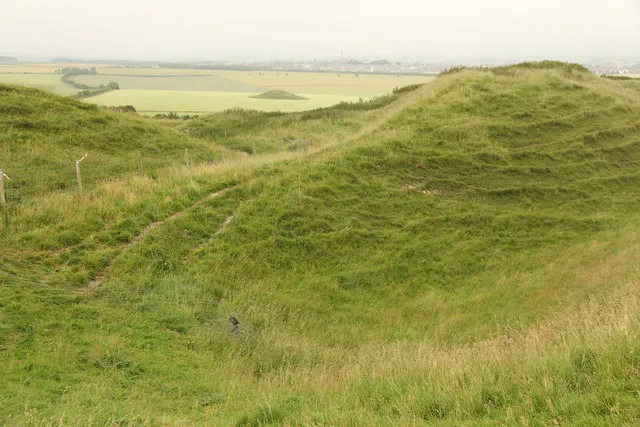
Outside Dorchester, a whole hill is wrapped in banks and ditches. Work on these defences began about 2,400 years ago and went on for 300 years, until Maiden Castle covered an area bigger than fifty football pitches, one of the largest hillforts in Britain. Under it lies something far older: a gathering place that the first farmers had ringed with banks.2
Where experts disagree: a battle with Rome?
A war cemetery, said the Wheelers.Mortimer and Tessa Wheeler dug here from 1934 to 1937. Mortimer Wheeler read the burials by the east gate, some with weapon wounds, as the dead of a Roman attack.2
Not one battle, say later dates.Radiocarbon dating suggests the people with weapon injuries were buried over several decades before the Romans came, carefully, by their own people. By AD 43 the hillfort was almost deserted.2
Late Bronze Age
about 2,900 years ago
Around the ninth century BC
Must Farm
Near Whittlesey in Cambridgeshire, at least five round houses stood on stilts above a slow river channel, inside a fence of posts. Around the ninth century BC they caught fire and fell into the river, perhaps only a year after they were built.3 The water and silt then kept what fell, from the timbers of the houses to the things inside them, close to where they had been in use.3 It was dug in ten months, from August 2015.
Early Bronze Age
about 4,300 years ago
About 2300 BC
The Amesbury Archer
On 3 May 2002, three miles from Stonehenge, archaeologists found the grave of a man buried about 2300 BC. The oxygen in his teeth shows he grew up somewhere colder than Britain, probably in the Alps of central Europe.4 His was the richest grave of its time found in Britain:4
- 2 small gold hair tresses
- 3 copper knives
- 2 stone wristguards, against the bowstring
- 16 flint arrowheads
Gold and copper were new. People like him carried the knowledge of metal into Britain from the continent.4
New Stone Age (Neolithic)
about 5,000 years ago
About 4000 to 2500 BC
Farmers, and their stones
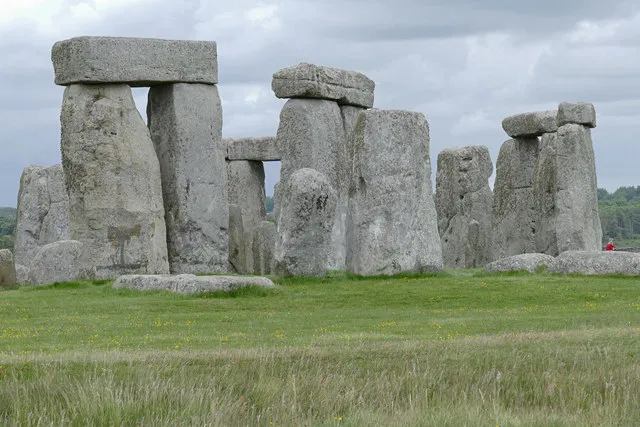
From about 4000 BC people in Britain began to farm.1 A thousand years later, on Salisbury Plain, they dug a circular ditch and bank: the first Stonehenge, about 3000 BC. The great stones were set up about 2500 BC, and the smaller bluestones were rearranged two or three hundred years after that.5
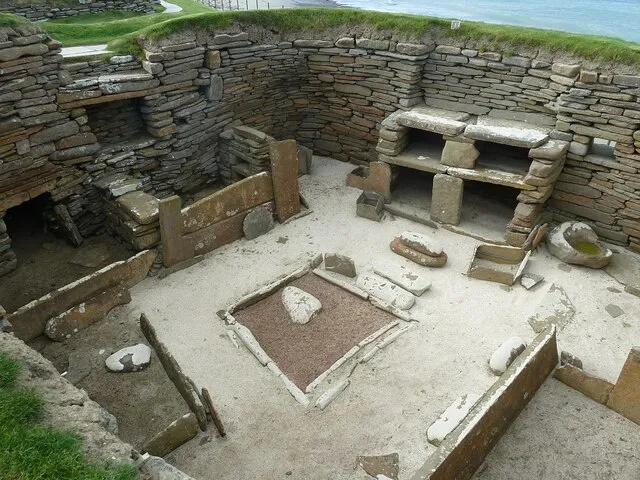
At the other end of Britain, in Orkney, the people of Skara Brae built their furniture out of stone: in each one-room house a dresser, two box beds and a hearth in the middle. Life in the village seems to have ended around 2500 BC, at about the time the stones went up at Stonehenge.6
Middle Stone Age (Mesolithic)
about 11,000 years ago
About 11,000 to 10,000 years ago
Hunters by a lake
About 11,000 years ago, hunters camped beside a lake at Star Carr in North Yorkshire. The lake has gone, but the waterlogged ground kept their wood and bone since the site was found in 1948.8 Among them are headdresses made from the skulls of red deer, with the antlers still on. More than nine in ten of all such headdresses known from prehistoric Europe come from this one site.7
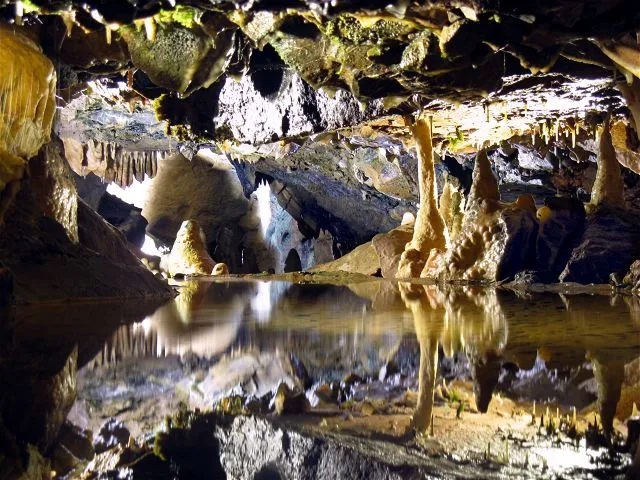
A little later, about 10,000 years ago, a man was buried in Gough’s Cave at Cheddar, where he was found in 1903. His DNA carries the genetic markers for dark skin and blue eyes. As the scientists say, he is just one person, but he stands for the people of Europe at that time.9
Old Stone Age (Palaeolithic)
about 42,800 years ago
44,200 to 41,500 years ago
A jaw in a Devon cave
In 1927, diggers in Kents Cavern at Torquay found a piece of a human upper jaw. Dated again in 2011, it turned out to be 44,200 to 41,500 years old: the oldest fossil of our own species known from north-west Europe. Its owner lived at the same time as the last Neanderthals in Europe.10
Between here and the next layer down lie hundreds of thousands of years of ice ages. This page does not try to tell that part; our companion site does, in The ice ages.
Before our species
about 900,000 years ago
About 1 million to 780,000 years ago
Footprints on the beach
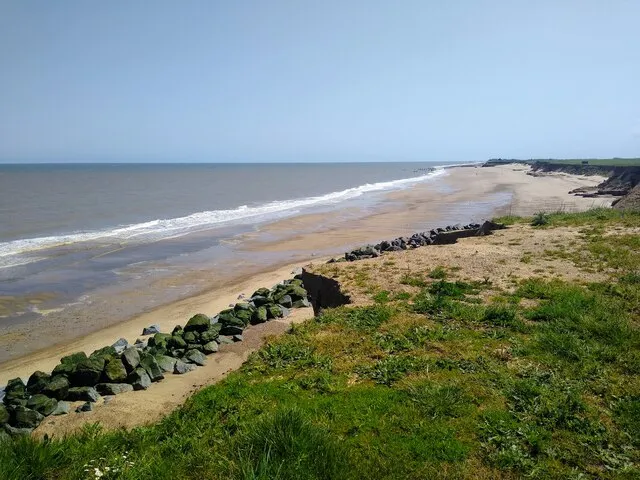
In May 2013 the sea at Happisburgh in Norfolk washed sand off an ancient layer of mud, and in it were footprints: adults and children, walking south along a river, between about a million and 780,000 years ago. They are the oldest human footprints known outside Africa. The tide wore them away within two weeks; they were recorded just in time.11
They were not made by our species. The best match is Homo antecessor, known from bones in Spain.11 Their story, and the Earth they walked on, belong to our companion site, Our Eons: Before us.
From the top of this trench to the bottom is about 900,000 years, and only the top few layers have names of places in them. A real trench would show the same thing: the deeper you dig, the less is left. See all twelve eras, or the whole world on one timeline.
Every lesson is written for anyone. Choose a course and the lessons that match it are marked.
National curriculum, Key Stage 2: “changes in Britain from the Stone Age to the Iron Age”
This page is an overview of the whole stretch, one site for each layer. Chapters for each age are still to come.
We are not an exam board. Check the details against your own course.
We have not matched this subject to a GCSE or A level course yet. Read it as an introduction.
We have not matched this subject to a GCSE or A level course yet. Read it as an introduction.
Sources for this page
Every number on this page comes from one of these. How we check.
Last reviewed 12 November 2026. Spotted a mistake? Tell us.
- English Heritage. Prehistoric England (Story of England). www.english-heritage.org.uk/learn/story-of-england/prehistory/Used for: Farming in England from about 4000 BC; prehistory ending with the Roman invasion of AD 43. Checked 12 November 2026.
- English Heritage. History of Maiden Castle. www.english-heritage.org.uk/visit/places/maiden-castle/history/Used for: The hillfort’s defences, the Wheelers’ dig of 1934 to 1937, the “war cemetery” and how it has been reread. Checked 12 November 2026.
- Knight, M., Ballantyne, R., Robinson Zeki, I. and Gibson, D. (2019). The Must Farm pile-dwelling settlement. Antiquity 93(369), 645–663. doi.org/10.15184/aqy.2019.38Used for: Must Farm: around the ninth century BC, at least five houses on stilts, lived in for about a year before it burned. Checked 12 November 2026.
- Wessex Archaeology. The Amesbury Archer. www.wessexarch.co.uk/our-work/amesbury-archerUsed for: The Archer’s grave: about 2300 BC, found in 2002, what was in it and where he grew up. Checked 12 November 2026.
- English Heritage. History of Stonehenge. www.english-heritage.org.uk/visit/places/stonehenge/history-and-stories/history/Used for: The first earthwork about 3000 BC, the stones set up about 2500 BC, the bluestones rearranged later. Checked 12 November 2026.
- Historic Environment Scotland. Skara Brae: history. www.historicenvironment.scot/visit-a-place/places/skara-brae/history/Used for: The stone furniture inside the houses, and village life ending around 2500 BC. Checked 12 November 2026.
- Little, A., Elliott, B., Conneller, C. and others (2016). Technological analysis of the world’s earliest shamanic costume: a multi-scalar, experimental study of a red deer headdress from the Early Holocene site of Star Carr, North Yorkshire, UK. PLoS ONE 11(4), e0152136. doi.org/10.1371/journal.pone.0152136Used for: The Star Carr headdresses: about 11,000 years old, and most of Europe’s known examples. Checked 12 November 2026.
- High, K., Milner, N., Panter, I. and others (2016). Lessons from Star Carr on the vulnerability of organic archaeological remains to environmental change. Proceedings of the National Academy of Sciences 113(46), 12957–12962. doi.org/10.1073/pnas.1609222113Used for: Star Carr’s discovery in 1948, and the waterlogged ground that kept its wood and bone. Checked 12 November 2026.
- Natural History Museum, London. Cheddar Man: Mesolithic Britain’s blue-eyed boy. www.nhm.ac.uk/discover/cheddar-man-mesolithic-britain-blue-eyed-boy.htmlUsed for: Cheddar Man: found in Gough’s Cave in 1903, about 10,000 years old, and what his DNA suggests. Checked 12 November 2026.
- Higham, T., Compton, T., Stringer, C. and others (2011). The earliest evidence for anatomically modern humans in northwestern Europe. Nature 479, 521–524. doi.org/10.1038/nature10484Used for: The Kents Cavern jaw: dug in 1927, dated to 44,200 to 41,500 years ago, the oldest modern human fossil in north-west Europe. Checked 12 November 2026.
- Ashton, N., Lewis, S. G., De Groote, I. and others (2014). Hominin footprints from Early Pleistocene deposits at Happisburgh, UK. PLoS ONE 9(2), e88329. doi.org/10.1371/journal.pone.0088329Used for: The Happisburgh footprints: their age, how they were found in May 2013 and washed away, and who may have made them. Checked 12 November 2026.
- Natural Earth, 1:110m and 1:50m land, public domain, via the world-atlas package by Mike Bostock (ISC licence). www.naturalearthdata.com/Used for: Every coastline drawn on this site. Checked 11 November 2026.